

Codely v2.0 public release is here
Lorem ipsum dolor sit amet, consectetur adipiscing elit lobortis arcu enim urna adipiscing praesent velit viverra sit semper lorem eu cursus vel hendrerit elementum morbi curabitur etiam nibh justo, lorem aliquet donec sed sit mi dignissim at ante massa mattis.
- Neque sodales ut etiam sit amet nisl purus non tellus orci ac auctor
- Adipiscing elit ut aliquam purus sit amet viverra suspendisse potent i
- Mauris commodo quis imperdiet massa tincidunt nunc pulvinar
- Adipiscing elit ut aliquam purus sit amet viverra suspendisse potenti
What has changed in our latest release?
Vitae congue eu consequat ac felis placerat vestibulum lectus mauris ultrices cursus sit amet dictum sit amet justo donec enim diam porttitor lacus luctus accumsan tortor posuere praesent tristique magna sit amet purus gravida quis blandit turpis.
All new features available for all public channel users
At risus viverra adipiscing at in tellus integer feugiat nisl pretium fusce id velit ut tortor sagittis orci a scelerisque purus semper eget at lectus urna duis convallis. porta nibh venenatis cras sed felis eget neque laoreet suspendisse interdum consectetur libero id faucibus nisl donec pretium vulputate sapien nec sagittis aliquam nunc lobortis mattis aliquam faucibus purus in.
- Neque sodales ut etiam sit amet nisl purus non tellus orci ac auctor
- Adipiscing elit ut aliquam purus sit amet viverra suspendisse potenti
- Mauris commodo quis imperdiet massa tincidunt nunc pulvinar
- Adipiscing elit ut aliquam purus sit amet viverra suspendisse potenti
Coding collaboration with over 200 users at once
Nisi quis eleifend quam adipiscing vitae aliquet bibendum enim facilisis gravida neque. Velit euismod in pellentesque massa placerat volutpat lacus laoreet non curabitur gravida odio aenean sed adipiscing diam donec adipiscing tristique risus. amet est placerat in egestas erat imperdiet sed euismod nisi.
“Nisi quis eleifend quam adipiscing vitae aliquet bibendum enim facilisis gravida neque velit euismod in pellentesque massa placerat”
Real-time code save every 0.1 seconds
Eget lorem dolor sed viverra ipsum nunc aliquet bibendum felis donec et odio pellentesque diam volutpat commodo sed egestas aliquam sem fringilla ut morbi tincidunt augue interdum velit euismod eu tincidunt tortor aliquam nulla facilisi aenean sed adipiscing diam donec adipiscing ut lectus arcu bibendum at varius vel pharetra nibh venenatis cras sed felis eget dolor cosnectur drolo.
Bonus depreciation can change what a deal is worth to you after tax, but it does not make the business itself better. In a 2026 SMB deal, the main issue is simple: 100% first-year expensing can make year-one cash flow look much stronger than normal, even though EBITDA stays the same.
Here’s the short version:
- Bonus depreciation is a timing item. It moves tax savings into year one.
- It can skew valuation if you treat that year-one tax drop like repeat cash flow.
- Purchase price allocation matters. Shifting 10% to 20% of value into bonus-eligible assets can change the tax shield by hundreds of thousands to several million dollars.
- State rules can cut the tax shield. Many states do not match the federal rule.
- Deal structure matters. An asset deal or a stock deal with the right election may create a step-up in basis. Without that step-up, the expected tax shield may not be there.
- The clean fix is to model the tax shield separately in the DCF instead of blending it into normal cash flow.
If I were reviewing a deal in the $5,000,000 to $50,000,000 range, I’d focus on five things right away:
- how much of the price goes to bonus-eligible assets
- whether the assets will be placed in service in the right tax year
- whether the state tax model matches federal treatment
- whether the structure gives me a stepped-up basis
- whether year-one tax savings are being kept out of terminal value
A simple example shows the problem fast: if a buyer pays $5,000,000 and assigns $1,500,000 to eligible equipment, the buyer may get a large year-one deduction. That can lift after-tax cash flow in year one, but only because taxes moved, not because the company now earns more.
| Issue | What it changes | Why I care |
|---|---|---|
| Bonus depreciation | Year-one cash taxes | Can overstate near-term cash flow |
| Allocation | Size of tax shield | Same multiple, different after-tax deal value |
| State nonconformity | State tax savings | Federal-only modeling can overstate returns |
| Deal structure | Basis step-up | No step-up can mean no added shield |
| Placed-in-service date | Timing of deduction | Delay cuts present value |
So my takeaway is direct: price the business on normalized cash flow, then add the present value of the tax shield as a separate item. That keeps a one-time tax event from inflating business value.
Where Bonus Depreciation Creates Valuation Problems
How Immediate Expensing Inflates Near-Term Cash Flow and Distorts Multiples
Bonus depreciation can slash cash taxes in year one. So after-tax free cash flow spikes, even when the business itself hasn't improved at all.
Here's the problem: that spike can fool buyers into thinking the company produces more cash on a recurring basis than it actually does.
Say a buyer finds a business for sale for $5,000,000 and allocates $1,500,000 to 5-year equipment that qualifies for bonus depreciation. In a 2026 model, a large share of that basis gets deducted in year one. That creates a big tax shield and makes after-tax cash flow look unusually strong.
But that extra cash flow isn't coming from better operations. It's coming from timing. The deduction pulls tax savings forward.
If a buyer treats that year-one shield like a normal, repeatable cash flow stream, the model starts to drift. Terminal value can get pushed too high. Debt capacity can look stronger than it is. Equity value can get stretched past what the deal can support.
That's why the year-one tax benefit has to be pulled out from steady-state cash flow. They are not the same thing.
How Purchase Price Allocation Can Change Deal Value More Than the Headline Multiple
Two deals can trade at the same EBITDA multiple and still have very different after-tax value. Why? Because purchase price allocation changes how much of the deal price gets fast tax treatment.
If more of the price is assigned to bonus-eligible assets, the buyer gets a larger year-one tax shield. If more goes to goodwill, that near-term benefit shrinks.
Same multiple. Different economics.
| Deal A | Deal B | |
|---|---|---|
| Bonus-eligible equipment and fixtures | $1,800,000 | $400,000 |
| Buildings and non-bonus assets | $1,000,000 | $1,200,000 |
| Section 197 intangibles and goodwill | $1,200,000 | $2,400,000 |
| Year-one tax shield | Larger upfront benefit | Smaller upfront benefit |
That difference doesn't just sit in year one. It rolls through the DCF and can change total after-tax deal value by a lot over time.
There's also a clear buyer-seller split here. Sellers usually prefer goodwill allocations because gains get taxed at capital gains rates. Buyers usually want more of the purchase price pushed into assets that produce faster deductions. That back-and-forth is negotiable, but only if the buyer has already run the cases before sitting down at the table.
Federal-State Mismatches and Policy Timing Risk
Federal tax treatment is only part of the story. Many states don't fully conform to federal bonus depreciation rules. So if a buyer uses one blended tax rate across the whole model, early after-tax cash flow can get overstated. And once that happens, value and debt capacity can get overstated too.
In plain English: state tax savings usually don't drop as much as federal savings do.
Timing can also trip up the model. The key date is the placed-in-service date, not the closing date. If installation runs late or equipment isn't ready, the deduction can slide into the next tax year. That cuts present value because the tax benefit arrives later and gets discounted harder.
For year-end closings, this is worth testing head-on. A short delay can change the cash tax picture more than people expect.
These items need their own modeling before offers are compared.
sbb-itb-97ecd51
Unlocking Tax Savings - What is Bonus Depreciation? | Ep 189 - The Nick Huber Show
How To Model Bonus Depreciation Correctly in Valuation
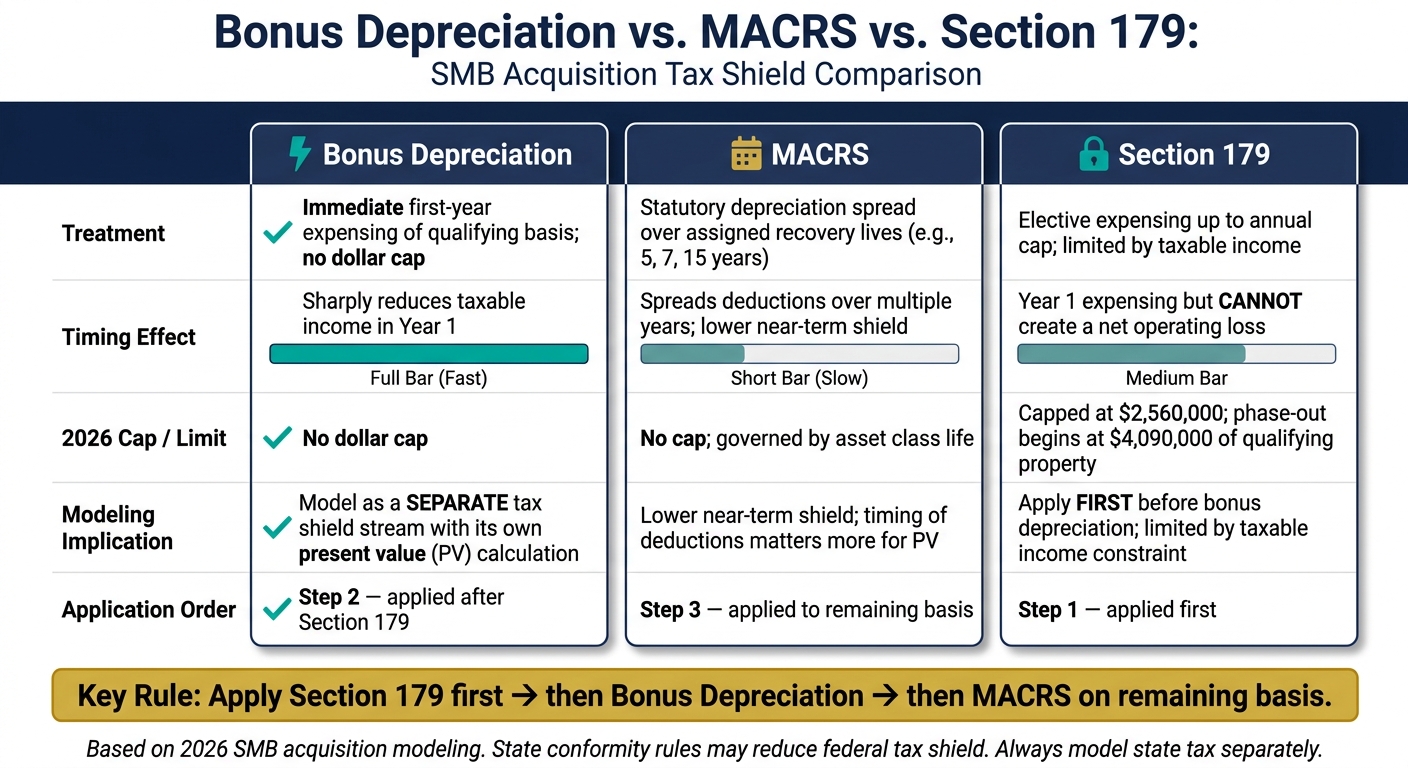
Bonus Depreciation vs. MACRS vs. Section 179: SMB Acquisition Tax Shield Comparison
Build the Depreciation Tax Shield as a Separate Cash Flow Stream
Once you've tested allocation and timing risk, pull the tax shield out of operating cash flow and model it on its own. The cleanest way to do this is in layers.
Start with unlevered free cash flow: revenue, operating costs, working capital, and maintenance capex. Then identify the bonus-eligible asset basis from the purchase price allocation, apply the right depreciation method, and multiply the deduction by the buyer's marginal tax rate. From there, discount those tax savings on their own and add only the present value back into the deal model. That keeps the tax shield from overstating normalized cash flow or terminal value.
Bonus Depreciation, MACRS, and Section 179: A Side-by-Side Comparison
These three deduction methods don't affect value the same way. In a 2026 SMB acquisition, the main difference is timing.
| Method | Treatment | Timing Effect | Modeling Implication |
|---|---|---|---|
| Bonus depreciation | Immediate first-year expensing of qualifying basis; no dollar cap | Can sharply reduce taxable income in year one | Model as a separate tax shield stream with its own PV calculation |
| MACRS | Statutory depreciation over assigned recovery lives | Spreads deductions over multiple years | Lower near-term shield; timing matters more |
| Section 179 | Elective expensing with annual cap and phase-out | Cannot create a net operating loss; limited by taxable income | In 2026, Section 179 is capped at $2,560,000, with phase-out starting at $4,090,000 of qualifying property |
The order matters too. Apply Section 179 first, then bonus depreciation, and use MACRS on the remaining basis.
Run Allocation and Timing Scenarios Before Finalizing Value
Before locking in value, test at least these cases:
- a baseline allocation
- a higher allocation to equipment and other bonus-eligible assets
- a goodwill-heavy allocation
- a timing case where assets are placed in service in a different tax year
- a state nonconformity case
The business doesn't change across these scenarios. What changes is when the buyer gets the tax savings, and how much of the federal tax break still holds up at the state level. That's a big deal, because timing feeds straight into present value and buyer returns.
Use those cases to shape your offer structure before negotiations start. A good scenario set shows the after-tax price before LOI terms are set.
Transaction Structure and Tax Planning Steps That Improve Outcomes
Choose the Structure That Preserves Stepped-Up Basis
Once you've modeled the tax shield, the next issue is simple: does the deal structure let you claim it at all?
That's where a lot of buyers get tripped up. The math may look great in the model, but if the structure doesn't create a stepped-up basis, that tax shield can disappear.
In an asset purchase, the buyer gets a new tax basis in the acquired assets based on the allocated purchase price. That stepped-up basis is what opens the door to bonus depreciation. In a stock purchase without a special election, the buyer usually takes over the target's existing asset basis instead. That means bonus depreciation on the acquisition premium usually isn't available.
If a stock deal is the only workable option, there may still be a path to asset-level tax treatment. A Section 338(h)(10) or Section 336(e) election can treat the stock acquisition as a deemed asset sale, which creates a stepped-up basis for allocation. In partnership deals, a Section 754 election can step up the buyer's share of inside basis under Section 743(b), and bonus depreciation may apply to the step-up portion of qualifying assets.
The timing here matters. This choice should be made early and written down early, ideally at the LOI stage. Once the structure is signed, the tax result is mostly locked in.
Negotiate Allocations With Valuation and Lender Reporting in Mind
After structure, allocation becomes the main lever.
Buyers usually want more of the purchase price assigned to bonus-eligible tangible assets like equipment, machinery, furniture, and vehicles. Why? Because those assets often qualify for bonus depreciation and usually have shorter MACRS lives. Sellers, on the other hand, often want more value pushed into goodwill, which is often taxed better from their side.
That back-and-forth isn't just a tax side issue. Allocation changes both the size and the timing of the tax shield, and that flows straight into present value and buyer returns.
There's also a financing angle. A tax allocation built to maximize bonus depreciation can slash taxable income in year one. That may create friction in debt service talks if the lender is focused on post-close financial statements. Put differently: the tax model may look great, while the lender package tells a tougher story.
Before signing, it helps to line up:
- the tax allocation model
- the lender package
- the pro forma financials
Getting those three to match can prevent ugly surprises later.
Build a Repeatable Diligence Process for Bonus Depreciation
After allocation, diligence is what protects the deduction.
In many deals, bonus depreciation isn't lost because the law changed. It's lost because the records are messy, incomplete, or missing at the moment they matter most. Sometimes the purchase agreement also fails to keep the support the buyer needs to defend the deduction.
Before closing, buyers should review the fixed asset schedule and confirm placed-in-service status. They should also confirm prior tax treatment and check whether any improvements qualify as qualified improvement property.
Form 8594 sits at the center of this process. It is the main IRS form used for allocation. It lines up the buyer's and seller's reported allocations and supports depreciation and amortization positions after closing. If the purchase agreement, Form 8594, lender materials, and tax return don't match, audit risk goes up and the buyer's bonus depreciation position gets weaker.
Conclusion: Bonus Depreciation Affects Value Timing, Not Business Quality
Once you model asset allocation, deal structure, and state tax rules, the takeaway is pretty simple: bonus depreciation is a tax timing mechanism, not a signal of business quality. It changes when taxes are paid, not how the business performs day to day.
That matters because two deals with the same EBITDA can still lead to different after-tax value if more purchase price is assigned to depreciable assets. And that tax result still turns on structure.
If the deal structure creates a step-up, the buyer may get the benefit sooner. If it doesn't, that benefit may not exist at all. On top of that, state decoupling can push part of the tax benefit further out.
So the clean way to handle this is in the DCF, not by mixing it into operating cash flow. Model the depreciation tax shield on its own inside the DCF. Then pressure-test the model for policy shifts and state-law changes, including moves like OBBBA's reinstatement of 100% bonus depreciation for property acquired after January 19, 2025.
Price the tax timing correctly, and you price the business correctly.
FAQs
How does bonus depreciation change what a deal is worth to me?
Bonus depreciation can make a deal worth more because it speeds up tax deductions. That cuts taxable income and can improve cash flow earlier, which matters a lot when you look at the deal in present-value terms.
In an asset purchase, the buyer may be able to step up acquired assets to fair market value. If those assets qualify for bonus depreciation, the buyer can take larger deductions upfront instead of spreading them out over many years. That front-loaded tax benefit can increase the deal’s present value and may help justify a higher purchase price.
Why shouldn’t I include bonus depreciation in terminal value?
Terminal value should reflect a business’s long-term, normalized cash flow once the business reaches a steady state. Bonus depreciation is a temporary, accelerated tax break linked to the year an asset is placed in service.
If you include it in terminal value, you skew the projection by treating a one-time tax benefit like it will keep showing up year after year. That can make the business look stronger than its steady-state economics support.
For a more accurate valuation, use normalized depreciation based on the assets’ long-term useful life.
When does deal structure affect the tax shield?
Deal structure shapes the tax shield because it decides whether the buyer can reset the tax basis of the assets being acquired.
In an asset purchase, the buyer can usually step up the basis to fair market value. That higher basis can lead to larger depreciation and amortization deductions over time.
In a stock purchase, the buyer usually takes on the seller’s lower basis instead. That means fewer tax deductions and a smaller tax shield.
There is one common workaround. Certain elections, such as Section 338, can allow some stock purchases to be treated like asset purchases for tax purposes.