

Codely v2.0 public release is here
Lorem ipsum dolor sit amet, consectetur adipiscing elit lobortis arcu enim urna adipiscing praesent velit viverra sit semper lorem eu cursus vel hendrerit elementum morbi curabitur etiam nibh justo, lorem aliquet donec sed sit mi dignissim at ante massa mattis.
- Neque sodales ut etiam sit amet nisl purus non tellus orci ac auctor
- Adipiscing elit ut aliquam purus sit amet viverra suspendisse potent i
- Mauris commodo quis imperdiet massa tincidunt nunc pulvinar
- Adipiscing elit ut aliquam purus sit amet viverra suspendisse potenti
What has changed in our latest release?
Vitae congue eu consequat ac felis placerat vestibulum lectus mauris ultrices cursus sit amet dictum sit amet justo donec enim diam porttitor lacus luctus accumsan tortor posuere praesent tristique magna sit amet purus gravida quis blandit turpis.
All new features available for all public channel users
At risus viverra adipiscing at in tellus integer feugiat nisl pretium fusce id velit ut tortor sagittis orci a scelerisque purus semper eget at lectus urna duis convallis. porta nibh venenatis cras sed felis eget neque laoreet suspendisse interdum consectetur libero id faucibus nisl donec pretium vulputate sapien nec sagittis aliquam nunc lobortis mattis aliquam faucibus purus in.
- Neque sodales ut etiam sit amet nisl purus non tellus orci ac auctor
- Adipiscing elit ut aliquam purus sit amet viverra suspendisse potenti
- Mauris commodo quis imperdiet massa tincidunt nunc pulvinar
- Adipiscing elit ut aliquam purus sit amet viverra suspendisse potenti
Coding collaboration with over 200 users at once
Nisi quis eleifend quam adipiscing vitae aliquet bibendum enim facilisis gravida neque. Velit euismod in pellentesque massa placerat volutpat lacus laoreet non curabitur gravida odio aenean sed adipiscing diam donec adipiscing tristique risus. amet est placerat in egestas erat imperdiet sed euismod nisi.
“Nisi quis eleifend quam adipiscing vitae aliquet bibendum enim facilisis gravida neque velit euismod in pellentesque massa placerat”
Real-time code save every 0.1 seconds
Eget lorem dolor sed viverra ipsum nunc aliquet bibendum felis donec et odio pellentesque diam volutpat commodo sed egestas aliquam sem fringilla ut morbi tincidunt augue interdum velit euismod eu tincidunt tortor aliquam nulla facilisi aenean sed adipiscing diam donec adipiscing ut lectus arcu bibendum at varius vel pharetra nibh venenatis cras sed felis eget dolor cosnectur drolo.
Selling a business takes time - often 3 to 10 years of preparation. Without a clear exit plan, many owners face regret post-sale, with 76% reporting dissatisfaction within the first year. To avoid this, you need a step-by-step timeline that focuses on boosting your business’s value, addressing risks, and ensuring a smooth transition.
Here’s the key takeaway: Start early. A well-planned exit timeline involves:
- Early Prep (3–5+ years out): Reduce risks, groom successors, and organize finances.
- Value Optimization (12–24 months out): Clean up financials, minimize buyer concerns, and increase profitability.
- Go-to-Market (6–12 months out): Approach buyers, negotiate terms, and prepare for due diligence.
- Closing & Transition (6–24 months post-sale): Finalize the deal, transfer operations, and plan your next chapter.
Each phase builds on the last, ensuring your business is attractive to buyers and you’re set for life after the sale. Start planning now to avoid common pitfalls and maximize your outcome.
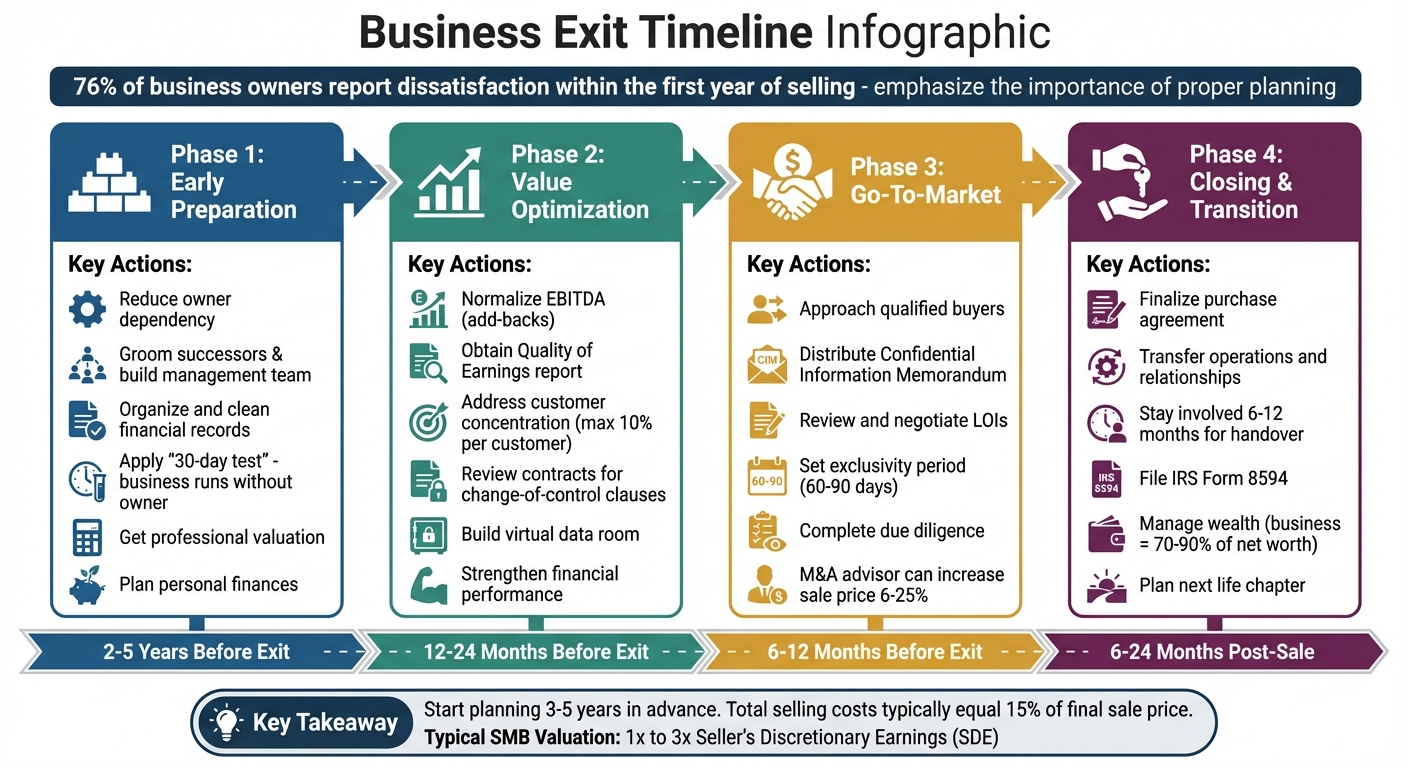
Business Exit Timeline: 4-Phase Preparation Guide for SMB Owners
Your Business Exit Timeline: Why waiting to plan costs you money | Andi Gray, Strategy Leaders
How to Build Your Exit Timeline
Creating a solid exit timeline involves working backward from your ideal exit date. By aligning your sale objectives, setting a clear exit date, and breaking the process into manageable phases, you can ensure a smoother transition.
Set Your Personal and Business Goals
Before setting a timeline, you need to clarify two key areas: your financial needs and your vision for the business's future. Start by identifying your "wealth gap" - the difference between your business's current value and the amount needed to fund your retirement. A financial advisor can help you calculate the income required for retirement.
On the business side, decide whether you're aiming for a full exit or partial liquidity. Do you want to step away entirely, or would you prefer to stay involved as an advisor? Your ideal outcome will guide the deal structure and determine the type of buyer to target - whether it's a strategic acquirer, private equity firm, or internal succession. Think about your legacy, too: Should the business remain in the family? Do you want to ensure employees are protected? These decisions will shape everything from buyer selection to deal terms.
To make your business more attractive to buyers, aim for operational independence. Your business should be able to run smoothly for at least 30 days without your direct involvement, which can boost both its marketability and valuation. Set a target valuation based on industry standards - small businesses, for instance, often sell for 1x to 3x Seller's Discretionary Earnings - and ensure this valuation supports your post-exit lifestyle. Finally, plan for your personal life after the sale, whether that includes philanthropy, launching new ventures, or traveling. Interestingly, 76% of former business owners report feeling regret within a year of selling, so having a plan in place for your next chapter is crucial.
Once your goals are clear, it’s time to pick a target date for your exit.
Choose Your Target Exit Date
With your goals in place, select a target exit date and work backward. Ideally, you should begin planning 3 to 5 years in advance to allow enough time to optimize your business's value and address operational weaknesses. A critical factor to address is owner dependency - if your management team can't run the business without you, it's not ready for sale.
Market conditions also play a role. Keep an eye on industry-specific EBITDA multiples and broader economic trends. Strong M&A activity in your sector might encourage you to speed up your timeline, while weak fundamentals could justify delaying your plans. Once you've chosen your exit date, establish key milestones: hire an M&A advisor 18 months before the sale, start the formal sale process a year out, and finalize your data room six months before going to market.
With your date set, break your journey into clear, actionable phases.
Map Your Exit Phases
Divide your timeline into four distinct phases, each with specific goals and timeframes:
| Phase | Timeline | Primary Focus |
|---|---|---|
| Early Preparation | 2–5 Years | Leadership succession, SOP documentation, and personal financial planning |
| Value Optimization | 12–24 Months | Financial cleanup, tax modeling, and strengthening value drivers |
| Go-To-Market | 6–12 Months | Buyer outreach, due diligence preparation, and negotiating LOIs |
| Post-Exit Transition | 6–24 Months | Handover of operations, earn-out management, and post-sale wealth management |
Each phase builds on the one before it, ensuring a structured and efficient process.
"Exit readiness is good business practice, even if you never plan to sell. It enforces discipline, boosts profitability, and gives you maximum leverage." - Shaun Savvy, Maus
The upcoming sections will explore each phase in detail, outlining specific steps to guide you through every stage of your exit journey.
Early Preparation: 2–5 Years Before Exit
The early stages of preparing for a business exit are all about laying a solid groundwork. During this time, you’ll evaluate your business’s current standing, organize your personal finances, and gradually step back from daily operations. Starting this process early allows you to tackle potential issues before they become roadblocks.
Determine Your Starting Point
The first step is to get a professional valuation to understand what your business is currently worth. For small businesses, the typical sale price is 1 to 3 times their Seller's Discretionary Earnings (SDE). If there’s a gap between your business’s value and the amount you need for retirement, this preparation phase gives you 2–5 years to bridge it. Closing this "wealth gap" should be your top priority.
Next, clean up your financial records. Move from basic bookkeeping to CPA-reviewed or audited financial statements. SBA lenders usually require at least three years of clean financials to approve loans for buyers. Transition to accrual accounting and ensure your profit and loss statements align with your tax returns to avoid raising any red flags.
Work with your CPA to identify and document add-backs, such as personal expenses, one-time charges, or above-market owner compensation, which can inflate costs. These adjustments are critical, as they directly impact the valuation of your business. You might also consider conducting a sell-side Quality of Earnings report about two years before listing your business. This can help uncover and address any financial issues before potential buyers spot them.
Review your business’s entity structure with a tax advisor as early as possible to avoid unexpected tax consequences. For example, switching from a C-Corp to an S-Corp (or vice versa) could trigger a "built-in gains" tax, which often requires a holding period of several years to mitigate.
Prepare Your Personal Finances
An exit plan isn’t just about the business - it’s about securing your future. Start by calculating how much net profit you’ll need from the sale to maintain your lifestyle and achieve financial independence. A financial advisor can help you pinpoint this number and address any gaps.
If estate planning is part of your strategy, start at least two years before the sale. Transferring business interests to family members or trusts early can allow you to take advantage of valuation discounts for gift-tax purposes. Additionally, review personal perks currently tied to the business - like car leases or health insurance - and estimate how much it will cost to replace them after the sale.
Collaborate with your advisors to develop a comprehensive financial strategy, including tax planning, wealth management, and preparations for your next phase of life. Strengthening your personal financial position now will also help you focus on building a strong management team.
Develop Your Management Team
A business that relies too heavily on its owner is less appealing to buyers. To increase its value, you need a capable management team in place. Apply the "30-day test": if your business can’t run smoothly for 30 days without you, it’s time to strengthen your team.
"A truly exit-ready company can thrive without its owner. That independence alone can add multiple turns to your valuation multiple." – Shaun Savvy, Maus
Start identifying and training key team members at least 2–5 years before your planned exit. Delegate major responsibilities to department leaders and shift your focus to monitoring high-level KPIs rather than handling daily operations. Document essential workflows to ensure no single point of failure disrupts the business.
To retain senior managers through the sale and beyond, consider offering equity incentives or long-term value plans. Cross-train employees so critical functions aren’t dependent on just one person. If buyers sense your departure could harm operations or profits, they may lower their offer - or back out entirely.
Building a management-led operation takes time, but it’s one of the most effective ways to boost your business’s value and ensure a smooth transition for the new owner.
Value Optimization: 12–24 Months Before Exit
As you approach the final 12–24 months before selling your business, the focus shifts to increasing its value. This period is all about refining financial performance, reducing operational risks, and preparing materials that will position your company as a premium asset to potential buyers.
Strengthen Financial Performance
Start by normalizing your EBITDA (Earnings Before Interest, Taxes, Depreciation, and Amortization). This involves adding back one-time expenses, non-recurring costs, and discretionary spending tied to ownership. Doing so gives a clearer picture of your company’s true operational performance. Valuation multiples vary depending on the industry - manufacturing businesses may see multiples of 4–6x, while high-growth areas like SaaS can reach 10–15x.
Recurring revenue streams often drive higher valuations. Consider locking in long-term contracts or introducing subscription-based models to boost recurring revenue.
Another key step is obtaining a sell-side Quality of Earnings (QofE) report. This report helps identify any financial inconsistencies early, ensuring your numbers are accurate and trustworthy. It’s also crucial to separate personal expenses from business accounts well in advance - ideally 12–24 months before the sale. Clean, transparent financials build buyer confidence and reduce skepticism.
Once your financials are in order, turn your attention to operational risks.
Address Operational Risks
Buyers will examine your business for any vulnerabilities that could impact future performance. One common concern is customer concentration. Ideally, no single customer should account for more than 10% of your total sales. If you’re close to or exceeding this threshold, now is the time to diversify your client base or secure long-term contracts with key customers.
Review your contracts for “change of control” or “anti-assignment” clauses, which could complicate a sale. These clauses are often found in leases, supplier agreements, and customer contracts. To avoid surprises, have legal counsel conduct a pre-sale audit well in advance.
Address any unresolved litigation, expired permits, or compliance issues, as these can lead to uncertainty discounts that lower your sale price. Additionally, ensure all intellectual property - such as patents, trademarks, or proprietary software - is owned by the company, not you personally. Documenting Standard Operating Procedures (SOPs) is also essential. Showing that your business can run smoothly for 30 days without your involvement adds to its appeal and value.
Once operational risks are minimized, it’s time to organize your materials for potential buyers.
Build Your Marketing Materials and Data Room
A well-prepared virtual data room is a must for showcasing your business. It signals operational discipline and speeds up the due diligence process. Include the following:
- Three to five years of tax returns
- Three years of audited or reviewed financial statements
- Your Quality of Earnings report
- Recasted financials that adjust for one-time costs and owner compensation
Additionally, include key legal and operational documents, such as articles of incorporation, bylaws, shareholder agreements, active supplier and customer contracts, organizational charts, key employee agreements, and a detailed asset inventory. If your business occupies real estate you own, include a Fair Market Value rent study to ensure the lease terms align with current market rates.
Keep sensitive financial data and your business’s identity private until potential buyers sign a Non-Disclosure Agreement (NDA).
For insights into market trends and potential buyers, platforms like Kumo can provide valuable data on current deal activity and buyer preferences. This information helps you tailor your marketing materials and position your business as a strategic asset.
"A clean slate heading into due diligence reduces uncertainty discounts buyers may otherwise apply." – Wendy G. Marcari, Member of the Firm, Epstein Becker Green
sbb-itb-97ecd51
Go-To-Market: 6–12 Months Before Exit
With your optimization efforts complete, it’s time to take your business to market. This phase is a balancing act - keeping your plans confidential while ensuring enough visibility to attract serious buyers. The goal? Qualify the right buyers and manage negotiations all the way to a signed Letter of Intent (LOI).
Start Buyer Outreach
Your approach to buyer outreach depends on your business size and how much confidentiality you need. For larger small-to-medium businesses (SMBs), discretion is key. In these cases, your advisor can privately reach out to a carefully selected list of strategic acquirers or private equity firms. On the other hand, smaller businesses often benefit from a broader approach, using anonymized public marketplace listings to attract individual buyers.
The process typically begins with an anonymized investment teaser. Once potential buyers show interest, they sign a Non-Disclosure Agreement (NDA) before receiving the full Confidential Information Memorandum. This 30–50 page document provides a detailed overview of your company, covering its history, sales processes, management structure, growth opportunities, and high-level financials.
Tools like Kumo can provide real-time insights into buyer activity, helping you adjust your strategy as needed.
Partnering with an M&A advisor during this stage can be a game-changer. Not only can they help increase your sale price by 6% to 25%, but they can also save you over 30 hours a week by handling communications and keeping negotiations on track.
Qualify Buyers and Review Offers
Not all buyers are created equal, and qualifying the right ones is crucial. Screen potential buyers based on three key factors:
- Strategic fit: Do they understand your industry and business model?
- Financial capability: Can they provide evidence of sufficient funds?
- Acquisition history: Do they have a track record of successful deals?
Different types of buyers come with their own pros and cons. Strategic acquirers, often competitors or firms in related markets, tend to offer higher prices but may restructure your operations or alter company culture. Private equity firms are typically focused on financial performance and may require you to stay on board post-sale. Internal buyers - like family members or key employees - offer smoother transitions but often lack upfront capital, sometimes requiring seller financing.
When reviewing LOIs, don’t just focus on the purchase price. Pay close attention to the payment structure. For instance, offers with more cash at closing are often preferable to those relying heavily on deferred payments or earn-outs.
| Buyer Type | Typical Advantage | Common Trade-Off |
|---|---|---|
| Strategic Acquirer | Higher purchase price; industry synergies | May restructure operations or change culture |
| Private Equity Firm | Professional process; growth capital | Often requires owner to stay involved |
| Internal Buyer | Smooth transition; preserves company culture | Limited upfront capital; may need seller financing |
Once you’ve identified buyers who meet your criteria, you can move forward with formal LOI negotiations.
Negotiate LOIs and Complete Due Diligence
Once you’ve narrowed down your list of buyers, it’s time to focus on negotiating clear LOI terms and preparing for due diligence. The LOI is a non-binding document that outlines key details like the purchase price, payment structure, exclusivity period (usually 60–90 days), and any major conditions. Setting a strict exclusivity deadline helps maintain momentum and avoids unnecessary delays.
During due diligence, the buyer’s team will thoroughly examine your financials, operations, and legal standing. Your advisor plays a critical role here, managing the flow of information and ensuring smooth communication to avoid hiccups that could derail the process. To stay organized, maintain a virtual data room with access to essential documents like tax returns, audited financial statements, employee agreements, and contracts spanning the last three to five years.
It’s also essential to keep your business running at full capacity during this period. Any drop in performance could lead to price reductions imposed by the buyer.
Finally, consider the costs involved in selling. Total selling expenses - covering advisor fees (2%–5%), legal fees, and accounting costs - typically amount to about 15% of the final sale price. Be sure to factor these expenses into your net proceeds when evaluating offers.
Closing and Post-Exit Transition
Complete the Sale
The final phase of selling your business involves formalizing the purchase agreement and transferring ownership. Before signing anything, ensure your attorney thoroughly reviews the sales agreement. This document should detail all assets, liabilities, inventory, and deal terms. At the closing, you’ll sign the necessary paperwork, hand over keys, access codes, and customer lists.
Don’t forget to handle these administrative tasks:
- File IRS Form 8594 (Asset Acquisition Statement) with the buyer, and include it in your income tax returns for the year of the sale.
- Cancel business registrations, permits, and licenses.
- Notify federal and state tax agencies to deactivate your Employer Identification Number (EIN).
If you have employees, make sure you comply with the Worker Adjustment and Retraining Notification (WARN) Act regarding final payments. Also, keep your tax and employment records for three to seven years after the sale, as required by law.
Once the sale is complete, your attention should shift to ensuring a smooth transition.
Manage the Transition Period
Most business owners stay involved for six months to a year after the sale to help with the handover. This period is essential for transferring relationships with key customers and training the new owner on daily operations. It’s a good idea to personally introduce the buyer to your major clients and creditors, helping to maintain trust and continuity.
Keeping top-performing employees on board is another key to ensuring operational stability. Consistency in business practices and communication can go a long way in easing concerns among employees and customers.
"Change often leads to uncertainty, which can make employees, customers, and stakeholders nervous about the future. To prevent unnecessary concern, business owners should focus on maintaining consistency in practices, policies, and communication".
Once the transition is running smoothly, you can begin focusing on what comes next.
Plan Your Post-Exit Life
Selling your business is more than just a financial step - it’s a personal shift, too. For many small business owners, their company represents 70% to 90% of their total net worth. Managing this new liquidity requires thoughtful planning. A wealth management advisor can help you build an investment portfolio that protects your legacy while meeting your retirement income needs.
Tax planning is another critical piece. Techniques like charitable giving, installment sales, and trusts can help reduce capital gains and estate taxes. Don’t forget to account for professional fees - legal, accounting, and broker expenses for a business earning $1 million annually can cost as much as $150,000.
Beyond the financial side, prepare for the emotional changes that often follow selling a business. Many owners experience an identity shift after stepping away from the company that gave them daily purpose. To ease this transition, outline your post-sale goals early - whether it’s traveling, starting a new venture, or dedicating time to philanthropy.
"Selling your business is not just a financial transaction, it is also a personal transition. Think ahead about what comes next".
Planning for your next chapter is just as important as the steps you took to sell your business.
Conclusion: Key Takeaways for SMB Owners
Selling your business isn’t something you can pull off overnight - it’s a process that takes years of thoughtful planning and consistent effort. Experts often suggest starting the exit process as early as possible. Why? It gives you the breathing room to strengthen your financials, reduce reliance on you as the owner, and position your business to command the best possible value. Unfortunately, many business owners skip this step and find themselves without a solid exit strategy. Don’t let that be your story.
Key milestones to focus on include setting a target exit date, achieving at least 30 days of operational independence, maintaining 3–5 years of clean financial records, and building a strong, experienced deal team. Each phase of the journey - whether it’s early groundwork, going to market, or transitioning post-sale - builds on the one before it. Skipping steps or rushing through the process often leads to regret, as many owners have learned the hard way. Following these steps ensures a smoother transition and helps you avoid unnecessary pitfalls.
One essential piece of the puzzle? Organized records. A Virtual Data Room can be a game-changer, providing a centralized hub for your financial statements, contracts, and corporate records - well before potential buyers start digging into the details. For added insights and tools, platforms like Kumo offer AI-driven listings, custom search filters, and data analytics to keep you informed about market trends and potential buyers. This kind of preparation is the backbone of a successful exit strategy.
Start early, surround yourself with trusted advisors, and focus on building a business that’s set up to thrive, even without you at the helm. Every step you take now - whether it’s organizing your records or planning your exit timeline - brings you closer to maximizing your company’s value. The effort you put in today will pay off when it’s time to pass the torch.
FAQs
What steps should I take to prepare for selling my small business?
Preparing to sell your small business takes thoughtful planning and preparation. A good starting point is to develop an exit plan well in advance - ideally 2–3 years before you intend to sell. During this time, bring together a reliable team of advisors, including financial planners, accountants, and legal professionals, who can help navigate the complexities of the process.
Make sure your financial records are clean and accurate and that all business operations are thoroughly documented. Streamlining your processes and improving efficiency can also contribute to boosting your business’s value. Once everything is in order, start identifying potential buyers and carefully vet them to ensure their vision aligns with your goals.
As the sale progresses, be ready for due diligence, negotiations, and the final closing steps. With early preparation and clear organization, you’ll set the stage for a smoother and more successful sale.
How can I make sure my business runs smoothly without me before selling?
To make your business appealing to potential buyers, it’s crucial to demonstrate that it can thrive without your constant involvement. Start by assembling a strong management team capable of handling daily operations and making key decisions. Clearly define their roles and connect their compensation to measurable goals like boosting revenue or improving customer retention.
Next, create detailed documentation for critical processes - think sales workflows, operational procedures, and HR guidelines. Standard operating procedures (SOPs) ensure that the business runs smoothly and consistently, even without you at the helm. Pair this with performance tracking tools such as monthly financial reports or KPI dashboards. These tools provide transparency and make it easier for others to monitor progress and outcomes.
Lastly, transition owner-specific tasks - like managing client relationships or approving major decisions - to your team. Set a realistic timeline, typically 12 to 24 months, to gradually shift these responsibilities. By building a business with robust systems and an empowered team, you reduce risks for buyers and enhance the attractiveness of your company. Platforms like Kumo can assist in connecting you with buyers who value a well-organized, self-sufficient business, simplifying your path to a successful sale.
How do I choose the best buyer for my business?
Selecting the right buyer is a key step in ensuring a smooth sale and achieving the outcome you’re aiming for. Begin by identifying your personal and financial priorities - do you want a complete cash exit, to keep a stake in the business, or to stay actively involved? Knowing this upfront will help you zero in on buyers whose goals match yours.
Think about the type of buyer that makes the most sense for your business. Strategic buyers, like competitors, might offer a higher price because they see opportunities to integrate your business with theirs. Financial buyers, such as private equity firms, tend to focus on profitability and might suggest structured deals. On the other hand, internal successors - whether they’re employees or family members - can help maintain the company’s culture but might face challenges in securing the necessary funding.
You’ll also want to assess the buyer’s reliability and resources. Make sure they have the financial means to complete the purchase, a proven track record, and a clear vision for the business after the sale. Tools like Kumo’s deal-sourcing platform can make this process easier by helping you find and evaluate qualified buyers more efficiently. Matching your goals with the right buyer not only simplifies the sale but also sets the stage for a satisfying outcome.