

Codely v2.0 public release is here
Lorem ipsum dolor sit amet, consectetur adipiscing elit lobortis arcu enim urna adipiscing praesent velit viverra sit semper lorem eu cursus vel hendrerit elementum morbi curabitur etiam nibh justo, lorem aliquet donec sed sit mi dignissim at ante massa mattis.
- Neque sodales ut etiam sit amet nisl purus non tellus orci ac auctor
- Adipiscing elit ut aliquam purus sit amet viverra suspendisse potent i
- Mauris commodo quis imperdiet massa tincidunt nunc pulvinar
- Adipiscing elit ut aliquam purus sit amet viverra suspendisse potenti
What has changed in our latest release?
Vitae congue eu consequat ac felis placerat vestibulum lectus mauris ultrices cursus sit amet dictum sit amet justo donec enim diam porttitor lacus luctus accumsan tortor posuere praesent tristique magna sit amet purus gravida quis blandit turpis.
All new features available for all public channel users
At risus viverra adipiscing at in tellus integer feugiat nisl pretium fusce id velit ut tortor sagittis orci a scelerisque purus semper eget at lectus urna duis convallis. porta nibh venenatis cras sed felis eget neque laoreet suspendisse interdum consectetur libero id faucibus nisl donec pretium vulputate sapien nec sagittis aliquam nunc lobortis mattis aliquam faucibus purus in.
- Neque sodales ut etiam sit amet nisl purus non tellus orci ac auctor
- Adipiscing elit ut aliquam purus sit amet viverra suspendisse potenti
- Mauris commodo quis imperdiet massa tincidunt nunc pulvinar
- Adipiscing elit ut aliquam purus sit amet viverra suspendisse potenti
Coding collaboration with over 200 users at once
Nisi quis eleifend quam adipiscing vitae aliquet bibendum enim facilisis gravida neque. Velit euismod in pellentesque massa placerat volutpat lacus laoreet non curabitur gravida odio aenean sed adipiscing diam donec adipiscing tristique risus. amet est placerat in egestas erat imperdiet sed euismod nisi.
“Nisi quis eleifend quam adipiscing vitae aliquet bibendum enim facilisis gravida neque velit euismod in pellentesque massa placerat”
Real-time code save every 0.1 seconds
Eget lorem dolor sed viverra ipsum nunc aliquet bibendum felis donec et odio pellentesque diam volutpat commodo sed egestas aliquam sem fringilla ut morbi tincidunt augue interdum velit euismod eu tincidunt tortor aliquam nulla facilisi aenean sed adipiscing diam donec adipiscing ut lectus arcu bibendum at varius vel pharetra nibh venenatis cras sed felis eget dolor cosnectur drolo.
Why do some companies dominate their industries for decades? The answer lies in their competitive moats - advantages that protect market share and profits from rivals. These include:
- Network Effects: More users make a product or service increasingly valuable (e.g., Google, Reliance Jio).
- High Switching Costs: Customers stick around due to the expense or hassle of leaving (e.g., Tata Consultancy Services).
- Proprietary Technology: Patents and trade secrets keep competitors at bay (e.g., Intuitive Surgical).
- Brand Power: Trusted names command loyalty and premium pricing (e.g., Apple, Starbucks).
- Economies of Scale: Larger operations reduce costs per unit, creating a pricing edge (e.g., McDonald's).
Companies with layered moats, combining multiple advantages, tend to outperform others. For example, Google blends network effects, brand strength, and economies of scale to stay ahead. However, even the strongest moats can weaken due to innovation, regulation, or poor decisions. Maintaining these edges requires constant reinvestment and vigilance.
Want to know how market leaders build and sustain these moats? Keep reading for actionable insights and real-world examples.
What Are Competitive Moats?
Definition of Competitive Moats
A competitive moat - often referred to as an economic moat - is a company's ability to maintain a long-term competitive edge. This could stem from a strong brand, exclusive technology, or large-scale operations. These advantages help safeguard market share and profit margins against competitors and external pressures.
Competitive moats are all about securing both the present and future edge in the market. Investment research firm Morningstar classifies these moats into two categories based on their durability: a "wide" moat is expected to last over 20 years, while a "narrow" moat should endure for at least 10 years. Companies achieve such longevity through strategies like network effects, proprietary technology, or leveraging economies of scale - topics we'll dig into later.
"The key to investing is...determining the competitive advantage of any given company and, above all, the durability of that advantage"
- Warren Buffett, Chairman and CEO of Berkshire Hathaway.
In practice, firms with wide moats tend to deliver higher returns on invested capital (ROIC) because they effectively shield their profits from competitors. For instance, McDonald's Corp, as of February 2026, exemplifies a cost advantage moat. With global systemwide sales nearing $130 billion, its massive scale allows it to source food and supplies at lower costs than smaller rivals.
This kind of edge doesn't just enhance a company's valuation - it also drives real-world market dominance.
Why Competitive Moats Matter
Wide-moat companies consistently outperform those without moats, showcasing the financial value of a lasting competitive advantage.
"The longer a company can generate excess returns, the more valuable that company is"
- David Sekera, CFA and Chief US Market Strategist at Morningstar.
Moats contribute to strong returns while also offering pricing power and creating high barriers to entry. These barriers make it extremely difficult or expensive for new competitors to replicate a company's success. Take Intuitive Surgical as an example: by March 2024, the company had installed over 8,000 da Vinci robotic systems in hospitals worldwide. Their moat is fortified by a database of over 14 million procedures and the training of 76,000 surgeons. Switching to a competitor would cost hospitals around $1.5 million per new system and require retraining staff - a daunting expense.
In mature markets, where growth slows and competition heats up, having a moat becomes critical. However, even the strongest moats can weaken over time due to factors like technological advancements, regulatory shifts, or poor management. For businesses aiming to stay competitive or protect their market position, understanding how to build and sustain these moats is crucial.
Corporate Finance Explained | Economic Moats: Competitive Advantage in Corporate Finance
How Market Leaders Build and Maintain Competitive Moats
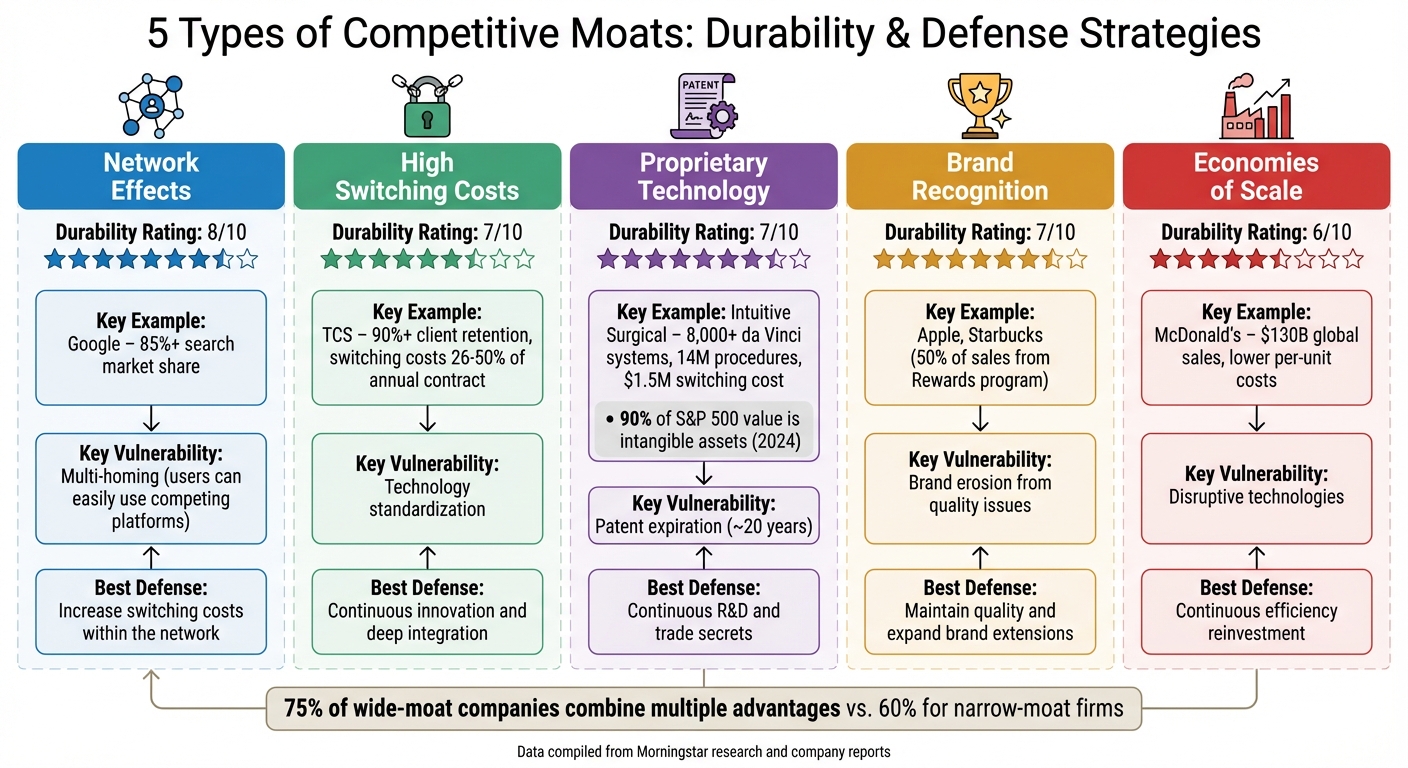
5 Types of Competitive Moats: Durability Ratings and Key Vulnerabilities
Market leaders rely on multi-layered strategies to protect their dominance and stay ahead of the competition. Let’s dive into five effective methods they use to secure their position.
Network Effects
Network effects occur when each new user increases the value of a product or service for everyone else. This creates a self-reinforcing cycle: more users attract more suppliers, and the growing ecosystem draws in even more users. The result? A powerful moat that’s tough to breach.
Take Google, for example. With over 85% of the search engine market, its dominance remains steady - shifting only slightly from 92% in 2019 to 91% in 2024. Every search query enhances Google’s algorithm, making it smarter and harder for competitors to catch up.
"Advertisers preferred the paper with the most circulation, and readers tended to want the paper with the most ads and news pages. This circularity led to a law of the newspaper jungle: Survival of the Fattest."
- Warren Buffett, Chairman and CEO, Berkshire Hathaway
Another example is MarketAxess, which grew its electronic bond trading platform to include over 1,500 institutional investors and broker-dealers between 2014 and 2018. By early 2019, it captured 85% of the U.S. investment-grade bond market, reducing trading costs to just 3.2 basis points - half the cost of traditional methods.
Building such a moat often requires bold investments. Reliance Jio, for instance, entered the Indian telecom market in 2016 with a free data offer, spending $18 billion over four years to amass 481 million subscribers. While network effects are highly durable (rated 8/10), they can weaken if users can easily switch to competing platforms.
High Switching Costs
Switching costs create friction that discourages customers from leaving, even when competitors offer better prices or features. Companies that deeply embed their products into customers’ operations make switching both expensive and inconvenient.
For example, Tata Consultancy Services (TCS) achieved a client retention rate of over 90% in FY2025 while generating $30 billion in revenue. Its long-term IT contracts, often spanning 5–10 years, create a dependency so strong that switching can cost clients 26% to 50% of the annual contract value.
| Moat Type | Average Durability | Key Vulnerability | Best Defense |
|---|---|---|---|
| Switching Costs | 7/10 | Technology standardization | Continuous innovation and deep integration |
| Network Effects | 8/10 | Multi-homing | Increasing switching costs within the network |
| Intangible Assets | 7/10 | Brand erosion | Maintaining quality and expanding the brand |
Ecosystem interdependence also amplifies switching costs. For instance, Starbucks reported that its Rewards program drove 50% of U.S. sales in 2021 by offering perks like free refills and mobile ordering. Psychological factors play a role, too - customers often stick with familiar providers to avoid the perceived risks of switching.
Proprietary Technology and Patents
Proprietary technology and patents transform ideas into enforceable barriers, preventing competitors from copying innovations. As of 2024, intangible assets make up 90% of the S&P 500’s market value, a sharp rise from just 17% in 1975.
Patents, which last approximately 20 years, force competitors to innovate around them, license the technology, or exit the market entirely. As Andrew Rapacke puts it:
"Patents matter because they transform an 'idea' into a tangible asset – and investors want to invest in appreciating assets and not ideas or concepts."
- Andrew Rapacke, Managing Partner, The Rapacke Law Group
Intellectual property-intensive industries contribute 41% of U.S. GDP and support 44% of jobs. By the mid-2020s, global patent licensing revenue is expected to hit $150 billion. AI-related patents are particularly hot, growing at an annual rate of 70%, and startups with patents are 6.4 times more likely to secure venture capital.
Many companies also protect trade secrets, especially in AI, where patenting software algorithms can be legally challenging. Defensive patent portfolios are often used more for negotiation leverage than litigation, helping market leaders maintain their edge.
Brand Recognition and Trust
A strong brand creates an intangible moat, allowing companies to charge premium prices and retain customers - even when cheaper alternatives exist. Well-known brands reduce customer acquisition costs and build loyalty, making it harder for competitors to lure customers away.
Brand-based moats average a durability rating of 7/10. However, maintaining this advantage requires consistent investments in quality and brand extensions to prevent erosion. In markets where customers can’t easily evaluate product quality upfront, a trusted brand significantly reduces perceived risk.
When paired with other moats, like network effects or high switching costs, brand recognition makes customers even less likely to switch to competitors.
Economies of Scale
Scale gives market leaders a cost advantage by spreading fixed costs across a larger volume of production. This allows them to negotiate better supplier terms, invest in automation, and lower per-unit costs - advantages smaller competitors often can’t match.
For example, in capital-intensive industries like manufacturing and logistics, scale is a key driver of profitability. Even in data-driven sectors, larger companies benefit from improved algorithms and personalized customer experiences. However, this moat’s durability (rated 6/10) can be undermined by disruptive technologies.
To maintain their edge, market leaders must continuously reinvest in efficiency improvements, as shifts in technology can quickly change cost structures. This ongoing investment ensures they remain competitive in a rapidly evolving landscape.
sbb-itb-97ecd51
Data as a Competitive Moat
In today’s business landscape, proprietary data stands out as a key advantage. While algorithms are widely available, the true edge comes from having superior data to fuel those systems. Back in 2019, only 27% of companies had achieved advanced data maturity, leaving plenty of room for forward-thinking leaders to surge ahead.
What makes a data moat so powerful is its self-reinforcing nature. The more users a platform attracts, the more data it generates. That data, in turn, improves machine learning models, which then draw even more users [23,25]. This cycle creates a nearly impenetrable barrier for competitors, especially when paired with other factors like high switching costs. The result? Highly personalized experiences that keep customers coming back.
Personalized Customer Experiences
Personalization driven by data doesn’t just enhance user satisfaction - it also makes it harder for competitors to lure customers away. Without access to the same personalized history, competitors often can’t match the experience [23,25]. Take Spotify as an example: between 2014 and 2024, the company used AI to analyze user engagement - things like genre preferences, tempo, and mood - to create tailored playlists. This strategy helped Spotify grow its user base by 1,000%, reaching over 600 million users and generating $14 billion in revenue.
Amazon offers another compelling case. Its "purchase graph" maps out the relationships between customers, products, and browsing habits. This system accounts for 50% of Amazon's sales and powers recommendations for about half of the 4,000 products sold every minute. It’s no wonder Amazon dominates 40% of the U.S. e-commerce market.
"The competitor with superior data can segment, customize, detect anomalies, see trends, and innovate faster than its competitors."
Modern cloud-based tools take personalization even further by enabling real-time adjustments. These instant tweaks to the user experience deepen engagement and loyalty, creating a lead that competitors without comparable historical data can’t easily close. But the benefits of data don’t stop at personalization - it also drives smarter, faster decisions.
Analytics for Market Insights
Proprietary data isn’t just about tailoring experiences; it’s also a foundation for better decision-making. Companies use analytics to track operations, refine strategies, and improve their core products. Netflix provides a standout example. Before producing House of Cards, the company analyzed viewing data to identify a strong overlap among fans of the original British series, director David Fincher, and actor Kevin Spacey. This insight turned a $100 million investment into a calculated bet rather than a risky gamble.
"We always use our in-depth knowledge (aka analytics and data) about what our members love to watch to decide what's available on Netflix."
- Jenny McCabe, Director of Global Media Relations, Netflix
John Deere offers another example of how data can transform a business. By adding sensors to its agricultural equipment, the company transitioned from being a traditional manufacturer to a tech-driven enterprise. These sensors collect performance data, enabling advanced decision-making tools for farmers and opening up new revenue streams.
Even industries like oil and gas are leveraging data for a competitive edge. One leading company worked with BCG to gather data on drilling operations and geological traits. By training machine learning algorithms on this data, they enabled real-time decision-making at the rig, reducing nonproductive time by 4% and increasing drilling speed by 6%.
Despite these successes, only about 10% of companies reported hitting their data goals over a three-year span. What sets market leaders apart is their approach: they treat data as a core asset, not just a byproduct of IT operations. This mindset, combined with a culture of experimentation and continuous improvement, reinforces their competitive moat and keeps them ahead of the pack.
Combining Multiple Moats
Why Multiple Moats Work Better
Relying on a single competitive advantage can be a gamble - no matter how strong, even the best moats can erode over time. Research shows that 75% of wide-moat companies rely on multiple sources of advantage, compared to just 60% for narrow-moat firms. To clarify, a wide moat represents a competitive edge likely to last 20 years or more, while a narrow moat typically endures for about 10 years. Companies with layered moats often enjoy higher returns on invested capital (ROIC) and maintain pricing power, even when cheaper alternatives exist.
When moats are layered, they work together to create a stronger overall defense. For instance, network effects can produce proprietary data, which then increases switching costs - each element reinforcing the others. This "defense-in-depth" strategy makes it incredibly challenging for competitors to overcome all barriers at once. It's a strategy that many of the world's leading companies have mastered.
Examples of Layered Moats
Some of the most successful companies demonstrate how combining multiple advantages strengthens their dominance.
Google is a prime example. It combines network effects, switching costs, brand recognition, and economies of scale to maintain its market leadership. From 2019 to 2024, its market share remained remarkably stable, shifting only slightly from 92% to 91%.
Apple takes a different but equally effective approach, leveraging its brand loyalty and high switching costs through its integrated ecosystem. Devices like MacBooks, iPhones, and AirPods work seamlessly together, making the prospect of switching to another provider both costly and inconvenient for users.
Taiwan Semiconductor Manufacturing Co. (TSM) secures its position with a mix of technological superiority, a vast patent portfolio, and high switching costs. Major clients like Apple and Nvidia rely on TSM's proprietary manufacturing processes, making it nearly impossible to switch providers without incurring significant time and financial costs.
Even traditional industries can benefit from layered moats. Waste Management, the largest waste company in the U.S., combines economies of scale with high switching costs and regulatory barriers. Its extensive network of landfills and exclusive municipal licenses creates hurdles that are nearly insurmountable for new competitors.
"The key to investing is...determining the competitive advantage of any given company and, above all, the durability of that advantage."
- Warren Buffett, Chairman and CEO, Berkshire Hathaway
Conclusion
Defending your market position is an ongoing effort. The most successful companies understand that long-term success comes from structural advantages that deliver consistent returns over time - not just short-lived wins that rivals can mimic with enough resources. Whether it's through network effects, switching costs, proprietary technology, or brand loyalty, combining these elements creates a stronger, more resilient competitive barrier.
What matters most is durability, not just initial impact. A truly effective moat should offer a competitive edge for decades - often 20 years or more. Companies with retention rates above 90% in B2B or 80% in B2C sectors often demonstrate this kind of staying power. However, no moat is invincible. Advances in technology, shifts in regulations, and changing customer demands can erode even the strongest defenses over time.
"The more sustainable the competitive advantage, the more difficult it is for competitors to neutralize the advantage." - Investopedia
To assess the strength of your moat, focus on measurable factors like margin premiums, customer retention rates, and the cost competitors would incur to replicate your position. If you're growing through acquisitions, prioritize targets with genuine structural advantages. High growth rates or market share alone often lack the protective qualities of a true moat.
Leveraging advanced analytics can make this evaluation process more effective. Tools like Kumo simplify the task by integrating AI-powered insights and data analytics to identify businesses with sustainable competitive advantages. Whether you're fortifying your current position or exploring potential acquisitions, the right tools can guide smarter, more strategic decisions.
FAQs
How do companies choose which competitive advantages to prioritize?
Companies focus on building and maintaining moats - their competitive advantages - by identifying which ones are the most durable and align with their long-term objectives. This process involves evaluating factors like brand strength, cost efficiency, network effects, customer switching costs, and regulatory barriers. These elements help determine the best strategies to safeguard market share and profitability over time.
The choice of which moat to prioritize often hinges on a company’s unique strengths and the specific conditions of its industry. For example, businesses with well-established brand recognition may channel efforts into enhancing their reputation, while those excelling in cost efficiency might prioritize scaling their operations. By zeroing in on the advantages that provide the most lasting edge, companies can allocate their resources wisely and stay ahead of the competition.
What strategies help companies protect and strengthen their competitive edge over time?
To stay ahead in the game, businesses need to double down on their core strengths - whether that's a strong brand, cost efficiency, or leveraging network effects. These elements act as natural barriers, making it harder for competitors to encroach and helping to secure a dominant position in the market. At the same time, committing to ongoing innovation and improvement ensures that their technology, processes, or intangible assets stay relevant in an ever-evolving landscape.
Another vital approach is focusing on customer retention by managing switching costs and amplifying network effects. This not only keeps customers loyal but also boosts profitability. Companies must also keep an eye on potential threats, like regulatory shifts or market disruptions, and tackle weaknesses before they become major issues. By prioritizing smart investments, staying innovative, and being ready to adapt, businesses can fortify their competitive edge and position themselves for long-term growth.
How can businesses evaluate the strength of their competitive advantages?
To understand how strong their competitive advantages are, businesses should examine how well these advantages hold up over time. One reliable measure is whether the business consistently earns returns on capital that are higher than its cost of capital. This signals a solid competitive position. Companies with enduring advantages often sustain them for decades, showcasing their ability to remain resilient in the long run.
It's also important to look at the specific elements that create a strong competitive moat. These include network effects, intangible assets (like patents or brand reputation), cost advantages, high switching costs, and efficient scale. Keeping an eye on trends such as market share, profit margins, and shifts within the industry can reveal whether these advantages are holding steady, getting stronger, or starting to weaken. Spotting early signs of decline is critical to staying ahead in a competitive landscape.