

Codely v2.0 public release is here
Lorem ipsum dolor sit amet, consectetur adipiscing elit lobortis arcu enim urna adipiscing praesent velit viverra sit semper lorem eu cursus vel hendrerit elementum morbi curabitur etiam nibh justo, lorem aliquet donec sed sit mi dignissim at ante massa mattis.
- Neque sodales ut etiam sit amet nisl purus non tellus orci ac auctor
- Adipiscing elit ut aliquam purus sit amet viverra suspendisse potent i
- Mauris commodo quis imperdiet massa tincidunt nunc pulvinar
- Adipiscing elit ut aliquam purus sit amet viverra suspendisse potenti
What has changed in our latest release?
Vitae congue eu consequat ac felis placerat vestibulum lectus mauris ultrices cursus sit amet dictum sit amet justo donec enim diam porttitor lacus luctus accumsan tortor posuere praesent tristique magna sit amet purus gravida quis blandit turpis.
All new features available for all public channel users
At risus viverra adipiscing at in tellus integer feugiat nisl pretium fusce id velit ut tortor sagittis orci a scelerisque purus semper eget at lectus urna duis convallis. porta nibh venenatis cras sed felis eget neque laoreet suspendisse interdum consectetur libero id faucibus nisl donec pretium vulputate sapien nec sagittis aliquam nunc lobortis mattis aliquam faucibus purus in.
- Neque sodales ut etiam sit amet nisl purus non tellus orci ac auctor
- Adipiscing elit ut aliquam purus sit amet viverra suspendisse potenti
- Mauris commodo quis imperdiet massa tincidunt nunc pulvinar
- Adipiscing elit ut aliquam purus sit amet viverra suspendisse potenti
Coding collaboration with over 200 users at once
Nisi quis eleifend quam adipiscing vitae aliquet bibendum enim facilisis gravida neque. Velit euismod in pellentesque massa placerat volutpat lacus laoreet non curabitur gravida odio aenean sed adipiscing diam donec adipiscing tristique risus. amet est placerat in egestas erat imperdiet sed euismod nisi.
“Nisi quis eleifend quam adipiscing vitae aliquet bibendum enim facilisis gravida neque velit euismod in pellentesque massa placerat”
Real-time code save every 0.1 seconds
Eget lorem dolor sed viverra ipsum nunc aliquet bibendum felis donec et odio pellentesque diam volutpat commodo sed egestas aliquam sem fringilla ut morbi tincidunt augue interdum velit euismod eu tincidunt tortor aliquam nulla facilisi aenean sed adipiscing diam donec adipiscing ut lectus arcu bibendum at varius vel pharetra nibh venenatis cras sed felis eget dolor cosnectur drolo.
When companies merge or acquire others, the success of the deal often depends on more than just financial planning - it’s about ensuring both organizations can work together effectively. A mismatch in how teams operate, make decisions, and communicate can lead to serious problems, including:
- High turnover: Up to 33% of key employees leave within the first year, risking revenue and customer relationships.
- Productivity drops: Misalignment can lower productivity by 15% and profitability by 20%.
- Missed goals: 70% of deals fail to meet expectations, often due to differences in work styles and decision-making.
To avoid these pitfalls, it’s critical to evaluate and address differences early. This involves assessing work habits, decision-making styles, and employee engagement during due diligence. After the deal, focus on gradual integration, clear communication, and tracking metrics like turnover and engagement to ensure a smooth transition. By prioritizing these steps, companies can avoid common challenges and set the stage for success.
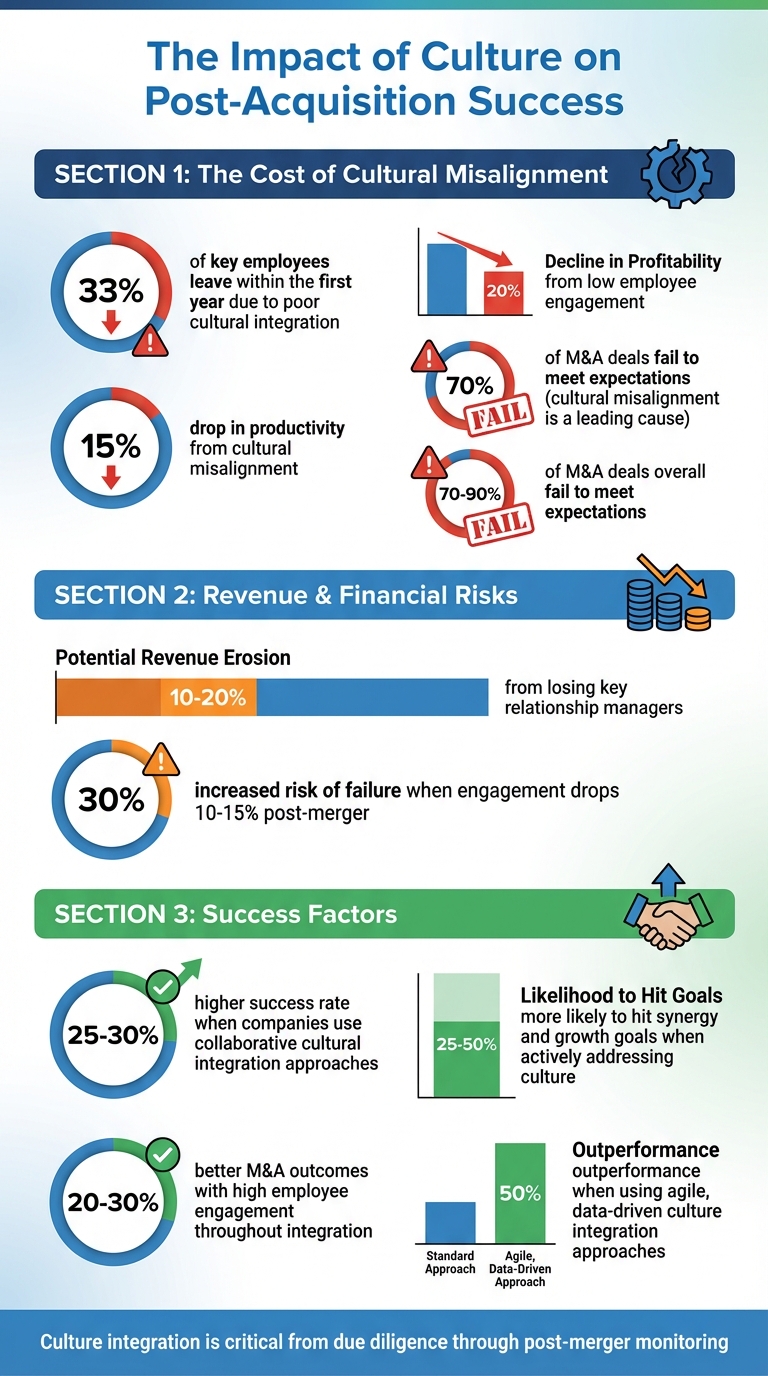
Key Statistics on Post-Acquisition Culture Impact and Success Metrics
The Risks of Mismatched Company Cultures
Common Post-Acquisition Problems
When company cultures clash after an acquisition, the fallout can be severe. One of the biggest issues is talent attrition - about 33% of key employees leave within the first year when cultural integration is poorly handled. For U.S. small and medium-sized business (SMB) buyers, even losing two or three crucial relationship managers can jeopardize both revenue and operations. This risk is especially high when a fast-paced, informal company is absorbed into a more structured, process-heavy organization. The added layers of approvals and bureaucracy can frustrate top performers, ultimately driving them to leave.
Employee engagement also takes a hit, and the consequences ripple through the organization. Low engagement can lead to a 15% drop in productivity and up to a 20% decline in profitability. This disengagement often results in internal conflicts, missed deadlines, and reduced collaboration. For SMBs, where profit margins are often tight, such setbacks can quickly wipe out any expected benefits of the deal.
Another major issue is the failure to achieve planned synergies. Misaligned decision-making styles, communication methods, and risk tolerance can leave teams bogged down in debates about how to work together instead of focusing on strategic goals. Initiatives like cross-selling may stall, back-office consolidations can get delayed, and system integrations may drag on as employees resist adopting unfamiliar processes. Research shows that up to 70% of deals fail to deliver expected synergies, with cultural misalignment being a leading cause. Understanding these risks early on is critical for conducting a thorough culture assessment during due diligence.
Warning Signs of Culture Mismatch
Spotting cultural red flags during due diligence is crucial. For example, a founder-centric decision-making model - where one person holds all the power - can indicate future resistance when control shifts to a broader leadership team. Similarly, poor communication practices, such as limited sharing of financial data or unclear performance expectations, can signal trouble. Employees in such environments may distrust new owners who introduce structured reporting systems or transparency measures.
Other warning signs include high turnover in key roles, a lack of formal HR or performance management processes, and few opportunities for employee feedback, such as engagement surveys. These issues often suggest that professionalizing the company or adding governance post-acquisition could disrupt the existing culture. Recognizing these signals early allows buyers to plan targeted interventions to ease the transition.
Financial Impacts of Culture-Related Risks
Cultural misalignment isn’t just a “soft” issue - it has real financial consequences. For instance, buyers can estimate revenue at risk by identifying key employees who manage major customer relationships. If even a few of these individuals leave post-acquisition, it could lead to client churn and revenue losses. In U.S. small businesses with concentrated customer bases, losing just a handful of relationship managers might erode 10–20% of revenue.
Missed synergies also come with a price tag. When cultural resistance slows or derails integration efforts, buyers can compare original synergy targets - such as cross-selling opportunities, headcount reductions, or system consolidations - to actual results. Shortfalls in these areas often tie back to cultural challenges. Additionally, unexpected costs like retention bonuses, recruiting expenses to replace departing employees, and prolonged operation of both legacy and new systems can drive up integration costs.
These financial risks highlight why aligning company cultures is essential for post-acquisition success. In fact, cultural mismanagement plays a significant role in the 70–90% of M&A deals that fail to meet expectations. What might seem like “soft” factors can have a very real impact on the bottom line.
Assessing Company Culture During Due Diligence
Key Steps in Culture Assessment
Start evaluating culture even before signing a letter of intent. Begin with a desk review of the target company's website, Glassdoor reviews, social media presence, and community engagement efforts. This helps you get a feel for their values and how their leadership operates. Once discussions become more serious, conduct structured interviews with owners and key managers. Ask behavior-based questions like, "Can you describe a time when the team missed a major target and how you handled it?" or "How was the decision-making process handled for a recent significant decision?" These types of questions can provide insight into accountability, decision-making speed, and whether the culture leans toward centralization or empowerment.
Gather anonymous employee feedback through surveys or small-group discussions. Focus on critical areas such as trust in leadership, openness to change, and psychological safety - these are strong indicators of post-deal retention and engagement. Also, don't overlook the importance of reviewing documents and artifacts. Take a close look at organizational charts, employee handbooks, performance review templates, compensation plans, and internal communication channels. Check platforms like Slack or email patterns to understand how work gets done. Request anonymized HR data from the past two to three years, including turnover rates by role, tenure, promotion statistics, and absenteeism. Any sharp deviations from industry norms could signal cultural or leadership challenges that might emerge post-acquisition.
Once you've gathered both qualitative and quantitative data, organize your findings into a straightforward framework for analysis.
Using Frameworks to Map Culture Differences
For small to mid-sized U.S. businesses, overly complex academic models aren't necessary. Instead, focus on a few practical dimensions: centralization versus autonomy (who makes decisions and how quickly?), risk tolerance versus risk aversion, speed versus deliberation, people focus versus task focus, and formality versus informality. Assign both organizations a score from 1 to 5 for each dimension based on the interviews, data, and artifacts you've reviewed. A spider chart is a helpful way to visualize these differences. Then, classify the gaps as either acceptable, manageable, or deal-breaking.
This framework can guide your integration strategy. For instance, if the target company has a highly autonomous, entrepreneurial sales team, but your organization operates with rigid approval structures, imposing your processes too quickly could alienate top performers. Research consistently shows that deals that explicitly address cultural differences during integration planning outperform those that don’t. The goal isn't to erase differences but to pinpoint areas where compromise is possible, where alignment is essential, and where gaps could undermine the deal's value.
Using Kumo for Early Risk Screening

Culture assessment should begin as early as deal sourcing. Kumo's custom search filters help you zero in on industries and business models where you already have a deep understanding of the cultural landscape. This allows you to avoid potential mismatches from the start. Kumo’s AI-powered summaries can quickly highlight cultural red flags in business descriptions. For example, keywords like "family-run", "founder-dependent", "flat organization", or "unionized workforce" can signal the need to prepare targeted cultural questions early in your outreach.
You can also set up deal alerts for regions where your existing culture is already well-suited. Similar labor markets, customer expectations, and regulatory environments often mean fewer surprises down the road. When Kumo flags a new listing that matches your saved criteria, you can immediately review an AI-generated summary to assess potential cultural compatibility - or conflicts - before committing time to deeper exploration. This early screening helps you focus on targets that are more likely to align with your organizational culture.
Strategies for Bridging Culture Gaps After Acquisition
Building a Shared Company Culture
Creating a unified culture after an acquisition isn’t just about merging processes - it’s about blending values and fostering mutual respect. Start by organizing joint workshops with leaders from both organizations to define shared values and aspirations. Together, draft a culture statement that combines the strengths of each company. For example, you might preserve the acquired company’s innovative practices while incorporating your established risk management protocols.
To bring this shared vision to life, appoint cultural ambassadors from both sides. These ambassadors can champion the new culture, gather feedback, and help address concerns. Research shows that companies taking this collaborative approach are 25–30% more likely to achieve successful integration. When leaders from both organizations visibly align with the new cultural narrative and model cooperative behavior, it builds trust and reduces the “us versus them” mindset. This foundation becomes the backbone of a step-by-step integration plan.
Phased Integration Planning
Trying to integrate everything at once can lead to chaos. Instead, break the process into manageable phases, prioritizing areas based on risk and impact. For instance, in the first 30 days, focus on stabilizing customer-facing operations. Misalignment here can directly affect performance. A notable example from the energy sector shows how phased cultural integration helped a company exceed its financial targets by 50%.
The next phase, which spans months 1–3, should focus on aligning core operations and leadership structures. Standardize processes where possible, but remain flexible enough to respect local practices. The final phase, starting at six months or later, should concentrate on embedding the new culture. This includes comprehensive training, refining policies, and developing long-term talent strategies. Pair each phase with targeted change-management efforts, such as clear communication, structured training sessions, and regular leadership check-ins. These steps ensure employees understand what’s changing and when.
People-Focused Interventions
As the integration progresses, keeping employees engaged should be a top priority. Offering retention bonuses and providing clear role definitions can help prevent turnover during the critical first year. Cross-company training programs are another effective tool - they help teams understand and appreciate diverse working styles and values.
Two-way communication is essential during this period. Regular town halls and Q&A sessions allow employees to share concerns and provide feedback. Anonymous pulse surveys can help identify potential issues early, and transparently addressing these concerns builds trust. Companies that maintain high employee engagement throughout the integration process often see 20–30% better M&A outcomes. Tailored onboarding programs that explain upcoming changes and the reasoning behind them further reinforce trust and help employees feel more secure in the transition.
sbb-itb-97ecd51
Measuring and Monitoring Integration Progress
Defining Culture-Related KPIs
Keeping track of culture integration requires clear, measurable metrics. A good starting point is the voluntary turnover rate, which you can calculate monthly using this formula: (voluntary departures / average headcount) × 100. After a merger, aim to keep this rate below 10–15% during the first year. If it spikes above 15% in the first six months, it’s often a warning sign of cultural friction. Research shows that such spikes are linked to 70% of mergers failing to hit synergy targets due to people-related challenges.
Another key indicator is employee engagement scores. Use quarterly pulse surveys with questions like, "I have the opportunity to do what I do best", rated on a 1–5 scale. Shoot for an average score above 4.0 or at least 70% favorable responses. A drop of 10–15% post-merger is a red flag - studies reveal that such declines increase the risk of failure by 30%. Also, monitor the absenteeism rate, which measures unplanned absences as a percentage of total workdays. A healthy benchmark is under 2–3%. If this rate suddenly rises, it could indicate stress or morale issues that may lead to resignations if left unchecked.
Other useful metrics include the employee Net Promoter Score (eNPS) - scores above 50 are ideal - and collaboration patterns between teams, such as the percentage of projects that include members from both legacy companies. These metrics can reveal whether silos are breaking down or becoming more entrenched. Together, these indicators lay the groundwork for integrating culture data into broader performance tracking.
Adding Culture Metrics to Performance Dashboards
Culture-related KPIs are just as important as financial metrics when assessing integration success. Instead of relegating them to separate HR reports, include culture metrics on the same dashboard as financial indicators like EBITDA, synergy capture, and cost savings. A balanced integration scorecard should assign culture metrics a weight of 20–30%. For instance, if engagement scores dip below 70% while financials look solid, it’s a sign you might be building on shaky ground.
To streamline this process, automate data feeds from HR systems and survey platforms so your dashboards update in real time. Review these combined metrics during bi-weekly integration steering committee meetings. When culture KPIs are presented alongside financial performance, they’re harder to overlook, and leaders are more likely to address early warning signs.
For companies using tools like Kumo to evaluate deals, insights gathered during the pre-close phase - such as whether a target company has a collaborative, founder-driven culture or a more hierarchical structure - can guide which KPIs to prioritize and what thresholds should prompt intervention.
Ongoing Monitoring and Adjustments
Once culture metrics are part of your performance dashboards, continuous monitoring becomes critical. Culture integration isn’t a one-and-done task - it requires consistent attention. Use frequent pulse surveys to catch issues early. Keep these surveys concise, with 5–10 questions, and aim for response rates above 70% in the first year. After that, you can shift to quarterly check-ins. Pair this quantitative data with qualitative feedback by hosting town halls, running focus groups across different teams, and maintaining anonymous feedback channels.
Set clear thresholds for action. For example, if engagement drops below 65% or absenteeism rises by 5%, implement immediate interventions like leadership coaching, peer mentoring programs, or workshops focused on shared values. According to McKinsey, companies that take this agile, data-driven approach to culture integration often outperform their peers by 50%.
During the first 6–12 months post-merger, review your culture dashboard monthly. As integration stabilizes, quarterly reviews will suffice. Focus on trends rather than isolated data points. For example, if voluntary turnover is disproportionately high among employees from the acquired company, or if collaboration metrics stall, adjust your strategy to address those specific challenges. Companies that treat culture tracking as seriously as financial tracking are the ones that turn acquisitions into long-term success.
How to Merge Cultures After a Business Acquisition
Conclusion: Achieving Post-Acquisition Success
Culture plays a crucial role in determining whether an acquisition fulfills its potential. Studies consistently show that cultural misalignment is a major factor behind many M&A failures. Companies that actively address culture - starting with early evaluations, followed by tailored integration plans and ongoing monitoring - are 25–50% more likely to hit their synergy and growth goals. Ignoring this aspect can lead to talent loss, productivity declines, and missed revenue opportunities. Here's how to weave culture into every stage of the acquisition process, from due diligence to post-merger integration.
The journey begins with early cultural due diligence. This step not only helps assess risks but also ensures that integration plans are built on a solid foundation. Tools like Kumo make this process more efficient by flagging cultural red flags in business listings and using AI-powered filters to identify targets that align with your operational goals.
Once the deal is finalized, maintaining cultural alignment becomes a continuous effort. Post-close, treat culture as a strategic priority on par with financial and operational assets. Integrate culture-related metrics - such as voluntary turnover rates, employee engagement levels, and collaboration indicators - into the same dashboards tracking financial outcomes like EBITDA, cost savings, and revenue synergies. This data-driven approach allows leaders to identify potential issues early and adapt strategies before they become major problems, giving companies a competitive edge.
Ultimately, culture can either create or destroy value. By combining thoughtful sourcing, thorough assessments, and targeted integration efforts, companies can choose the right targets, mitigate risks, and unlock the full potential of their acquisitions.
FAQs
What are the best ways to spot cultural misalignment during due diligence?
When conducting due diligence, spotting potential cultural mismatches is crucial. Companies should focus on aspects like employee attitudes, communication styles, decision-making processes, and leadership approaches. Tools like interviews, surveys, and cultural assessments can help uncover these differences.
It’s also helpful to review company policies, observe day-to-day workplace interactions, and examine past integration challenges for clues about potential problems. Site visits and consulting with cultural experts can offer deeper insights into underlying differences that could influence the success of a post-acquisition integration.
What are the best ways to align company cultures after an acquisition?
Merging company cultures after an acquisition takes thoughtful planning and deliberate actions to ensure a seamless transition and lasting success. Start by prioritizing open communication - this builds trust and provides clarity for employees navigating the change. Conduct a detailed cultural assessment to pinpoint both the common ground and the differences between the two organizations.
Involve leadership teams early in the process to align them on shared goals and consistent messaging. Promote employee participation by encouraging collaboration and addressing concerns head-on. Lastly, focus on integrating and reinforcing shared core values to establish a cohesive culture, while still respecting the unique aspects of each organization. These efforts can help ease tensions and set the foundation for a smooth post-acquisition integration.
Why is it important to track cultural KPIs during a merger?
Keeping an eye on cultural KPIs during a merger is crucial. Why? Because it helps spot potential cultural clashes early on, giving organizations the chance to tackle integration issues head-on and align team values before they become bigger problems.
Tracking these metrics can lead to higher employee engagement, less friction, and a smoother transition for everyone involved. When teams are culturally aligned, it often plays a big role in ensuring long-term success after the acquisition.