

Codely v2.0 public release is here
Lorem ipsum dolor sit amet, consectetur adipiscing elit lobortis arcu enim urna adipiscing praesent velit viverra sit semper lorem eu cursus vel hendrerit elementum morbi curabitur etiam nibh justo, lorem aliquet donec sed sit mi dignissim at ante massa mattis.
- Neque sodales ut etiam sit amet nisl purus non tellus orci ac auctor
- Adipiscing elit ut aliquam purus sit amet viverra suspendisse potent i
- Mauris commodo quis imperdiet massa tincidunt nunc pulvinar
- Adipiscing elit ut aliquam purus sit amet viverra suspendisse potenti
What has changed in our latest release?
Vitae congue eu consequat ac felis placerat vestibulum lectus mauris ultrices cursus sit amet dictum sit amet justo donec enim diam porttitor lacus luctus accumsan tortor posuere praesent tristique magna sit amet purus gravida quis blandit turpis.
All new features available for all public channel users
At risus viverra adipiscing at in tellus integer feugiat nisl pretium fusce id velit ut tortor sagittis orci a scelerisque purus semper eget at lectus urna duis convallis. porta nibh venenatis cras sed felis eget neque laoreet suspendisse interdum consectetur libero id faucibus nisl donec pretium vulputate sapien nec sagittis aliquam nunc lobortis mattis aliquam faucibus purus in.
- Neque sodales ut etiam sit amet nisl purus non tellus orci ac auctor
- Adipiscing elit ut aliquam purus sit amet viverra suspendisse potenti
- Mauris commodo quis imperdiet massa tincidunt nunc pulvinar
- Adipiscing elit ut aliquam purus sit amet viverra suspendisse potenti
Coding collaboration with over 200 users at once
Nisi quis eleifend quam adipiscing vitae aliquet bibendum enim facilisis gravida neque. Velit euismod in pellentesque massa placerat volutpat lacus laoreet non curabitur gravida odio aenean sed adipiscing diam donec adipiscing tristique risus. amet est placerat in egestas erat imperdiet sed euismod nisi.
“Nisi quis eleifend quam adipiscing vitae aliquet bibendum enim facilisis gravida neque velit euismod in pellentesque massa placerat”
Real-time code save every 0.1 seconds
Eget lorem dolor sed viverra ipsum nunc aliquet bibendum felis donec et odio pellentesque diam volutpat commodo sed egestas aliquam sem fringilla ut morbi tincidunt augue interdum velit euismod eu tincidunt tortor aliquam nulla facilisi aenean sed adipiscing diam donec adipiscing ut lectus arcu bibendum at varius vel pharetra nibh venenatis cras sed felis eget dolor cosnectur drolo.
When purchasing a small or medium business (SMB), reviewing the right legal documents is critical to avoid costly surprises. Missed issues like hidden debts, contract risks, or regulatory penalties can derail your deal. Here's what you need to know:
- Corporate Records: Confirm ownership, governance, and compliance by reviewing Articles of Incorporation, Bylaws, stock ledgers, and meeting minutes.
- Contracts: Focus on key customer, supplier, and employment agreements. Pay attention to change-of-control and termination clauses.
- Financials and Taxes: Examine 3–5 years of financial statements, tax returns, and debt agreements to assess liabilities and compliance.
- Licenses and Intellectual Property: Verify operating permits and IP ownership, including trademarks, patents, and trade secrets.
- Employee Documents: Review employment agreements, worker classifications, and benefit plans to identify potential HR liabilities.
- Purchase Agreements: Ensure representations, warranties, and indemnification clauses protect your interests post-closing.
Thorough due diligence, which typically takes 60–90 days and costs 1–3% of the purchase price, can prevent deal-breaking risks and secure your investment. Start early, prioritize high-impact documents, and negotiate protections for a smoother acquisition process.
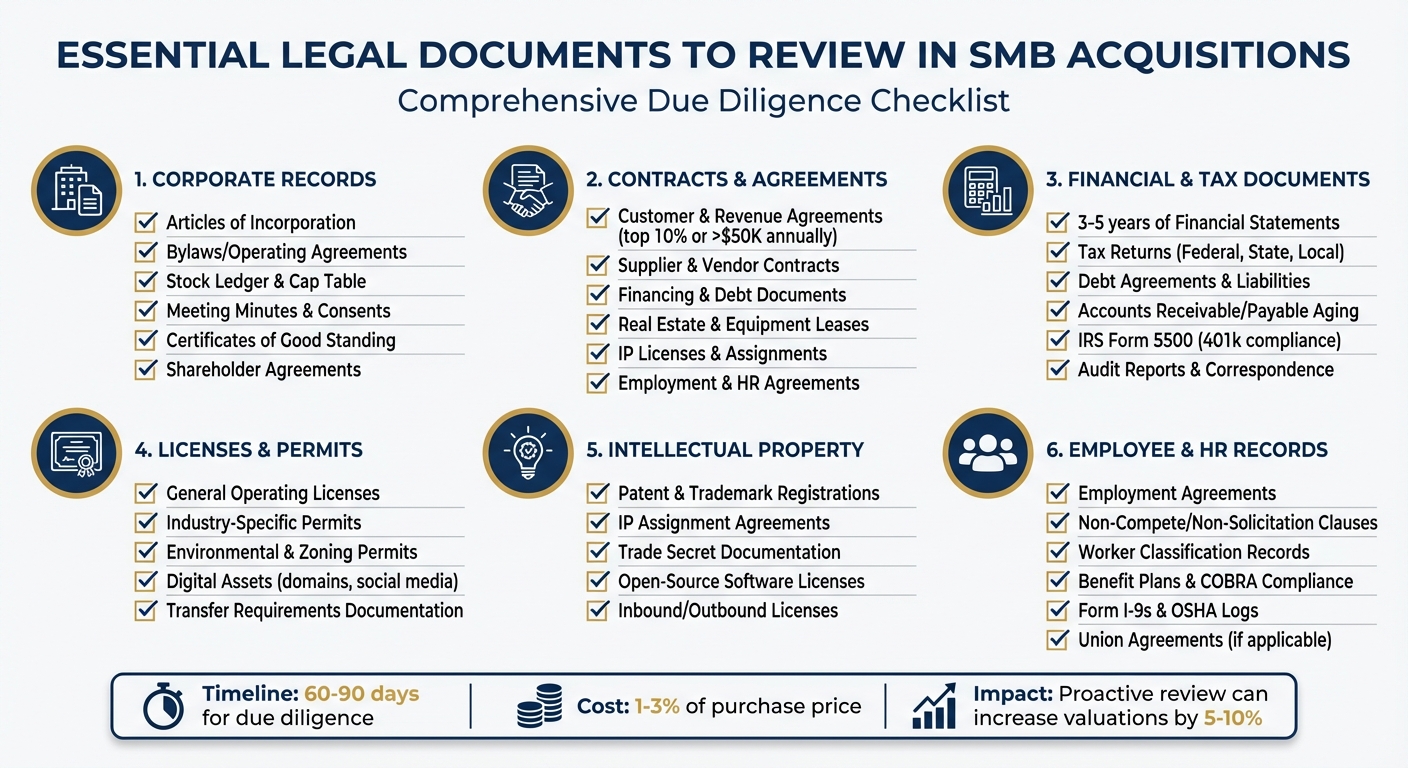
Essential Legal Documents Checklist for SMB Acquisitions
Business Acquisition Due Diligence | Beginner's Tutorial (UK)
Corporate Records and Organizational Documents
Corporate records are the backbone of any business, showcasing ownership, governance, and compliance. When these records are incomplete, businesses risk ownership disputes, regulatory penalties, and even personal liability for their owners.
"Meeting minutes are the primary paper trail of a corporation's legal life." - Anthony Mancuso, Author, The Corporate Records Handbook
Thorough corporate records are essential for spotting potential risks before diving into contract and financial reviews. These documents confirm a company's legal existence, ownership structure, and governance history. Neglecting proper corporate formalities can strip a business of its corporate protections, leaving owners personally exposed.
Key Corporate Records to Review
Start by reviewing the Articles of Incorporation (sometimes called the Certificate of Formation or Charter). Filed with the Secretary of State, this document establishes the company’s legal existence and outlines its basic capital structure. Check state records to ensure all amendments were filed correctly and confirm the entity remains active, not dissolved.
Next, examine the Bylaws or Operating Agreements. These internal documents set the rules for how the company operates, such as meeting schedules, voting procedures, quorum requirements, and the powers of officers. Pay attention to any supermajority clauses that could block an acquisition.
The stock ledger and capitalization table are critical for verifying equity distribution. Ensure there are enough reserved shares in employee stock option plans to avoid over-issuance. For S-Corporations, locate the original IRS election (Form 2553) and related shareholder agreements to confirm the tax status remains valid.
Review the minute books, which document shareholder and board meetings, as well as written consents for actions taken without formal meetings. These provide a chronological record of key corporate decisions. Double-check that all minutes and consents are signed, as unsigned documents may need ratification before closing.
Obtain Certificates of Good Standing from the relevant Secretary of State offices to confirm the company is authorized to operate and has current filings. Other essential documents include organizational charts, lists of officers and directors, and any fictitious name (DBA) filings.
Finally, inspect shareholder agreements for clauses that could affect a sale, such as restrictions on share transfers, drag-along/tag-along rights, or voting agreements. If the deal falls under the Hart-Scott-Rodino (HSR) Act, confirm that the required filing and 30-day waiting period have been addressed before moving forward.
Common Issues in Corporate Documentation
Incomplete or inaccurate records can lead to significant liabilities. For example, undocumented equity issuances may spark disputes with former employees or partners claiming ownership of shares. Missing stock ledgers make it impossible to confirm ownership, potentially halting the transaction.
Gaps in meeting minutes often signal poor governance or operational inefficiencies. If minutes were never prepared, "paper meetings" may be required to retroactively document past actions and bring records up to date - a process that can delay closing.
Outdated provisions in the Articles of Incorporation or Bylaws can unintentionally block an acquisition. Buyers often respond to record-keeping gaps by demanding price reductions of 5% to 10%, larger escrow holdbacks, or specific indemnities to cover hidden risks. Missing signatures, incomplete resolutions, or delayed third-party consents are common culprits for last-minute transaction delays.
For small and medium-sized businesses (SMBs) where founders or employees received restricted stock, verify that Section 83(b) tax elections were filed with the IRS within 30 days of the grant. Missing these filings can lead to unexpected tax liabilities. On the flip side, proactive sell-side due diligence can lead to 5% to 10% higher valuations and speed up transaction timelines by 20% to 30%.
Material Contracts and Agreements
Contracts and agreements outline the obligations, risks, and terms that come with a business acquisition. These documents play a central role in shaping the deal structure and ensuring smooth operations after the acquisition.
"Material contracts form the backbone of a company's operational and financial health, making their review one of the most vital and detailed aspects of due diligence." - Jack Nicholaisen, Founder, Business Initiative
A thorough review of these contracts is essential to identify potential deal-breaking issues before finalizing the transaction. Special attention should be given to specific contract categories that have a significant impact on the acquisition.
Types of Contracts to Focus On
Start by reviewing customer and revenue agreements. Pay close attention to contracts that represent the top 10% of revenue or generate over $50,000 annually. A customer concentration exceeding 40% is a red flag, as it increases the risk of instability during ownership transitions.
Next, examine supplier and vendor contracts, especially those critical to the supply chain. Focus on agreements with sole-source vendors or those involving long lead times. Financing and debt documents - such as loan agreements, credit lines, promissory notes, and liens - should also be carefully reviewed to uncover any hidden liabilities or default risks.
Real estate and equipment leases are another priority. Verify the terms for all properties, including occupancy rates and workstation details. Similarly, intellectual property licenses and IP assignment agreements for contractors and employees require scrutiny. For small and medium-sized businesses (SMBs), ensure that all core software or products developed by contractors are backed by formal legal assignments, not just invoices.
Employment and HR agreements for key personnel are crucial. Look for non-compete, non-solicitation, and retention clauses. Finally, review partnership and joint venture agreements to understand profit-sharing arrangements, management roles, and decision-making processes. Many SMB deals apply a "materiality standard", limiting the review to contracts that significantly affect the business's value or operations.
These steps help mitigate the risks that often accompany business acquisitions.
Key Clauses to Review
Once you’ve identified the critical contracts, focus on specific clauses that could influence the deal’s success.
Change-of-control provisions are among the most important. These clauses allow a counterparty to alter or terminate an agreement upon acquisition, potentially putting key revenue or supply contracts at risk. To address these concerns, deals often include Director Support Agreements and Lock-Up Agreements to ensure stability after the transaction.
Assignment and assumption clauses determine if a contract can legally transfer to the buyer. In asset purchases, contracts typically require third-party consent for assignment. In stock purchases or mergers, the contract remains with the legal entity, but change-of-control provisions may still apply. Prepare a list of contracts needing third-party consent and secure approvals before closing, as counterparties may use this as an opportunity to renegotiate terms.
"When contractual restrictions cannot be avoided through creative deal structuring, M&A parties must obtain written consents from third parties who have rights that would be triggered by a deal." - Destiny Aigbe, Securities Attorney, The Law Offices of Destiny Aigbe PLLC
Termination rights and penalties reveal the financial risks of ending a contract early or triggering a default due to the acquisition. Pay close attention to "termination for convenience" clauses, which might allow a key customer or vendor to exit shortly after the deal. Non-compete and non-solicitation clauses in employment and partnership agreements are also critical for protecting the business's goodwill and competitive position.
Indemnification provisions outline compensation for losses resulting from breaches of representations, warranties, or covenants. Additionally, earn-out and milestone provisions tie part of the purchase price to future performance metrics, such as EBITDA, shifting some risk between the buyer and seller based on post-acquisition results. Lastly, Material Adverse Effect (MAE) clauses allow the buyer to exit the deal if a major event significantly reduces the target’s value.
Leveraging automated due diligence tools can save 15 to 20 hours of manual work. Modern due diligence often involves secure online repositories for tracking documents and managing versions. If possible, request the seller’s due diligence reports to streamline the process and avoid duplicating efforts.
Financial and Tax Documents
Financial and tax records play a critical role in uncovering hidden liabilities, ensuring compliance, and providing a clear picture of a company's performance and risks.
"The difference between successful and failed transactions often comes down to rigorous financial due diligence and meticulous preparation." - Sidharth Ramsinghaney, Director of Corporate Strategy and Operations, Twilio
Analyzing both historical and current records is essential for accurately assessing a company's financial health.
Financial Records to Examine
After reviewing corporate and contractual documents, financial records provide the numbers that reveal the business's true condition.
Start by examining 3–5 years of audited and unaudited income statements, balance sheets, and cash flow statements. Ensure you're working with a profit and loss statement (P&L) dated within the last 180 days. To verify revenue, cross-check bank statements and general ledger details.
Pay attention to aging accounts receivable and extended payables, as they can signal potential cash flow issues.
"If accounts payable remain outstanding for extended periods, it might signal underlying cash flow issues." - John Silvestri, General Counsel, Craveworthy Brands
Examine all debt agreements, including loans, promissory notes, credit lines, and off-balance-sheet liabilities. Look for "change of control" clauses, which could increase debt or require immediate repayment if the company is sold. Free cash flow, calculated by subtracting capital expenditures from operating cash flow, is another key metric to assess.
"The most revealing red flags often appear in month-over-month operational metrics rather than annual statements." - Sidharth Ramsinghaney, Director of Corporate Strategy and Operations, Twilio
Compare the company's profit margins to industry averages. For instance, home health care businesses typically operate with profit margins between 10% and 15%. Investigate non-operating expenses for potential padding, as some companies misclassify operating costs to boost their financial results artificially. Review recent management reports, forecasts, and audit correspondence to uncover areas for improvement.
Tax Compliance and Liabilities
Financial analysis isn't complete without a thorough review of tax filings, which can reveal hidden risks and liabilities.
Examine 3–5 years of federal, state, local, and foreign tax returns, including payroll, sales, and excise filings. In equity transactions, such as stock or LLC interest purchases, the buyer inherits all historical tax risks - both known and unknown - making it crucial to review tax documents to quantify these liabilities.
"The acquisition of equity comes with it all known and unknown historical tax risk, so it is important to have a tax diligence team that is knowledgeable in the areas of federal, state and international taxation." - Schneider Downs
Even in asset purchases, successor liabilities for unpaid taxes can arise. Verify the company's S-Corporation status to avoid unexpected back taxes or penalties. Review historical filings to identify any "nexus" issues - states where the company should have filed taxes but failed to do so.
Cross-check employment tax filings with payroll records to ensure accurate payments. Specifically, review IRS Form 5500 for 401(k) compliance, which could reveal retirement plan liabilities. Examine correspondence with tax authorities and audit reports from the past three years to identify unresolved disputes or judgments. Additionally, search for undisclosed tax liens that might encumber the assets being acquired.
For middle-market transactions (valued between $5 million and $50 million), tax-specific due diligence typically costs $20,000 to $100,000, which is part of the 1% to 3% of the total purchase price spent on due diligence. This investment can prevent costly surprises, such as misclassified employees or unpaid payroll taxes, which often surface during financial reviews.
sbb-itb-97ecd51
Licenses, Permits, and Intellectual Property
Failing to verify operating licenses and intellectual property could mean acquiring a business that legally cannot operate. Here's what to watch for.
Review of Licenses and Permits
Start by ensuring that all general operating licenses are up-to-date and valid for the locations where the business operates. For industry-specific permits - like those for health, restaurants, or financial services - confirm their validity as well. Be aware of change-of-control clauses, which could void certain permits when ownership changes hands. Pay special attention to environmental and zoning permits, as violations can result in immediate closures or hefty fines. Don’t overlook digital assets like domain names and social media accounts - these should be registered under the company’s name.
"Proper investigation and evaluation of the IP assets to be acquired in a deal can be the difference between a successful transaction and an unsuccessful one."
– Nicole M. Bulman, Attorney, von Briesen & Roper, s.c.
Ask licensing authorities for written confirmation about transferability requirements. Some permits might transfer automatically, while others may need new applications or third-party approvals before the deal closes. Once licenses are squared away, move on to reviewing intellectual property rights.
Intellectual Property Documentation
It’s crucial to establish a clear chain of title for intellectual property, tracing ownership from its creation to the target company. Check employment and contractor agreements for proper assignment clauses. The language should be in the present tense (e.g., "hereby assigns") to ensure rights are effectively transferred. Verify the status of patents and trademarks with the USPTO to confirm they are active, properly maintained, and not expired. Also, look for signs of disputes, such as active litigation, cease-and-desist letters, or oppositions in legal registries. For trade secrets, ensure NDAs and confidentiality agreements are in place to safeguard sensitive information.
"IP is not just paperwork. It's power. And diligence is how you make sure you're actually buying it."
– PatentPC
In acquisitions involving technology, confirm that any open-source software used complies with its license terms to avoid unintentionally exposing proprietary code. Additionally, review inbound licenses (for software and third-party tech the company uses) and outbound licenses (for agreements generating revenue) to identify any restrictions on transferability.
Employee and HR-Related Documents
Workforce records can often hide risks that might impact the value of a deal. Just like corporate records and contracts reveal financial and legal concerns, employee-related documents can uncover liabilities tied to human resources. These records offer insight into the workforce you’re acquiring, potential obligations, and any compliance hurdles you might face after closing the deal. Below, we’ll break down the key employee documents and compliance areas that require attention.
Key Employee Documents to Review
Start by reviewing employment agreements, including offer letters, executive contracts, and severance arrangements. Pay close attention to change-of-control clauses, often referred to as "golden parachutes", as these can lead to significant payouts or signal potential challenges with retention.
Restrictive covenants, such as non-compete and non-solicitation agreements, also deserve careful examination. Keep in mind that enforceability of these agreements varies by state - California, for instance, generally prohibits post-employment non-compete clauses. Additionally, ensure proper worker classification by examining payroll records and job descriptions. Misclassifying employees as independent contractors or exempt workers can result in costly liabilities under the Fair Labor Standards Act (FLSA), which may require payment of overdue overtime wages along with liquidated damages.
"Employment law due diligence is not simply a box to check - it identifies hidden risks and informs integration strategies."
– Scott Horton, Attorney, Horton Management Law
Don’t overlook benefit plans. Review 401(k) summaries, health insurance details, and COBRA compliance. Similarly, examine compliance records like Form I-9s and OSHA logs to ensure workplace safety and legal adherence. If the workforce is unionized, take a close look at any Collective Bargaining Agreements, especially for successor clauses that might require you to maintain existing wages and benefits.
Key Personnel and Labor Compliance
A PwC survey highlighted a sharp decline in M&A success related to employee retention, dropping from 56% in 2010 to just 10% in 2019. To mitigate risks, request a complete employee census that includes job titles, hire dates, salaries, exempt/non-exempt classifications, and work locations. Reviewing performance evaluations and disciplinary records can help identify key employees essential to operations and those who may not align with future plans.
"A buyer-side employment lawyer can have a significant impact on a business transaction by spotting employment-related liabilities in the target company that might otherwise have gone unnoticed."
– Anthony J. Oncidi, Proskauer Rose LLP
Ensure that non-discretionary bonuses are factored into overtime pay calculations to avoid unexpected wage liabilities. Determine whether WARN Act requirements apply, especially in cases involving mass layoffs, and verify compliance with local WARN laws. In stock purchases, employment liabilities typically transfer automatically to the buyer. However, in asset deals, you may have the flexibility to choose which employees to retain. That said, federal common law may still impose successor liability if you continue operations with knowledge of existing claims. Carefully review employment liabilities under all relevant federal and state laws to avoid surprises.
Purchase Agreement and Closing Documents
The purchase agreement is the backbone of any acquisition. It pulls together the results of negotiations, due diligence, and legal protections into a single binding document. Whether it's an Asset Purchase Agreement (APA), Stock Purchase Agreement (SPA), or Merger Agreement, this document acts as the guide for the entire transaction and continues to define rights and responsibilities well after the deal closes. It builds on earlier due diligence to secure every aspect of the transaction.
One of the most heavily debated sections is representations and warranties. These are guarantees made by the seller about the business's condition - covering everything from financial performance to potential legal issues.
"Representations and warranties are statements and guarantees made by the parties related to the transaction... used by many buyers to force the seller to disclose all material facts about the business and flush out potential problems".
These guarantees typically remain in effect for 18 to 24 months after closing. However, critical representations, like those concerning ownership or taxes, may last 3 to 6 years - or even indefinitely.
The indemnification clause acts like a safety net. It ensures that the party responsible for a breach compensates the other for related costs. To manage this, most deals set aside 10% to 20% of the purchase price in an escrow account for post-closing indemnification claims. The agreement should clearly outline deductibles (baskets) and payout limits (caps). In deals without Reps & Warranties Insurance, indemnity caps often fall between 8% and 12% of the purchase price. With insurance, seller liability can drop significantly, often to just 0.5% to 1.5%.
To finalize the transaction, specific transfer documents are essential. In asset sales, this includes a Bill of Sale and Assignment and Assumption Agreements. Stock sales, on the other hand, require Stock Certificates, Stock Powers, and a Closing Statement that outlines financial adjustments. It's also important to review change-of-control clauses in these documents.
Don't overlook ancillary agreements, which offer additional protections and support. Examples include non-compete agreements and Transition Services Agreements (TSAs). Non-compete agreements prevent the seller from launching a competing business and should be limited to reasonable timeframes and geographic areas. If the seller is providing financing, you'll also need a Promissory Note and Security Agreement. TSAs can be particularly helpful, as they ensure the seller provides temporary assistance with IT, accounting, or operational needs after closing.
Conclusion
Reviewing legal documents during an SMB acquisition is a crucial step to avoid turning a promising deal into a financial nightmare. Statistics reveal that insufficient due diligence is a major factor behind the high failure rates in mergers and acquisitions (M&A). These failures often stem from overlooked liabilities, loss of key contracts, or missing legal ownership of critical assets.
Due diligence isn't cheap - typically ranging from 1% to 3% of the purchase price (around $150,000 to $500,000 or more for middle-market deals) - but it’s a small price to pay compared to the risks. For example, in one $12 million transaction, due diligence uncovered EPA violations with a $1.2 million cleanup cost. This discovery led to a restructured deal, including a $1.5 million escrow and specific environmental indemnity protections.
The documents you review lay the groundwork for a secure acquisition. Start the process as soon as the Letter of Intent is signed. The 60 to 90 days typically allocated for middle-market due diligence are there for a reason. Prioritize high-impact items like the top 10 customer contracts, intellectual property ownership, and material agreements. Spotting potential deal-breakers early gives you leverage to negotiate safeguards like indemnification clauses, escrow holdbacks, or price adjustments.
Every document you examine contributes to the bigger picture of the deal. A meticulous review today can turn your acquisition into a driver of growth rather than a costly error. Each contract, agreement, and disclosure tells a story - read them thoroughly to ensure your next move is a step toward success.
FAQs
What legal documents should I focus on when buying a small or medium business (SMB)?
When buying a small or medium-sized business (SMB), reviewing key legal documents is a must. This step helps ensure the transaction goes smoothly and safeguards your interests. Start with the purchase agreement - this document spells out the terms of the sale, so understanding it inside and out is essential. Next, dive into the financial records to get a clear picture of how the business has been performing.
You’ll also want to carefully examine the due diligence materials, which include contracts, licenses, and corporate records. These documents confirm the business’s legal and operational status, giving you confidence in what you’re acquiring. Don’t overlook non-compete agreements, which are crucial for preventing the seller from starting a competing business after the sale. Similarly, warranties or guarantees can provide peace of mind by addressing the business’s condition and any assurances being made.
Finally, double-check that all closing documents are in order before finalizing the deal. Taking the time to review these thoroughly can help you avoid surprises and make a well-informed decision.
What are the risks of missing or incomplete corporate records during an acquisition?
Missing or incomplete corporate records can pose serious risks during an acquisition by introducing uncertainties and potential liabilities. Essential documents such as articles of incorporation, bylaws, shareholder agreements, and stock ledgers play a key role in confirming ownership, the authority to sell, and the company’s overall legal standing. Without these, verifying ownership becomes a challenge, potentially leading to delays or even legal disputes.
Gaps in records can also complicate the evaluation of the business’s compliance with legal and regulatory requirements, such as necessary licenses or permits. This increases the likelihood of unforeseen liabilities, penalties, or expensive corrective measures after the acquisition. Moreover, missing documentation might conceal existing debts, liens, or contractual obligations, which could threaten the financial health of the acquired company. Conducting a thorough review of corporate records is crucial to ensure the acquisition process is both smooth and secure.
What should you look for when reviewing employment agreements during a business acquisition?
When going through employment agreements during a business acquisition, there are several critical elements to evaluate that could impact both the deal itself and the future of the combined operations. The first step is to establish whether the transaction is a stock purchase or an asset purchase, as this determines whether employment relationships automatically transfer or require renegotiation.
Key areas to scrutinize include non-compete, non-solicitation, and confidentiality clauses within employee contracts. These provisions can have a direct effect on competition and workforce dynamics post-acquisition. It's also essential to examine employee benefit plans, retirement commitments, and collective bargaining agreements, as these factors can significantly influence costs and integration strategies. Additionally, ensure all employment practices comply with applicable labor laws, and address any existing disputes or liabilities to mitigate potential risks.
Lastly, think about your post-acquisition goals. Whether you're planning employee retention initiatives or workforce reductions, having a clear strategy in place will help ensure a smooth transition while aligning with your overall business objectives.