

Codely v2.0 public release is here
Lorem ipsum dolor sit amet, consectetur adipiscing elit lobortis arcu enim urna adipiscing praesent velit viverra sit semper lorem eu cursus vel hendrerit elementum morbi curabitur etiam nibh justo, lorem aliquet donec sed sit mi dignissim at ante massa mattis.
- Neque sodales ut etiam sit amet nisl purus non tellus orci ac auctor
- Adipiscing elit ut aliquam purus sit amet viverra suspendisse potent i
- Mauris commodo quis imperdiet massa tincidunt nunc pulvinar
- Adipiscing elit ut aliquam purus sit amet viverra suspendisse potenti
What has changed in our latest release?
Vitae congue eu consequat ac felis placerat vestibulum lectus mauris ultrices cursus sit amet dictum sit amet justo donec enim diam porttitor lacus luctus accumsan tortor posuere praesent tristique magna sit amet purus gravida quis blandit turpis.
All new features available for all public channel users
At risus viverra adipiscing at in tellus integer feugiat nisl pretium fusce id velit ut tortor sagittis orci a scelerisque purus semper eget at lectus urna duis convallis. porta nibh venenatis cras sed felis eget neque laoreet suspendisse interdum consectetur libero id faucibus nisl donec pretium vulputate sapien nec sagittis aliquam nunc lobortis mattis aliquam faucibus purus in.
- Neque sodales ut etiam sit amet nisl purus non tellus orci ac auctor
- Adipiscing elit ut aliquam purus sit amet viverra suspendisse potenti
- Mauris commodo quis imperdiet massa tincidunt nunc pulvinar
- Adipiscing elit ut aliquam purus sit amet viverra suspendisse potenti
Coding collaboration with over 200 users at once
Nisi quis eleifend quam adipiscing vitae aliquet bibendum enim facilisis gravida neque. Velit euismod in pellentesque massa placerat volutpat lacus laoreet non curabitur gravida odio aenean sed adipiscing diam donec adipiscing tristique risus. amet est placerat in egestas erat imperdiet sed euismod nisi.
“Nisi quis eleifend quam adipiscing vitae aliquet bibendum enim facilisis gravida neque velit euismod in pellentesque massa placerat”
Real-time code save every 0.1 seconds
Eget lorem dolor sed viverra ipsum nunc aliquet bibendum felis donec et odio pellentesque diam volutpat commodo sed egestas aliquam sem fringilla ut morbi tincidunt augue interdum velit euismod eu tincidunt tortor aliquam nulla facilisi aenean sed adipiscing diam donec adipiscing ut lectus arcu bibendum at varius vel pharetra nibh venenatis cras sed felis eget dolor cosnectur drolo.
When selling your business, choosing the right broker is critical to ensure a smooth process and maximize your sale price. Brokers can charge 5%-15% of the sale price, so it's essential to know what you're paying for and how they’ll support you. Here’s what to ask before hiring a broker:
- Experience & Track Record: How many deals have they closed in your industry recently? Do they specialize in businesses of your size?
- References: Can they provide at least three references from past clients with similar businesses?
- Fees & Contracts: What is their commission rate, and are there upfront fees? Are there exclusivity clauses or termination penalties?
- Buyer Vetting: How do they qualify buyers to ensure confidentiality and avoid wasting time?
- Negotiation & Closing Support: What strategies do they use to secure favorable terms? Will they help with due diligence and legal coordination?
- Communication: How often will they provide updates, and who will be your main point of contact?
Preparation is key. By asking these questions and clarifying deliverables upfront, you can avoid costly mistakes and ensure your broker aligns with your goals. Tools like Kumo can also help track broker performance and ensure accountability throughout the process.
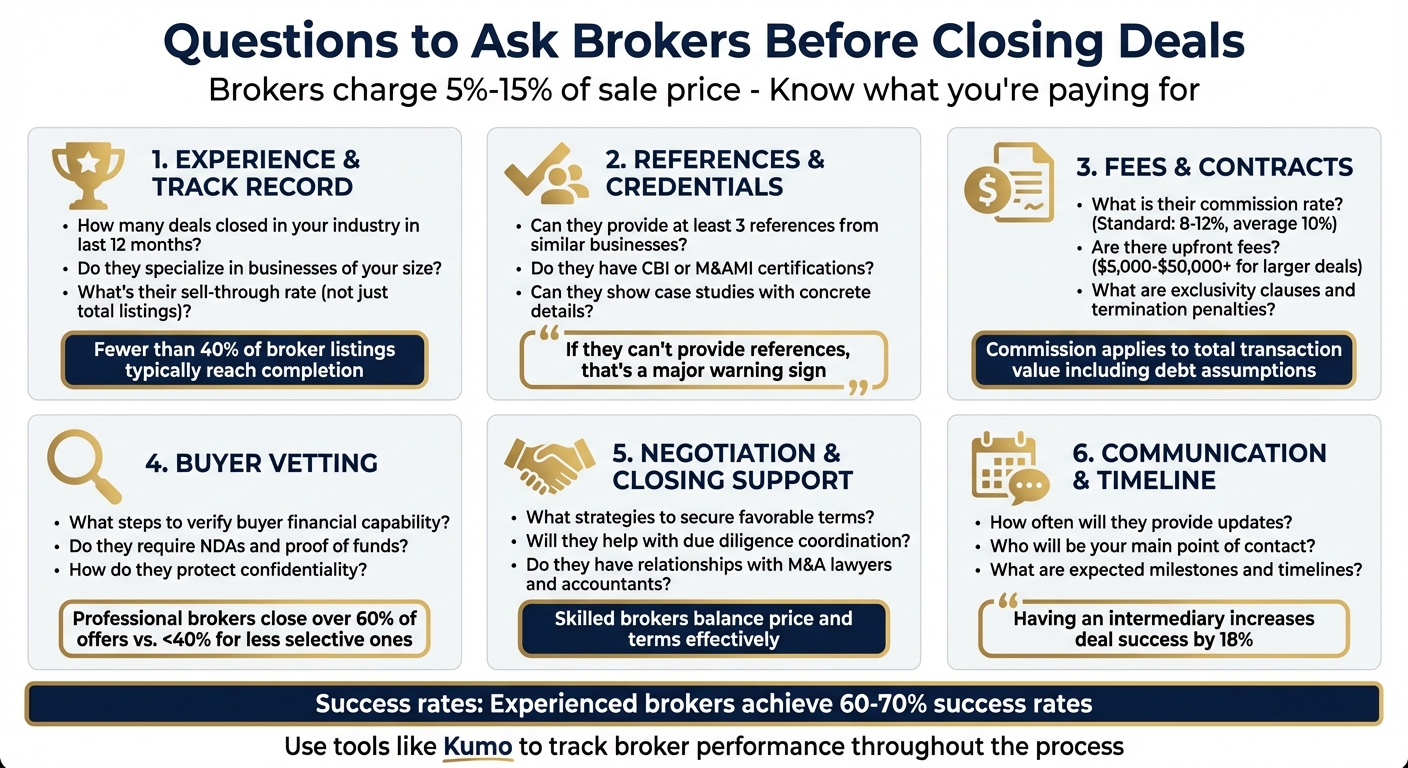
Essential Questions to Ask Business Brokers Before Hiring
What Should I Ask A Business Broker Before I Hire Them?
Evaluating Broker Experience and Track Record
It's crucial to match a broker's expertise to the size and industry of your deal. This alignment minimizes the risk of costly errors. For instance, selling a $500,000 retail shop requires a different approach than handling a $10 million manufacturing business. Brokers typically fall into three categories: main-street brokers (deals under $1 million), lower-middle-market firms ($1–$25 million), and middle-market advisors (deals over $25 million).
Industry knowledge is another key factor. A broker well-versed in restaurant health regulations might not be equipped to handle the complexities of calculating "work in progress" for a manufacturing firm or managing licensing for trade businesses like plumbing. Erik Sullivan from MidStreet emphasizes this point:
"Choosing a broker who sells companies of a similar size is one of the biggest keys to success."
By selecting someone with relevant experience, you set the stage for a smoother and more effective sales process.
Reviewing Past Deals
Ask brokers about the number of deals they've closed in your industry within the last 12 months - not over their entire career. Recent activity shows they have up-to-date market knowledge and are actively closing deals. While many brokers aim to close 8–10 deals annually, fewer than 40% of these deals typically reach completion. Look for brokers who consistently close a higher percentage of their listings.
Pay close attention to their sell-through rate rather than the total number of listings. A high sell-through rate, particularly at market-competitive prices, is a strong indicator of reliability. Brokers with outdated or stagnant listings may not have the expertise to close your deal effectively.
Requesting References or Case Studies
After reviewing a broker's past deals, verify their claims by speaking directly with former clients. Request at least three references from clients in your revenue range and geographical area. It's essential to get feedback from sellers who faced similar challenges in your industry. As Lien De Pau, Founder of The Big Exit, advises:
"If they're good at what they do, they'll have happy past clients willing to vouch for them. If they make excuses or can't provide references, that's a major warning sign."
When reviewing case studies, look for concrete details like photographs or financial records. Additionally, check for professional credentials such as Certified Business Intermediary (CBI) from the IBBA or Mergers & Acquisitions Master Intermediary (M&AMI) from M&A Source. These designations reflect a broker's commitment to industry standards and ongoing education. Taking the time to vet brokers thoroughly at this stage ensures you're partnering with someone capable of managing your sale from start to finish.
Understanding Fee Structures and Agreement Terms
While gauging a broker's past performance is essential, having a clear understanding of their fee structure is equally important for safeguarding your financial interests. Before signing anything, make sure you fully comprehend all fees and payment schedules. Typically, business brokers charge a commission ranging from 8% to 12% of the final sale price, with 10% being the standard rate in the industry. Smaller businesses often face higher percentages due to the additional risks and challenges involved in selling them. However, commission is just one piece of the puzzle - be sure to understand every financial obligation tied to the agreement.
Breaking Down Commission Rates
The broker's commission is calculated on the total transaction value, which includes cash, securities, inventory, work-in-process, non-compete agreements, and even debt assumptions. For instance, if a $1 million deal also involves a $200,000 debt assumption, the commission applies to the full $1.2 million value.
It’s also crucial to clarify whether real estate is subject to the same commission rate. Real estate transactions often follow a different fee structure, and you don’t want to be surprised by unexpected costs at closing. Be direct and ask: "How is the commission calculated, and what specific components are included in the transaction value?"
Discussing Upfront Fees or Retainers
For larger deals, brokers may charge upfront fees, which can range from $5,000 to over $50,000. These fees typically cover expenses like marketing, business valuation, and the preparation of sale materials. While brokers handling smaller transactions (under $1 million) often work on a success-only basis, M&A firms managing larger deals almost always require retainers.
"Choosing a broker that charges significant upfront fees can be risky. The broker could profit off of the listing even if your business doesn't sell."
Always confirm whether upfront fees will be deducted from the final commission. Additionally, ask about other potential costs, such as marketing fees (often around 1% of the sale price), valuation fees, and administrative charges. One seller shared an experience of paying $25,000 to terminate their contract early, highlighting the importance of understanding termination penalties before signing anything.
Reviewing Exclusivity Clauses
Most brokers will require you to sign an "exclusive right to sell" agreement. This means you'll owe them a commission no matter who finds the buyer - even if you secure the buyer yourself. These agreements typically last between six months and one year. Be aware of "tail" clauses, which could extend the broker's right to a commission for up to 24 months after the agreement ends if the buyer was introduced during the contract period.
To protect yourself, list any potential buyers you’ve already contacted and request that they be excluded from the agreement. This ensures you won’t owe a commission for deals you were already negotiating. Ask specific questions like: "Can we carve out certain buyers I’ve already approached?" and "What’s the process and cost if I need to terminate this agreement early?" If the broker avoids providing clear answers or references, consider it a red flag that warrants further scrutiny.
Confirming Buyer Vetting and Negotiation Support
Your broker plays a critical role in safeguarding your interests by thoroughly vetting potential buyers and negotiating terms that align with your goals.
Screening and Qualifying Buyers
A reliable broker won’t share your business’s financial details lightly. They’ll require signed NDAs, completed buyer questionnaires, and proof of funds before proceeding. When working with a broker, ask directly: "What steps do you take to confirm a buyer's financial capability and identity before sharing my business information?"
Michelle Seiler-Tucker, a well-known business broker and author, emphasizes this point:
"If the buyer is not willing to provide his/her financials and you have no other way to verify their financials, then the broker should not provide the buyer with any information whatsoever on our seller's business."
This process ensures you avoid wasting time with unqualified buyers who aren’t serious about making an offer.
To ensure your broker is thorough, request a copy of their vetting checklist. This should cover financial verification, background checks, and lender pre-qualification. Brokers who use CRM systems to track previously qualified buyers can also match your business with serious prospects more efficiently. Be cautious of brokers who take a less proactive approach - professional brokers typically close over 60% of their offers, while less selective ones may close fewer than 40%.
Once buyers are properly vetted, the focus shifts to negotiating terms that meet your priorities.
Negotiating Key Terms
Ask your broker: "What strategies do you use to secure favorable terms for sellers?" Skilled brokers understand the balance between price and terms. For instance, offering seller financing might help you achieve a higher sale price, but it often means receiving less cash upfront. Beyond financial terms, they should also address non-monetary factors, such as retaining key employees or securing a role for you as an advisor after the sale.
Experienced brokers use consultative questioning to uncover a buyer’s motivations and constraints, which can provide leverage during negotiations. They may also use strategic concessions - offering certain terms with the intent of trading them for more critical points later. Don’t hesitate to ask for examples of past successful negotiations and the tactics they used to close deals.
Strong negotiation practices also tie into maintaining confidentiality throughout the process.
Managing Confidentiality
Confidentiality is crucial to protecting your business’s value while a deal is in progress. A professional broker will use a phased disclosure approach: share general details anonymously in initial listings, release detailed financials only after securing an NDA and verifying the buyer, and save sensitive information, such as employee details, for the final stages of negotiation.
As First Choice Business Brokers explains:
"Maintaining strict confidentiality throughout the selling process protects your business's value and reputation."
Ask your broker: "How do you handle confidentiality during buyer interactions and property showings?" and "Can you share examples of how you’ve protected seller identities in the past?" A good broker acts as a buffer, ensuring your identity and sensitive business details are revealed only when absolutely necessary. They should also explain how they redact or withhold information until the due diligence phase.
sbb-itb-97ecd51
Clarifying Deliverables During Closing
Closing a deal involves a flurry of paperwork and precise coordination. Your broker's role is to keep everything on track while managing "deal fatigue" - that creeping frustration that can derail transactions when they drag on too long. By clearly defining and organizing every deliverable, brokers help ensure no critical step gets missed during this crucial phase.
Providing Assistance With Due Diligence
One essential question to ask your broker is: "What specific documents will you organize, and how will you ensure nothing is overlooked during due diligence?" A skilled broker acts as the central organizer, pulling together key documents like financial statements, tax returns, leases, and employee records. Their job isn't just about gathering paperwork; it's about reviewing these documents with a sharp eye to spot errors early, which can boost the buyer's confidence and keep the process moving smoothly.
But their role doesn't stop with document organization. Brokers also coordinate with legal professionals to verify critical details like business licenses, intellectual property rights, and compliance with regulations. If unexpected issues pop up - say, discrepancies in accounts receivable - a good broker steps in with strategic advice to renegotiate terms and keep the deal alive. As Ad Astra Equity explains:
"If unexpected findings arise during due diligence, brokers can help renegotiate terms or find creative solutions to financial issues".
Coordinating Legal and Advisory Support
A broker's ability to recognize when specialized expertise is needed is another key factor in a smooth closing. Ask them: "Who on your team will be involved, and do you have relationships with M&A lawyers, accountants, or wealth managers?" This question helps you gauge whether the broker has the resources to handle complex transactions or if they’re trying to juggle everything solo. A well-structured team with a manageable workload ensures precise and personalized coordination during closing.
Your broker should also act as the central point of communication between you, the buyer, and any advisory teams. By managing the flow of information, they reduce the risk of misunderstandings and ensure that every deliverable is handled on time. For deals involving real estate or long-term leases, confirm whether your broker holds a real estate license or if they’ll bring in a licensed agent.
Once all the moving parts are aligned, the focus shifts to post-deal support to ensure a seamless transition.
Offering Post-Closing Support
Another important question to ask is: "What role will you play after the deal closes?" Some brokers go the extra mile by assisting with ownership transitions, providing buyer training, or handling sensitive communications during the handover phase. Just as they manage communication during the deal, proactive post-closing support can help maintain momentum and prevent hiccups.
It’s also a smart idea to request early access to the closing packet. This allows you to spot and fix any errors ahead of time, avoiding last-minute delays. By clarifying these post-closing responsibilities upfront, you ensure you’re not left scrambling to manage the transition on your own.
Setting Communication and Timeline Expectations
Once deliverables are finalized, it's important to establish clear communication guidelines for updates and responsiveness. Laying out these expectations upfront helps avoid misunderstandings and keeps everyone on the same page as the transaction progresses. This communication plan works hand-in-hand with managing deliverables.
Frequency of Updates
Start by asking: "How often will you provide updates, and through which channels?" Brokers might rely on video calls, detailed reports, or email summaries. Clearly define the best communication methods for different situations - like phone calls for urgent matters, emails for regular updates, or a secure data room for sensitive documents. Also, agree on response times and broker availability.
Mary Reed from A Simple Model emphasizes the value of streamlining communication:
"Summarizing requests for new information in a daily or weekly email (versus firing them off as they come to you) will win you points with a broker's overworked deal team".
This method respects the broker's workload while ensuring your concerns are addressed. If email responses are slow, don't hesitate to switch to a call.
Addressing Timeline Risks
The timeline for business sales can be unpredictable, varying from days to years based on market conditions and the type of buyer. For instance, investment firms often have specific criteria and may take their time for the right deal, while individuals making career shifts may act more quickly.
Ask your broker: "What key milestones and timelines should we expect, and how will delays be handled?" A thorough answer should outline the typical process - valuation, marketing, buyer screening, negotiation, due diligence, and closing - along with strategies to stay on schedule.
Delays can lead to deal fatigue, a common reason transactions fall apart. Jacqueline McGee from Robbinex explains:
"Deal fatigue is when the buyer, seller, or both begins to feel frustrated, irritated, or upset by the pace of the transaction and is a leading cause for deals to fall apart".
To address this, ask your broker how they plan to manage frustrations and keep momentum during challenges. For insight into their efficiency, request details on the timelines of their last three closed deals.
Designating a Point of Contact
In addition to setting update protocols, clarify who your primary contact will be throughout the process. Ask: "Who will be my main point of contact, and how can we ensure timely responses to urgent questions?" Some brokers work individually, while others use a team approach, with specialists handling valuation, marketing, or closing.
Having an intermediary involved can increase the likelihood of a successful deal by as much as 18% compared to deals sourced without one. Determine whether you’ll have direct access to the lead broker or if communication will go through assistants. Also, confirm whether the entire deal team should be included in emails and establish guidelines for drop-in visits or after-hours communications.
As Team Acquira points out:
"Consistent, clear communication is crucial. A broker who doesn't return calls promptly or fails to answer questions might not be reliable".
Finally, create a master work plan - a centralized document or spreadsheet - to track data requirements, meeting schedules, timelines, and task ownership. This tool ensures accountability and helps prevent important details from slipping through the cracks.
Using Kumo to Track Broker Deliverables

Once deliverables are clearly laid out, the next step is ensuring those promises are met. That’s where tracking broker performance becomes crucial. Kumo provides a centralized platform that pulls together data from over 120,000 deals across thousands of brokers and marketplaces, giving you a clear, transparent view of the entire deal landscape. This streamlined system makes it easy to monitor broker activity and confirm that every relevant opportunity is being presented.
Kumo’s advanced algorithms scan hundreds of sources to identify inconsistencies in listings. Instead of relying on outdated manual spreadsheets, Kumo consolidates all this data into one intuitive dashboard, making accountability much more straightforward.
"We are building a unified platform and source network - so entrepreneurs can concentrate on creating value, not ordering spreadsheets." – Kumo
The platform also provides automated daily alerts for new listings that match your criteria, allowing you to compare your broker’s activity against more than 700 unique daily deals. With over $26 billion in total listings tracked, Kumo gives you a benchmark to measure your broker’s performance against the broader market. For instance, if your broker promised weekly updates on new opportunities, but Kumo shows dozens of matching listings that haven’t been shared, it could signal a gap in accountability.
Kumo’s tools also help you track specific deliverables outlined during the broker vetting process - like receiving a Confidential Information Memorandum (CIM) or updates on buyer screening progress. By centralizing deal data, the platform creates a clear, accessible record that you can use to follow up on your broker’s commitments. This ongoing monitoring strengthens the accountability framework you’ve established from the start.
Conclusion
Starting with clear questions can save you from unnecessary delays, unexpected costs, and potential missteps. When you define fee structures, deliverables, and communication expectations before signing any agreements, you ensure smoother transactions and avoid unpleasant surprises. As The Internicola Law Firm aptly explains:
"The best way to solve future problems is to address the issue before a problem arises. Having a conversation with your business broker before signing the commission agreement can save you time, money and heartache down the road".
Preparation is what sets a seamless transaction apart from a messy, costly ordeal. Take, for example, an agency owner who increased their sale value by 42% simply by implementing a thorough 10-question screening process. This highlights how proper due diligence when selecting a broker can directly influence the success of your sale.
Clear communication also plays a vital role in avoiding deal fatigue. Aligning on timelines, vetting processes, and next steps ensures everyone is on the same page. Brokers with a proven track record often achieve success rates of 60% to 70%, demonstrating the value of experience and reliability.
Technology platforms like Kumo add another layer of transparency to the process. By consolidating multiple deal sources, Kumo allows you to monitor your broker’s performance and confirm that all potential opportunities are being considered.
Choosing the right broker, supported by well-defined agreements and diligent oversight, can transform your acquisition experience. By prioritizing these critical discussions early on, you set the stage for a transaction that aligns with your goals and protects your interests.
FAQs
What should I ask to verify a broker’s experience and track record in my industry?
To determine if a broker has the right experience for your industry, ask for specific examples of their past work. Questions like, “How many businesses similar to mine have you sold in the past year?” or “What was the average sale price and timeline?” can give you a sense of their expertise. A broker with relevant experience should be able to share details about comparable deals and recent transactions.
You should also request references from previous clients to understand how the broker managed critical aspects such as valuation, buyer screening, and negotiations. Take the time to verify their professional background as well. For securities or investment brokers, you can use FINRA’s BrokerCheck or consult your state’s securities regulator to review their licensing and any disciplinary history. If you're working with a business-sale broker, confirm their registration with the appropriate state agency or professional association.
For additional insights, consider using data-driven tools like Kumo. This platform aggregates business listings and provides valuable information on broker performance, including deal volume and client reviews. By combining references, documented history, and verified credentials, you’ll gain a better understanding of a broker’s expertise and reliability.
What should I look for in a broker's fee structure before closing a deal?
When looking at a broker's fee structure, it’s important to first understand how their fees are calculated. Typically, brokers charge a commission based on a percentage of the final sale price. However, this percentage can change depending on factors like the size of the deal, its complexity, or the broker’s level of experience. Larger or more complicated transactions might come with higher percentages or tiered rates.
It’s also worth asking if the broker has upfront fees, retainer fees, or other costs beyond the commission. Some brokers may require an initial payment to cover marketing or due diligence, while others operate strictly on commission. Be sure to clarify what their fees include - are real estate charges separate? Are there additional costs for advertising or legal services? Knowing these details upfront can save you from unexpected expenses later.
Lastly, make sure the fee agreement is crystal clear and transparent. Insist on a written contract that spells out everything: the exact commission percentage, any tiered rates (like 8% on the first $1,000,000 and 6% on amounts above that), and any minimum or performance-based fees. Having these terms clearly outlined will help you avoid surprises and put you in a better position to negotiate.
What steps can I take to ensure confidentiality when selling my business?
Protecting confidentiality during a business sale is crucial to avoid unnecessary disruptions, such as alerting competitors, unsettling employees, or causing concern among customers. A skilled broker plays a central role in keeping sensitive information secure by adhering to strict protocols. For example, they often use anonymized teasers that exclude the company name and only share detailed information with thoroughly vetted buyers who have signed a non-disclosure agreement (NDA).
To safeguard your confidentiality, it’s important to ask your broker targeted questions, such as: "What steps do you take to protect sensitive information?" Effective measures typically include:
- Creating marketing materials that only provide high-level, anonymous details.
- Ensuring NDAs are signed before sharing confidential data.
- Using secure platforms for document sharing.
- Gradually disclosing information, starting with general data and sharing specifics only as buyer interest is confirmed.
If you’re using a deal-sourcing platform like Kumo, its secure interface and AI tools can add another layer of protection. These features let you control who views your listings, helping maintain discretion while attracting serious buyers. Together, these strategies ensure your sale process remains private and professionally managed.