

Codely v2.0 public release is here
Lorem ipsum dolor sit amet, consectetur adipiscing elit lobortis arcu enim urna adipiscing praesent velit viverra sit semper lorem eu cursus vel hendrerit elementum morbi curabitur etiam nibh justo, lorem aliquet donec sed sit mi dignissim at ante massa mattis.
- Neque sodales ut etiam sit amet nisl purus non tellus orci ac auctor
- Adipiscing elit ut aliquam purus sit amet viverra suspendisse potent i
- Mauris commodo quis imperdiet massa tincidunt nunc pulvinar
- Adipiscing elit ut aliquam purus sit amet viverra suspendisse potenti
What has changed in our latest release?
Vitae congue eu consequat ac felis placerat vestibulum lectus mauris ultrices cursus sit amet dictum sit amet justo donec enim diam porttitor lacus luctus accumsan tortor posuere praesent tristique magna sit amet purus gravida quis blandit turpis.
All new features available for all public channel users
At risus viverra adipiscing at in tellus integer feugiat nisl pretium fusce id velit ut tortor sagittis orci a scelerisque purus semper eget at lectus urna duis convallis. porta nibh venenatis cras sed felis eget neque laoreet suspendisse interdum consectetur libero id faucibus nisl donec pretium vulputate sapien nec sagittis aliquam nunc lobortis mattis aliquam faucibus purus in.
- Neque sodales ut etiam sit amet nisl purus non tellus orci ac auctor
- Adipiscing elit ut aliquam purus sit amet viverra suspendisse potenti
- Mauris commodo quis imperdiet massa tincidunt nunc pulvinar
- Adipiscing elit ut aliquam purus sit amet viverra suspendisse potenti
Coding collaboration with over 200 users at once
Nisi quis eleifend quam adipiscing vitae aliquet bibendum enim facilisis gravida neque. Velit euismod in pellentesque massa placerat volutpat lacus laoreet non curabitur gravida odio aenean sed adipiscing diam donec adipiscing tristique risus. amet est placerat in egestas erat imperdiet sed euismod nisi.
“Nisi quis eleifend quam adipiscing vitae aliquet bibendum enim facilisis gravida neque velit euismod in pellentesque massa placerat”
Real-time code save every 0.1 seconds
Eget lorem dolor sed viverra ipsum nunc aliquet bibendum felis donec et odio pellentesque diam volutpat commodo sed egestas aliquam sem fringilla ut morbi tincidunt augue interdum velit euismod eu tincidunt tortor aliquam nulla facilisi aenean sed adipiscing diam donec adipiscing ut lectus arcu bibendum at varius vel pharetra nibh venenatis cras sed felis eget dolor cosnectur drolo.
Want to quickly evaluate potential business acquisitions? An executive summary is your go-to tool. It’s a concise, 1-2 page document that distills the key details of a business - its operations, financials, and market position - into an easy-to-skim format. Whether you’re reviewing dozens of opportunities or narrowing down your options, a well-crafted summary saves time and helps you focus on the most promising deals.
Here’s what you’ll find in an effective executive summary:
- Business Overview: What the business does and its value proposition.
- Market Opportunity: The demand, market size, and competitive position.
- Financial Highlights: Revenue, profit, and growth metrics.
- Management and Operations: Key leaders and systems in place.
- Why It’s Worth Buying: Growth potential and alignment with buyer goals.
Tools like Kumo simplify the process by providing access to over 120,000 listings and AI-generated insights, making it easier to create summaries based on accurate, up-to-date data.
Bottom line: A clear, data-driven executive summary helps you make informed decisions faster, whether you’re an investor, buyer, or lender.
What is an Executive Summary for SMB Acquisitions?
Definition and Purpose
An executive summary is a brief, stand-alone document that distills a full business plan or acquisition proposal into a concise 1-to-2-page overview. It highlights key elements like the business's value proposition, financial performance, and the management team's credentials.
"Your executive summary is the CliffsNotes of your business plan." - Eric Butow, Owner, Butow Communications Group
The purpose of this document is to grab attention and sell the business idea right from the start. Think of it as an elevator pitch on paper, designed to hook the reader and encourage them to explore further. For SMB buyers evaluating multiple opportunities on platforms like Kumo, the executive summary acts as a crucial screening tool. It helps determine whether a business is worth a deeper dive or should be passed over.
A strong executive summary provides enough detail to understand the core opportunity without needing to reference the full report immediately. It covers everything from the business concept and market position to financial projections and competitive advantages. In essence, it’s both informative and strategic, serving as the first step in the SMB acquisition process.
Role in the Deal Sourcing Process
The concise nature of an executive summary makes it indispensable during the deal sourcing phase. When reviewing potential acquisitions - especially on platforms like Kumo - it’s essential to quickly identify businesses that align with your criteria. With investors and financiers often reviewing over 1,000 business plans or deal summaries annually, these summaries are critical for making swift, informed decisions about which opportunities deserve further exploration.
On average, readers spend about 5 minutes reviewing an executive summary. That means the most important metrics and strategic insights need to be front and center. Whether it’s cash flow for cautious buyers or growth potential for more aggressive investors, the summary should immediately address the factors that matter most to your acquisition strategy.
"Investors often make a determination as to whether they will invest in a company or not based solely on the executive summary." - Paul Borosky, MBA
In practical terms, the executive summary provides essential context before diving into detailed data. It explains why the business fits your search parameters, what sets it apart from competitors, and whether its financial performance aligns with your goals. This early filtering process ensures you spend time analyzing only the most promising opportunities, saving countless hours on deals that don’t meet your criteria.
sbb-itb-97ecd51
How to Write an Executive Summary for a Business Plan
Key Components of an SMB Executive Summary
An executive summary for SMB acquisitions should include five essential sections that come together to tell the business's story. Ideally, this summary should be concise - about 250 to 400 words spread across one to two pages - yet detailed enough to help buyers make an initial decision.
Business Overview and Value Proposition
Start by outlining the business's core purpose and value. What problem does it solve? Who are the target customers? What makes it stand out?
"The Executive Summary is the most critical element of the business plan. If it does not grab the investor's attention, the investor will not bother with the rest of the business plan." – Team ZenBusiness
This section should spotlight the unique selling proposition. If the business has proprietary technology, exclusive contracts, or a niche market position, make that clear.
Market Opportunity and Competitive Position
Buyers want to see evidence of demand. Use this section to quantify the market size, describe target customer demographics, and highlight current industry trends. Include the total addressable market to give a sense of scale.
For the competitive analysis, identify direct competitors and explain why this business stands out. Don’t just claim superiority - back it up with specifics. For example, emphasize advantages like lower costs, faster delivery, better service, or exclusive partnerships. If the business holds a 15% market share in a growing industry or has modernized while competitors lag behind with outdated systems, make those points clear.
Financial Highlights
Numbers tell the story of a business’s stability and potential. Start with annual revenue, then break down operating expenses, net profit, and profit margin. For established businesses, include historical performance to show consistency. If the business is in a growth phase, include revenue projections for the next three years.
| Financial Metric | What It Shows | Why It Matters |
|---|---|---|
| Annual Revenue | Total sales generated | Reflects business scale and market reach |
| Net Profit | Earnings after all expenses | Indicates the “bottom line” appeal |
| Profit Margin % | Net profit divided by revenue | Highlights operational efficiency |
| Growth Rate | Year-over-year revenue growth | Demonstrates momentum and potential |
These figures should be presented in US dollars. For instance, if the business generated $2.4 million in revenue last year with a 22% profit margin and 18% year-over-year growth, those numbers alone paint a strong picture of its performance.
"The succinct financial summary shows investor or loan officer the company's potential profits in short order." – Quality Business Plan
Management Team and Operations
Buyers need to know who’s running the business and whether its operations can continue smoothly post-acquisition. Highlight the experience and track records of key leaders to show their ability to deliver results.
Also, describe the operational systems in place - like inventory management, customer service processes, technology infrastructure, or supplier relationships. The goal is to demonstrate that the business has a solid foundation and isn’t overly reliant on the current owner. A well-structured operation increases buyer confidence.
Why This Business is Worth Buying
Finally, this section answers the buyer’s key question: “Why is this deal worth pursuing?”
Showcase growth opportunities, such as market expansion, product diversification, or increased market share. For example, if the business operates at 60% capacity and could double its revenue with a $200,000 investment in equipment, highlight that potential. Explain how the acquisition aligns with buyer goals, whether it’s entering a new market, gaining a loyal customer base, or achieving operational efficiencies through consolidation.
Tailor this section to your audience. Banks may care more about financial stability and debt coverage, while investors will focus on scalability and competitive advantages. On platforms like Kumo, where buyers sift through multiple opportunities daily, this section should make a compelling case for why this specific business stands out from the crowd.
How to Write an Executive Summary: 5 Steps
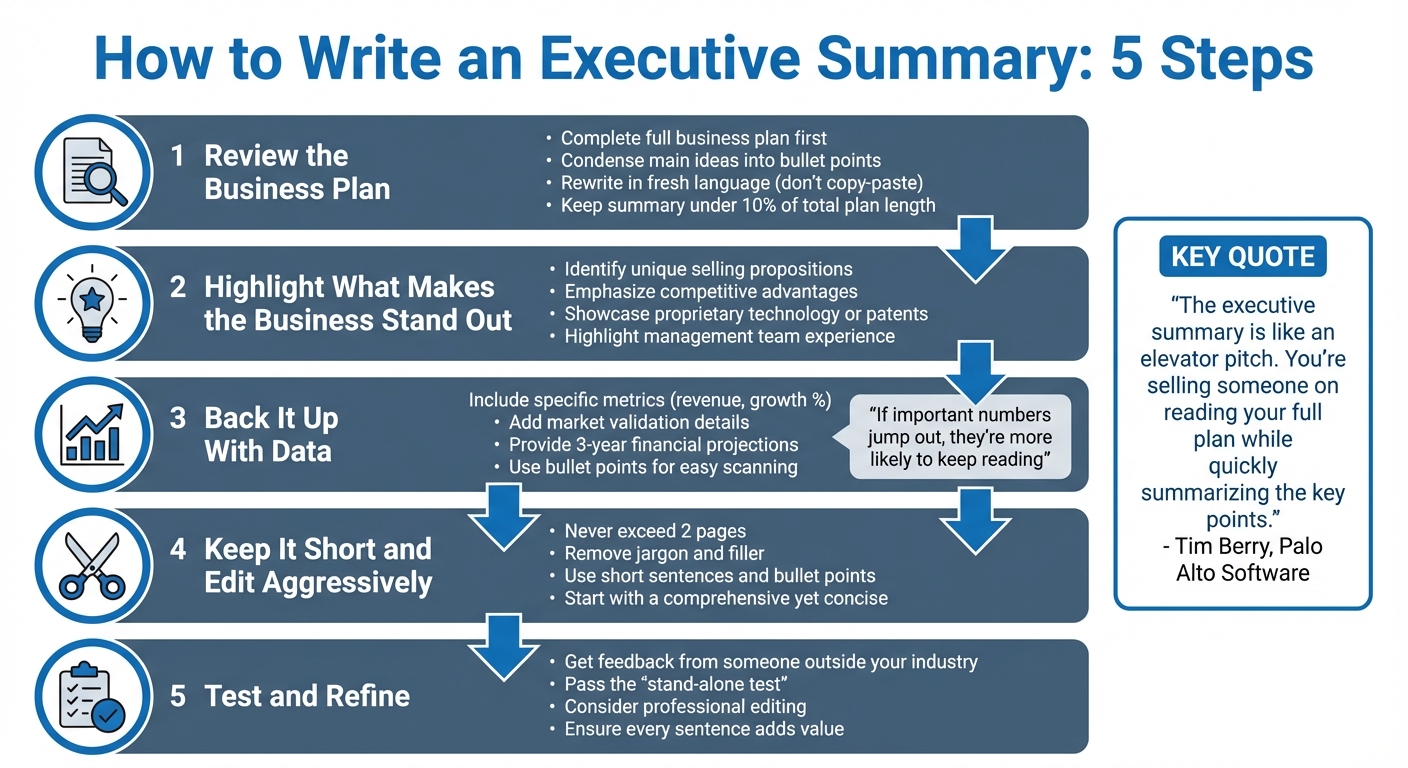
5 Steps to Write an Effective Executive Summary for SMB Acquisitions
Crafting an executive summary is much easier when you follow a clear, step-by-step process. The first rule? Complete your full business plan before tackling the summary. After all, you can't summarize what hasn’t been written yet. Think of the executive summary as a snapshot - a brief, one-to-two-page overview highlighting the most essential details.
"The executive summary is like an elevator pitch. You're selling someone on reading your full plan while quickly summarizing the key points." – Tim Berry, Founder and Chairman, Palo Alto Software
Here’s a breakdown of how to create a summary that aligns with the fast-paced decision-making process of potential buyers.
Step 1: Review the Business Plan
Start by revisiting your completed business plan. Go through each section and condense the main ideas into single-line bullet points. This will help you focus on the most important details while avoiding unnecessary complexity. Ask yourself key questions: What is the business about? Who are its customers? What are the financial highlights? What sets it apart?
Avoid the temptation to copy and paste directly from your plan. Instead, rewrite the key points in fresh, engaging language. And keep this in mind: the executive summary should make up less than 10% of the entire business plan.
Step 2: Highlight What Makes the Business Stand Out
What makes this business a smart investment? Pinpoint its standout features - things like proprietary technology, patents, unique market positioning, or major contracts. Buyers, especially those looking at small and medium-sized businesses, want to know why this opportunity is special.
"What do you do for whom? How do it differently? Why are you particularly good at it?" – Tim Berry, Founder and Chairman, Palo Alto Software
Emphasize competitive advantages, whether it’s innovative processes, a prime location, or an untapped market need. It’s also wise to spotlight the management team’s experience and connections to build trust and credibility [11, 12].
Step 3: Back It Up With Data
Numbers tell the real story, so include specific metrics to add weight to your claims. Instead of saying "strong growth", provide hard data, like "$15 million in annual revenue with 20% year-over-year growth".
Add market validation details too - such as the total addressable market size, projected growth, and current market share. You should also include three-year financial projections and operational metrics, like employee count and years in business. If funding is part of the plan, briefly outline how much is needed, where it will go, and the expected returns.
"If important numbers and convincing stats jump out at the reader, they're more likely to keep reading." – NerdWallet
Use bullet points to make these figures easy to spot, and double-check for accuracy.
Step 4: Keep It Short and Edit Aggressively
An executive summary should never exceed two pages. Cut out anything unnecessary - buzzwords, technical jargon, and filler sentences. Stick to short, clear sentences and use bullet points to improve readability. Plenty of white space helps too, making the document easy to skim.
Start with a strong hook, perhaps a compelling industry fact or statistic. Avoid overused comparisons like "the next Uber or Facebook." Instead, use solid data to demonstrate the business's strengths.
The summary should be comprehensive enough that someone can understand the business case without needing the full plan. Follow the same structure as your business plan, but focus only on the most critical points.
Step 5: Test and Refine
Ask someone unfamiliar with your industry to review the summary. This "fresh eyes" approach can help you identify confusing phrases or gaps in logic. The goal is for your summary to pass the stand-alone test: Can someone with no prior knowledge understand your proposal after one read?
"Put yourself in the business plan reader's shoes, and think about what you would like to know in the report." – Marius Thauland, Business Strategist, OMD EMEA
If needed, bring in a professional editor to fine-tune the language and improve overall impact. Review the summary multiple times, ensuring every sentence adds value. By following these steps, you’ll create an executive summary that grabs attention - perfect for buyers browsing platforms like Kumo.
Common Executive Summary Mistakes to Avoid
Even the most experienced professionals can stumble into common pitfalls when crafting executive summaries. The good news? These missteps are easy to correct once you know what to watch out for. Here's a breakdown of the most frequent errors and how to steer clear of them. Avoiding these mistakes can help streamline decision-making, especially on platforms like Kumo.
Being Too Vague
Using generic language can undermine your credibility. Statements like "we offer innovative solutions" or "the market is growing rapidly" fail to communicate anything specific or actionable. Considering that busy executives spend an average of just 127 seconds skimming a proposal, vague phrasing wastes valuable time.
Instead, replace broad adjectives with precise data. For instance, rather than saying "strong revenue growth", specify "$15 million in annual revenue with 20% year-over-year growth." Every claim should be backed up with concrete numbers or evidence.
"If your summary sounds like it could belong to any company, it's a red flag. Investors and lenders want to know exactly what you do." – Kaylee Philbrick-Theuerkauf, Co-founder, PlanGrow Lab
A helpful trick is the "Pub Test": imagine explaining your business deal to a friend over drinks. If they can't understand your pitch in 30 seconds, your summary is likely too vague.
Using Too Much Technical Language
While technical terms can demonstrate expertise, they can also alienate readers who aren’t familiar with the jargon. For example, instead of writing "migration to microservices architecture", focus on the outcome: "our new system launches products in 2 days instead of 3 months". This approach emphasizes results without overwhelming readers with technical details.
To simplify your language, try the "Fifth Grader Test": have someone outside your industry read the first paragraph. If they can’t explain what your company does after one read-through, your language is too complex. Another tip? Use personal pronouns like "we" and "our" to create a more approachable, conversational tone.
Different stakeholders have different priorities, so tailor your language to their interests. The CRG Model can help: CFOs focus on cost savings and ROI, COOs prioritize risk mitigation and operational efficiency, and CEOs care about growth and competitive advantages.
Ignoring the Buyer's Needs
One of the biggest mistakes is focusing on what you want to say instead of what the buyer needs to know. An executive summary isn’t the place to showcase every detail of your research - it’s a tool to help someone quickly determine whether your business is worth their time and investment.
Lead with the most critical information. Strategic document design can boost reader comprehension by 287%, so start with the essentials: what your business does, why it’s valuable, and the action you’re proposing.
"Tell the board what they need to know, not what you know." – David Platt, Chief Strategic Development Officer, Moody's
Use the "So What?" Test for every sentence. If it doesn’t add to the reader’s understanding or help them make a decision, cut it. Buyers need clarity and actionable insights, including any potential risks or challenges, rather than an exhaustive analysis.
Tools for Creating Better Executive Summaries
When it comes to crafting executive summaries that resonate with SMB buyers, having accurate and up-to-date data is non-negotiable. Manually gathering information from various brokerages can take weeks, but deal sourcing platforms streamline this process. They centralize market data and automate research, allowing you to analyze opportunities much more efficiently.
Finding Deals with Kumo

Kumo is a powerful platform that pulls together over 120,000 active listings, updating daily from thousands of brokers and major marketplaces. With over $26 billion in total listings being tracked, it gives you access to the entire market through a single dashboard.
The platform’s AI-driven search and filtering tools make it easy to narrow down opportunities based on specific metrics, geographic locations, and industries. These features are particularly useful for building the "Market Opportunity" and "Financial Highlights" sections of your executive summaries. On top of that, Kumo sends you custom alerts with new listings that match your criteria, ensuring your summaries are based on the most current data. It also removes duplicate deals that appear across multiple sources, so you’re left with clean, accurate insights without redundant entries. This level of automation and precision sets the stage for creating summaries backed by solid, reliable data.
Using Kumo's Data for Executive Summaries
Kumo doesn’t just help you find deals - it also helps refine your executive summaries. Its AI-generated listing summaries condense long, detailed business descriptions into concise overviews, making it easier to pull out essential details for your "Overview" section. To bolster your "Competitive Position" analysis, you can compare the target business to others in the same industry or region, using real-world benchmarks.
The platform’s export feature lets you download search results as CSV files, which you can easily integrate into spreadsheets or CRMs for deeper financial analysis. This ensures your "Financial Highlights" section includes precise figures like annual revenue, EBITDA multiples, and asking prices, rather than relying on rough estimates. Plus, by cross-referencing listings from multiple sources, you can uncover inconsistencies that may signal potential red flags - valuable insights to include in your summary. With tools like these, you can create executive summaries that are not only data-rich but also highly actionable, covering everything from market opportunities to financial specifics.
Conclusion
A strong executive summary is the cornerstone of successful SMB acquisitions. Keep it short and impactful, highlighting the essentials: the business opportunity, competitive edge, financial highlights, and why the management team is poised for success. Make sure to complete your full business plan or deal analysis first - this ensures you can pull the most compelling details accurately.
Focus on delivering clear, targeted insights that resonate with your audience. For example, banks care about financial stability and repayment capabilities, while investors are drawn to growth potential and the team’s track record. Tailor your content to these priorities and edit relentlessly to ensure every word adds value. Start with a strong opening to immediately grab attention. As Marty Zwilling from Cayenne Consulting explains:
"The executive summary is the first section of your business plan... it should make the reader want to learn more about your opportunity".
Kumo simplifies this process by offering access to over 100,000 active listings and $26 billion in tracked opportunities. With AI-generated summaries and automated data export features, Kumo helps you create data-rich executive summaries in record time. Instead of spending weeks gathering information, you can use Kumo’s tools to pull accurate financials, market benchmarks, and competitive insights directly from a centralized dashboard. These streamlined insights can spark immediate interest from buyers.
While tools like Kumo can save time, your success ultimately depends on strategic thinking. Use technology to streamline research and data collection, but rely on your judgment to craft a summary that speaks directly to your buyer’s priorities. Lead with your strongest recommendation, include clear three-to-five-year financial projections, and finish with a decisive call to action - whether it’s requesting a meeting or advancing with an LOI.
A well-crafted executive summary, combining concise data with strategic insights, can be the key to closing deals effectively.
FAQs
How can I create an executive summary that highlights a business's unique value effectively?
To create an executive summary that grabs attention, start by clearly articulating the core value proposition. This means summarizing what the business does, who it serves, and what sets it apart from competitors. Keep this statement short and impactful so it’s easy to grasp at a glance.
Back up your claims with specific metrics that resonate with potential buyers. Highlight figures like revenue growth, cost savings, or market share using clear formatting - for example, "$2.5 million in annual revenue" or "15% year-over-year growth." Align your language with the buyer’s priorities, focusing on how the business supports their objectives.
Keep the summary concise and engaging, ideally just a few pages. Use bullet points to spotlight major strengths, such as patented innovations or exclusive partnerships. If you’re presenting the opportunity on platforms like Kumo, a well-crafted, data-rich summary ensures your business stands out to buyers worldwide.
What mistakes should I avoid when writing an executive summary for SMB acquisitions?
When crafting an executive summary for an SMB acquisition, steer clear of these common mistakes:
- Lack of clarity or focus: Keep your summary sharp and to the point. Clearly outline the business's value, the significance of the deal, and the financial opportunity. Avoid vague language or sweeping generalizations.
- Overloading with details: Resist the urge to cram in too much information. Skip heavy jargon, exhaustive financial tables, or operational specifics. Stick to the highlights that matter most to a buyer.
- Omitting key data: Make sure to include essential metrics like revenue trends, EBITDA, and cash flow. Leaving these out can make your summary seem incomplete or unreliable.
- Unstructured flow: Organize your summary logically. Start with a brief business overview, highlight the key value proposition, and conclude with how the deal aligns strategically.
Keep it under one page, write in plain language, and always consider the buyer's perspective. Proofread for accuracy and consistency, and make sure to present standout metrics upfront to grab attention.
How can Kumo help SMB buyers create data-driven executive summaries?
Kumo makes crafting data-driven executive summaries a breeze by pulling together over 120,000 current deal listings, with an impressive 700+ new entries added every single day. It offers customizable search filters and analytics tools to help SMB buyers zero in on the metrics and insights that matter most.
By using Kumo, you can effortlessly incorporate critical data points into your executive summaries, enabling smarter decision-making and delivering clear, impactful presentations.