

Codely v2.0 public release is here
Lorem ipsum dolor sit amet, consectetur adipiscing elit lobortis arcu enim urna adipiscing praesent velit viverra sit semper lorem eu cursus vel hendrerit elementum morbi curabitur etiam nibh justo, lorem aliquet donec sed sit mi dignissim at ante massa mattis.
- Neque sodales ut etiam sit amet nisl purus non tellus orci ac auctor
- Adipiscing elit ut aliquam purus sit amet viverra suspendisse potent i
- Mauris commodo quis imperdiet massa tincidunt nunc pulvinar
- Adipiscing elit ut aliquam purus sit amet viverra suspendisse potenti
What has changed in our latest release?
Vitae congue eu consequat ac felis placerat vestibulum lectus mauris ultrices cursus sit amet dictum sit amet justo donec enim diam porttitor lacus luctus accumsan tortor posuere praesent tristique magna sit amet purus gravida quis blandit turpis.
All new features available for all public channel users
At risus viverra adipiscing at in tellus integer feugiat nisl pretium fusce id velit ut tortor sagittis orci a scelerisque purus semper eget at lectus urna duis convallis. porta nibh venenatis cras sed felis eget neque laoreet suspendisse interdum consectetur libero id faucibus nisl donec pretium vulputate sapien nec sagittis aliquam nunc lobortis mattis aliquam faucibus purus in.
- Neque sodales ut etiam sit amet nisl purus non tellus orci ac auctor
- Adipiscing elit ut aliquam purus sit amet viverra suspendisse potenti
- Mauris commodo quis imperdiet massa tincidunt nunc pulvinar
- Adipiscing elit ut aliquam purus sit amet viverra suspendisse potenti
Coding collaboration with over 200 users at once
Nisi quis eleifend quam adipiscing vitae aliquet bibendum enim facilisis gravida neque. Velit euismod in pellentesque massa placerat volutpat lacus laoreet non curabitur gravida odio aenean sed adipiscing diam donec adipiscing tristique risus. amet est placerat in egestas erat imperdiet sed euismod nisi.
“Nisi quis eleifend quam adipiscing vitae aliquet bibendum enim facilisis gravida neque velit euismod in pellentesque massa placerat”
Real-time code save every 0.1 seconds
Eget lorem dolor sed viverra ipsum nunc aliquet bibendum felis donec et odio pellentesque diam volutpat commodo sed egestas aliquam sem fringilla ut morbi tincidunt augue interdum velit euismod eu tincidunt tortor aliquam nulla facilisi aenean sed adipiscing diam donec adipiscing ut lectus arcu bibendum at varius vel pharetra nibh venenatis cras sed felis eget dolor cosnectur drolo.
Managing supplier contract risks is crucial for avoiding financial losses, operational disruptions, and reputational harm. Here's what you need to know:
- Key Risks: Financial issues (e.g., supplier insolvency, price fluctuations), delivery delays, quality problems, compliance violations, and cybersecurity vulnerabilities.
- Risk Assessment: Conduct due diligence on suppliers' financial health, legal history, and operational capabilities. Categorize suppliers by risk level to allocate resources effectively.
- Contract Safeguards: Focus on clear terms for payment, liability caps, termination rights, pricing controls, and data security. Avoid vague language and ensure audit rights.
- Mitigation Tactics: Diversify suppliers, maintain backup plans, and include protective clauses like force majeure and indemnifications.
- Continuous Monitoring: Regularly review supplier performance and contracts, track key metrics, and plan for renewals or structured exits.
Takeaway: Proactively addressing supplier risks can save up to 50% on disruption-related costs. Focus on identifying risks, negotiating strong contracts, and maintaining oversight throughout the supplier relationship.
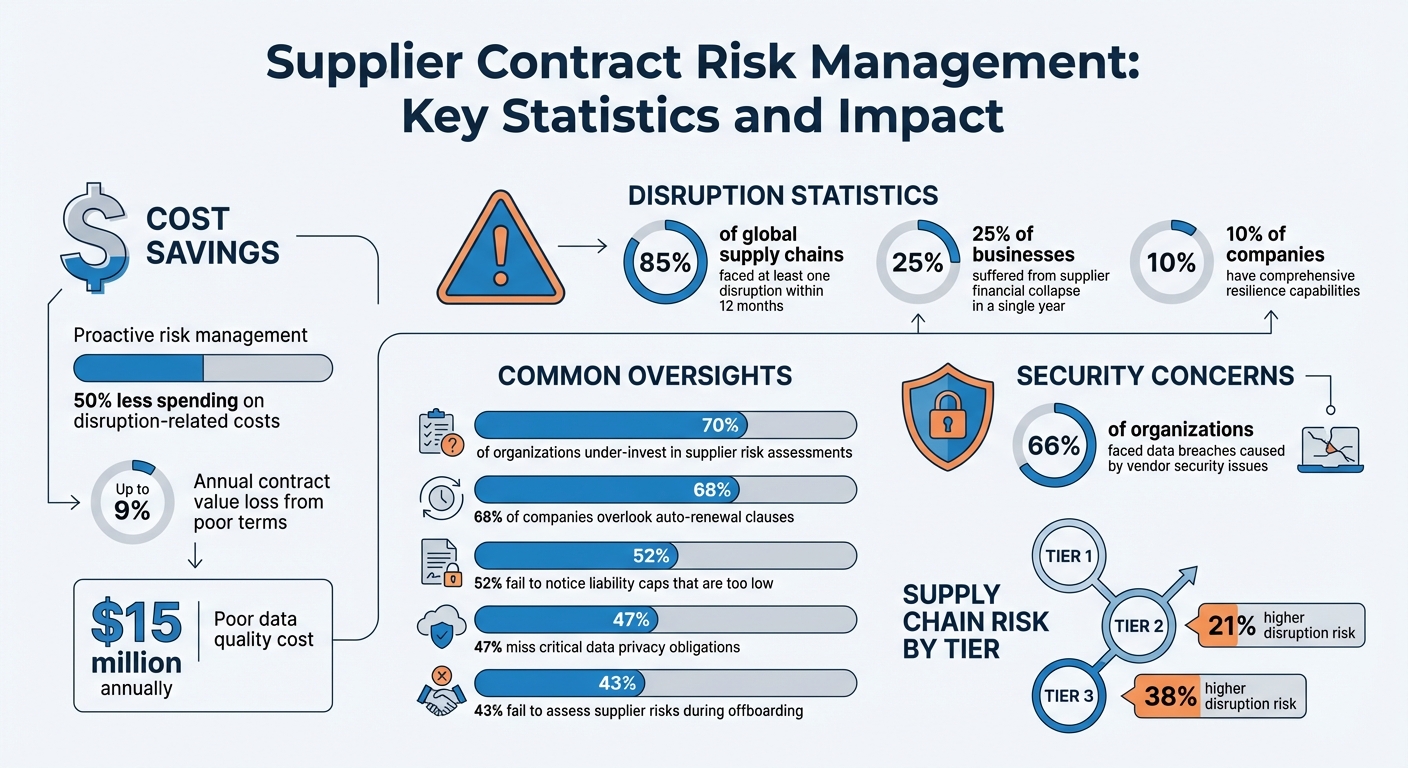
Supplier Contract Risk Management: Key Statistics and Impact
Webinar: Supplier Risk Mitigation Through Contracting
sbb-itb-97ecd51
Common Supplier Contract Risks
Supplier contracts come with a variety of risks that, if left unchecked, can disrupt acquisitions and daily operations. Identifying these risks early can save your business from costly setbacks.
Financial and Operational Risks
Financial risks often start with supplier insolvency - when a vendor can't meet their obligations due to poor cash flow, overwhelming debt, or economic instability. Price fluctuations add another layer of unpredictability, with factors like inflation, currency changes, or tariffs driving sudden cost increases. Billing fraud is another concern, including duplicate charges, inflated markups, or misuse of related-party transactions.
Operational risks can have a direct impact on your business. Delivery delays can stem from logistics breakdowns, material shortages, or unexpected events like natural disasters or geopolitical tensions. Quality issues arise when suppliers provide subpar goods, potentially affecting your end product. Additionally, capacity limitations can become a problem if a vendor is unable to scale production to meet growing demand or adapt to changing business needs.
"Effective supplier risk management serves as a vital shield against supply chain disruptions that can severely impact business operations." - GEP
Compliance and Regulatory Risks
Supplier contracts also carry regulatory risks that can result in penalties or tarnish your reputation. If a supplier violates environmental laws, labor standards, or industry-specific regulations, your company could face shared liability. These risks are particularly tricky when dealing with sub-tier suppliers, where transparency is often lacking. Expanding into new markets adds another layer of complexity. For example, working with state-owned entities or navigating unfamiliar local laws without proper due diligence can expose your organization to unexpected challenges. Companies that address these risks proactively spend 50% less on disruption-related costs compared to those that react after the fact.
Cybersecurity and Data Risks
Data security has become a growing concern in supplier contracts. Vulnerabilities within your supplier network can create hidden risks. The danger isn't limited to direct data breaches; it also includes the lack of visibility into tier-two and tier-three suppliers, where structured data is often unavailable. Poor IT security or mishandling of confidential information by a supplier can lead to far-reaching consequences, well beyond the immediate breach.
"The philosophy of risk management must transition from reactive firefighting to proactive management and reduction of risk exposure." - BCG
How to Assess Contract Risks
Spotting risks early is crucial when reviewing supplier contracts, as it can help avoid up to 9% in annual contract value loss due to issues like leakage and poorly aligned terms.
Supplier Due Diligence
Start your assessment by confirming the supplier's financial health. Review their business registration, good standing status, and Dun & Bradstreet (D&B) ratings. Dive into their financial statements and debt-to-equity ratios to ensure they can meet long-term commitments. A supplier struggling financially is unlikely to deliver, no matter how favorable the contract terms might seem.
Next, investigate their reputation and legal history. Check for any past disputes, litigation records, or Better Business Bureau (BBB) ratings. Verify industry references and confirm compliance with relevant standards, such as GDPR, HIPAA, or SOX. Ensure they hold all required licenses and permits.
Assess their operational capabilities to determine if they can meet your needs. Look at their track record for hitting delivery milestones and their quality control metrics, like "parts per million" defect rates. For cybersecurity, check for certifications like ISO 27001, SOC 2, or NIST - especially important since 66% of organizations have faced data breaches caused by vendor security issues.
Don’t forget to evaluate their supply chain. Identify their own vendors and watch for single-source dependencies or geographic risks that could create bottlenecks. Alarmingly, 70% of organizations have under-invested in supplier risk assessments, making this step all the more critical.
"Effective procurement function must closely collaborate with the company's risk management and business units." - Wolfgang Schnellbächer et al., Boston Consulting Group
Tier your suppliers based on their importance to your operations. Not every supplier requires the same level of scrutiny. Assign an "inherent risk score" (Critical, Medium, Low) based on factors like their access to sensitive data and operational impact. This helps you focus your resources wisely. Also, confirm that the person signing the contract has the legal authority to bind their company - this is a surprisingly common oversight.
Once you've vetted the supplier, turn your attention to reviewing the contract terms for potential risks.
Reviewing Contract Terms
Thoroughly reviewing contract terms is essential to catch risks that often arise from how clauses interact, not just from individual terms. For instance, a liability cap might lose its effectiveness if paired with overly broad indemnification language.
Avoid ambiguous language. Phrases like "best reasonable efforts" are too vague and can lead to disputes or unmet expectations. During reviews, 68% of companies overlook auto-renewal clauses, 52% fail to notice liability caps that are too low, and 47% miss critical data privacy obligations. These oversights can create vulnerabilities across your supplier agreements.
Pay close attention to clauses that directly impact your risk exposure, such as:
- Payment terms: Options like Net 30, 60, or 90 days affect cash flow. Look for early payment discounts.
- Liability caps: These should cover at least 12–24 months of fees. Be wary of "unlimited liability" clauses.
- Price escalation: Tie these to the Consumer Price Index (CPI) or set a cap (e.g., 3–5%) to avoid uncontrolled price hikes.
Include termination rights to protect yourself. "Termination for Convenience" with a 30–90 day notice period prevents vendor lock-in, while "Termination for Cause" safeguards against breaches or repeated SLA violations. Also, ensure you have audit rights to monitor the vendor's financial health and compliance with security standards like SOC 2 or ISO 27001.
| Risk Dimension | Key Terms to Review | Potential Hidden Risk |
|---|---|---|
| Financial | Price escalation, currency risks, tax responsibilities | Margin erosion, unexpected cost spikes |
| Legal | Indemnity, governing law, liability caps | Unlimited exposure, unfavorable jurisdictions |
| Operational | SLAs, KPIs, delivery milestones, subcontractors | Service disruptions, quality failures |
| Strategic | IP ownership, exclusivity, non-compete clauses | Vendor lock-in, loss of competitive advantage |
| Compliance | Data privacy (GDPR/CCPA), ESG, audit rights | Regulatory penalties, reputational damage |
"You don't need expensive software to quantify your contract risk... Even using a low-tech tool like Excel provides the ability to capture, track, and report on data." - Hebe Doneski, Founder, 108 Legal PLLC
After clarifying contract details, it's time to rate and prioritize the risks you've identified.
Risk Scoring and Prioritization
Once risks are identified, the next step is to rate and prioritize them based on their probability and potential impact. This ensures you focus on the most critical vulnerabilities while avoiding wasted resources on low-priority issues. Proactive risk management pays off - organizations that take this approach spend 50% less on managing supplier disruptions than those that reactively address issues.
Use a risk scoring matrix to evaluate risks by their likelihood and severity. For instance:
- Critical risks with high probability and impact require immediate mitigation before signing.
- High risks need negotiated changes or added protections.
- Medium risks should be monitored and adjusted as needed.
- Low risks can often be accepted and documented.
To ensure accountability, establish a risk register that catalogs each identified risk, its severity, and the corresponding mitigation plan. Many organizations are now turning to AI-powered Contract Lifecycle Management (CLM) tools that can extract clauses, compare them to standard playbooks, and assign risk levels - cutting the time to identify risks by up to 70%.
Beware of "threshold blindness", a common issue where businesses miss systemic risks across their portfolio. For example, if 60% of your contracts contain the same unfavorable clause, it creates a widespread vulnerability that needs immediate attention. Focus your most thorough reviews on high-value contracts (e.g., over $100,000) or those involving sensitive data access.
| Risk Level | Impact | Action Required |
|---|---|---|
| Critical | High | Immediate mitigation required before signing |
| High | Medium to High | Negotiate changes or add protective clauses |
| Medium | Medium | Monitor closely; consider minor adjustments |
| Low | Low | Accept risk and document the decision |
How to Reduce Supplier Contract Risks
Managing supplier contract risks effectively means addressing both their likelihood and potential impact. Companies that take a proactive approach to supply chain risks spend 50% less on handling supplier disruptions compared to those that only react after issues arise.
Working with Multiple Suppliers
Relying on just one supplier is risky. If that supplier fails, your entire operation could come to a standstill. To avoid this, consider working with multiple vendors.
Start by implementing a Request for Proposal (RFP) process to evaluate several vendors at once. This helps confirm their reliability and establishes relationships with backup suppliers in case your primary vendor falls through. Keep these runner-up vendors engaged as secondary options.
Transparency within your supply chain is also critical. Risks increase as you move further up the supply chain - Tier 2 and Tier 3 suppliers face 21% and 38% higher disruption risks, respectively. To address this, modify your supplier contracts or portals to require Tier 1 suppliers to share information about their upstream suppliers. For example, in 2023, a global brewery used AI to analyze rising costs of soda ash and industrial sand, predicting a shortage of molded glass vials. They responded by stockpiling materials, securing long-term contracts with secondary suppliers, and identifying alternative vendors with lower risk exposure.
Geographic diversification is another key strategy. By sourcing from different regions, you can protect your supply chain from disruptions caused by localized events like natural disasters, political instability, or regulatory changes.
While diversification lays the groundwork, protective contract clauses can further safeguard your business.
Adding Protective Contract Clauses
Including specific clauses in your supplier contracts can help transfer risk and provide flexibility in case of disruptions.
Termination rights give you the ability to exit agreements when needed. Negotiate a 30–90 day "Termination for Convenience" clause to avoid being locked in, even if it includes an exit fee. For critical contracts, avoid mutual termination rights - ensure vendors have longer notice periods while you retain shorter ones. Additionally, define clear material breach terms and shorten cure periods to expedite your exit if necessary.
Transition and portability clauses are essential for smooth operations. These clauses outline transition services, data portability, and associated fees from the start. Waiting until the end of a contract to negotiate these terms can lead to complications.
"A company should never rely exclusively on a vendor for data backup. Cyber incidents, insolvency, or natural disasters could result in permanent data loss." - Koley Jessen
Add pricing controls to ensure cost predictability. Negotiate specific periods where fees can't increase, enforce significant notice requirements for price hikes, and set percentage caps (typically 3–5%) on fee adjustments. For international contracts, include tariff adjustment clauses to share costs during regulatory changes, and flexible pricing triggers to renegotiate terms if trade policies or product availability shift significantly.
Indemnification clauses protect your company from third-party claims. One critical example is IP Infringement Indemnity, where the vendor assumes responsibility for legal fees and settlements if their service infringes on patents or copyrights. Ensure certain liabilities - such as IP infringement, data breaches caused by gross negligence, and confidentiality breaches - are either uncapped or have significantly higher limits than standard liability caps.
Force majeure clauses should address unforeseen financial liabilities from events like government actions or changes in law. Define the threshold as a "material effect on performance" rather than "impossibility" for better protection. Additionally, include key personnel clauses that name specific vendor staff critical to your project and give you veto rights if the vendor tries to reassign them to other accounts.
| Clause Type | Risk Mitigated | Recommended Action |
|---|---|---|
| Fee Increase Caps | Financial/Vendor Lock-in | Limit increases to a specific % or CPI index |
| Transition Assistance | Operational Continuity | Define services, data formats, and fees upfront |
| Audit Rights | Compliance/Security | Require periodic access to security and financial logs |
| Force Majeure | External/Regulatory | Explicitly include or exclude specific economic events |
| Key Personnel | Service Quality | Name specific staff and require approval for changes |
Even with strong contracts, it’s essential to have contingency plans in place.
Creating Backup Plans
Contracts alone can't prevent supplier failures. Backup plans ensure your operations continue smoothly, even during disruptions.
Start by identifying critical assets - the suppliers or components whose disruption would have the greatest impact on your business. Focus your backup planning on these areas. Surprisingly, only 10% of companies have developed comprehensive resilience capabilities to handle major supply chain disruptions, so this step puts you ahead of most competitors.
Maintain internal knowledge throughout your supplier relationships. Document workflows, system configurations, and integration points, so your teams can operate independently if needed. Regularly cross-train staff on vendor-managed processes to reduce reliance on external support during crises.
Buffer inventories of critical components can also provide breathing room. By stockpiling essential materials, you gain time to activate alternative sourcing options. Use early warning triggers like monitoring defect rates (e.g., parts per million) and financial health indicators (e.g., debt-to-equity ratios) to detect potential problems. These signals can prompt you to initiate contingency plans before a disruption escalates.
"The philosophy of risk management must transition from reactive firefighting to proactive management and reduction of risk exposure." - BCG
Finally, develop a detailed exit strategy. This should include protocols for retrieving data and protecting intellectual property. Use AI tools and simulation modeling to prepare for various failure scenarios, such as insolvency or natural disasters. A well-documented plan ensures you're ready to respond quickly and effectively when challenges arise.
Ongoing Contract Monitoring and Management
Signing a contract is just the beginning. In fact, 87% of procurement professionals emphasize the importance of ongoing supplier risk management, yet many still treat contracts as if they're set in stone. The reality is that supplier performance, market conditions, and business needs are constantly changing. Without regular oversight, you risk missing early warning signs of potential problems. This is where consistent performance tracking becomes essential.
Measuring Supplier Performance
To stay ahead of potential issues, focus on 5–10 key metrics that span operational, financial, compliance, and governance areas. These metrics can be grouped into four main categories:
- Operational: Metrics like on-time delivery rates or defect rates (e.g., Parts Per Million) help assess day-to-day performance.
- Financial: Look at factors such as invoice accuracy and whether cost savings are realized.
- Compliance: Track adherence to regulations and audit results.
- Governance: Monitor issue resolution times and how often contracts require changes.
The importance of each metric should align with the supplier's role in your business. For example, a supplier providing critical components might need monthly or quarterly evaluations with a strong focus on quality metrics. On the other hand, lower-risk vendors might only require annual reviews. Poor data quality costs companies approximately $15 million annually, so it’s worth standardizing scorecards and automating alerts to catch performance problems before they escalate.
"Review the contract results along with the supplier on regular basis gives the buyer an opportunity to give feedback on performance. Regular reviews give the buyer also the opportunity to hear from supplier updates on the market, potential issues/risks in the supply chain, technological advances, reduce the risk of contract and performance disputes." - Anca Toader, Director of Purchasing, Grup Feroviar Roman
Conducting Regular Contract Reviews
Contract reviews shouldn’t be scheduled based on convenience - they should be based on the level of risk. High-value or high-risk suppliers should have formal reviews at least quarterly, while lower-risk suppliers can be reviewed annually. Use a weighted scoring system that accounts for factors like the supplier’s value, contract complexity, and performance history to determine how often reviews should happen.
Set automated reminders 90, 60, and 30 days before contract expiration to avoid unintentional auto-renewals. During these reviews, assess the supplier’s financial health, ensure compliance with current regulations, and confirm that their capabilities still align with your business needs. For critical contracts, supplement desk reviews with on-site visits to verify production processes and safety standards that might not be evident in documentation. These regular evaluations help you prepare for timely renewals or structured exits.
Planning for Renewals and Exits
Regular reviews provide valuable insights for renewal strategies and help ensure smooth exits when necessary. Start planning for renewals 90–120 days in advance, and use an offboarding checklist to verify data return, revoke access, and maintain clear audit trails. This timeframe gives you the opportunity to benchmark market rates, renegotiate terms, or identify alternative suppliers if needed. Compare performance data against your key performance indicators (KPIs) and conduct a new financial health assessment - 43% of companies fail to actively assess supplier risks during offboarding, leaving themselves exposed to data breaches and incomplete transitions.
When ending a contract, require suppliers to provide certificates of data destruction or proof of data return before issuing final payment. Confirm that all deliverables have been met and keep detailed records of the transition. Remember, supplier risks don’t disappear when the contract ends. Obligations like data security and support often extend beyond the agreement’s official conclusion, making continued monitoring a necessity.
Conclusion
Supplier contract risks don’t just vanish when the ink dries - they linger throughout the relationship and can even resurface after the agreement ends. These risks evolve, requiring constant attention and well-thought-out strategies.
Consider this: 85% of global supply chains faced at least one disruption within a 12-month span. On top of that, 25% of businesses suffered due to a supplier's financial collapse in a single year. The difference between managing these challenges reactively versus proactively is stark - companies with a proactive approach spend 50% less handling supplier disruptions compared to those scrambling to react.
Shifting from a reactive mindset to proactive management isn’t just a smart move - it’s a financial necessity. Whether it’s performing initial due diligence, adding protective clauses to contracts, diversifying suppliers, or keeping a watchful eye even after a contract ends, each measure helps shield your operations from costly setbacks like production delays, emergency sourcing, or reputational harm. Alarmingly, 43% of companies fail to assess supplier risks during offboarding, leaving them vulnerable to data breaches and incomplete transitions that can erode long-term stability.
To strengthen your supply chain, prioritize your suppliers based on their risk levels and allocate resources accordingly. For instance, tier-two suppliers face 21% higher disruption risks than tier-one, while tier-three suppliers face a staggering 38% higher risk. Streamline your evaluation processes, embrace automated monitoring tools, and encourage collaboration across departments like procurement, legal, finance, and IT security. The aim isn’t flawlessness; it’s building a supply chain that can withstand disruptions.
Every step you take, from meticulous due diligence to active contract monitoring, adds another layer of protection to your risk management framework. These strategies not only safeguard your investments but also reinforce trust with stakeholders in an unpredictable business landscape.
At Kumo, we’re here to provide you with the tools and insights needed to refine your supplier management strategy at every stage of the acquisition process. Let’s build resilience together.
FAQs
What are the best ways to evaluate a supplier's financial stability?
To get a clear picture of a supplier's financial stability, start by digging into their audited financial statements and analyzing key metrics like the current ratio, quick ratio, debt-to-equity ratio, and profit margins. These numbers can give you a sense of their liquidity, profitability, and overall financial health. Comparing these figures to industry standards can help flag potential risks before they become major issues.
You might also want to check out third-party credit reports and payment history scores for an unbiased look at the supplier's creditworthiness. Tracking trends in their cash flow, earnings consistency, and capital expenditures over several years can offer deeper insights into how well they’re positioned to weather economic ups and downs.
For ongoing monitoring, tools like Kumo can streamline the process by pulling together financial data, credit updates, and AI-driven risk assessments into a single platform. Setting up real-time alerts can keep you informed about critical changes in the supplier's financial situation, helping you avoid unexpected disruptions.
What steps should I take to ensure supplier contracts comply with U.S. data privacy laws?
To keep supplier contracts aligned with U.S. data privacy laws such as the CCPA and CPRA, make sure to include a Data Protection Addendum (DPA) in the agreement. This addendum should outline the types of personal data being processed, the legal grounds for handling that data, and security measures like encryption and access controls. It’s also critical to require suppliers to notify you of any data breaches within a set timeframe (e.g., 72 hours) and to cooperate fully with any investigations.
When selecting vendors, perform a privacy risk assessment and review their compliance certifications, such as ISO 27001 or SOC 2. The contract should clearly allocate liability for any privacy violations, include indemnification clauses to cover fines and legal expenses, and require the supplier to carry sufficient cyber liability insurance - $5,000,000 is a common benchmark.
To maintain compliance over time, set up ongoing oversight measures. This can include scheduling regular audits, requiring periodic compliance reports, and retaining the right to terminate the contract if privacy standards aren’t met. Tools like Kumo, a centralized contract management platform, can help you monitor key deadlines and ensure that privacy requirements are consistently upheld across all supplier agreements.
How can I diversify my supplier base to minimize risks?
Diversifying your supplier base is a smart move to minimize risks and strengthen your supply chain. Start by taking a close look at your current network to pinpoint areas where you're overly reliant on a single supplier for critical components. Once you've identified these vulnerabilities, broaden your options by seeking out alternative suppliers from various regions or industries. This helps protect your operations from disruptions caused by natural disasters, regulatory shifts, or geopolitical challenges.
Leverage technology to make this process more efficient. Tools like deal-sourcing platforms can streamline your search for new suppliers. For instance, AI-driven search filters and deal alerts can uncover qualified vendors you might not have found otherwise, saving both time and effort. At the same time, don’t overlook the importance of nurturing your existing supplier relationships. Share your forecasts, collaborate on risk assessments, and negotiate flexible contracts that allow for quick pivots when necessary.
Keep a close eye on your supplier network with continuous monitoring. Set up alerts for potential issues, such as financial troubles or labor strikes, and regularly evaluate suppliers on factors like compliance and capacity. By blending proactive sourcing, solid partnerships, and vigilant monitoring, you can create a diversified supplier base that reduces risks and ensures your operations stay on track.