

Codely v2.0 public release is here
Lorem ipsum dolor sit amet, consectetur adipiscing elit lobortis arcu enim urna adipiscing praesent velit viverra sit semper lorem eu cursus vel hendrerit elementum morbi curabitur etiam nibh justo, lorem aliquet donec sed sit mi dignissim at ante massa mattis.
- Neque sodales ut etiam sit amet nisl purus non tellus orci ac auctor
- Adipiscing elit ut aliquam purus sit amet viverra suspendisse potent i
- Mauris commodo quis imperdiet massa tincidunt nunc pulvinar
- Adipiscing elit ut aliquam purus sit amet viverra suspendisse potenti
What has changed in our latest release?
Vitae congue eu consequat ac felis placerat vestibulum lectus mauris ultrices cursus sit amet dictum sit amet justo donec enim diam porttitor lacus luctus accumsan tortor posuere praesent tristique magna sit amet purus gravida quis blandit turpis.
All new features available for all public channel users
At risus viverra adipiscing at in tellus integer feugiat nisl pretium fusce id velit ut tortor sagittis orci a scelerisque purus semper eget at lectus urna duis convallis. porta nibh venenatis cras sed felis eget neque laoreet suspendisse interdum consectetur libero id faucibus nisl donec pretium vulputate sapien nec sagittis aliquam nunc lobortis mattis aliquam faucibus purus in.
- Neque sodales ut etiam sit amet nisl purus non tellus orci ac auctor
- Adipiscing elit ut aliquam purus sit amet viverra suspendisse potenti
- Mauris commodo quis imperdiet massa tincidunt nunc pulvinar
- Adipiscing elit ut aliquam purus sit amet viverra suspendisse potenti
Coding collaboration with over 200 users at once
Nisi quis eleifend quam adipiscing vitae aliquet bibendum enim facilisis gravida neque. Velit euismod in pellentesque massa placerat volutpat lacus laoreet non curabitur gravida odio aenean sed adipiscing diam donec adipiscing tristique risus. amet est placerat in egestas erat imperdiet sed euismod nisi.
“Nisi quis eleifend quam adipiscing vitae aliquet bibendum enim facilisis gravida neque velit euismod in pellentesque massa placerat”
Real-time code save every 0.1 seconds
Eget lorem dolor sed viverra ipsum nunc aliquet bibendum felis donec et odio pellentesque diam volutpat commodo sed egestas aliquam sem fringilla ut morbi tincidunt augue interdum velit euismod eu tincidunt tortor aliquam nulla facilisi aenean sed adipiscing diam donec adipiscing ut lectus arcu bibendum at varius vel pharetra nibh venenatis cras sed felis eget dolor cosnectur drolo.
Valuing a logistics business requires understanding its assets, earnings, and market conditions. Here's a quick guide:
-
Key Methods:
- Asset-Based: Focuses on physical assets like trucks and warehouses.
- Market Multiples: Compares your business to similar companies sold recently.
- Discounted Cash Flow (DCF): Projects future earnings and discounts them to present value.
-
Important Metrics:
- EBITDA: For mid-to-large firms, highlights operational profitability.
- SDE: For smaller firms, includes owner salary and personal expenses.
- Free Cash Flow (FCF): Shows cash left after operations and capital costs.
- Fleet Condition: Impacts maintenance costs and resale value.
-
Industry Factors:
- Fuel price volatility, regulatory compliance, and labor shortages affect valuation.
- Diversified customer contracts and geographic reach increase stability and value.
-
Final Steps:
- Use a combination of methods for a balanced valuation.
- Compare results to industry benchmarks to ensure accuracy.
This approach ensures you’re neither overpaying nor undervaluing a logistics business.
How to Value a Logistics Company in Nevada | Peak Business Valuation

Key Metrics and Data Needed for Valuation
When it comes to valuing a logistics business, having the right data is non-negotiable. Accurate financial and operational metrics form the backbone of any reliable valuation. While the specifics may vary based on the size and structure of the business, certain key metrics are universally important across the logistics industry.
Financial Metrics to Track
One of the most commonly used metrics for mid-to-large logistics firms is EBITDA (Earnings Before Interest, Taxes, Depreciation, and Amortization). This metric eliminates the noise of financing, taxes, and accounting adjustments, offering a clear view of operational performance. As Andrew Rogerson, a Certified M&A Advisor, explains:
"EBITDA business valuation method provides a raw picture of a trucking and logistics company's net income before accounting for other factors that affect the business's income, such as taxes, interest payments, and the depreciation of assets".
For smaller businesses, Seller's Discretionary Earnings (SDE) is often more relevant. This metric includes the owner's salary, benefits, and personal expenses to show the actual earnings a new owner could expect. Typically, SDE is used for businesses with earnings under $500,000, while EBITDA becomes the go-to metric for larger earnings.
Another critical metric is Free Cash Flow (FCF), which reveals the cash left after covering operational costs and maintaining capital assets. According to Terry Dickens and Jesse Proctor from Moss Adams:
"Most investors prefer reviewing income in the form of cash flow - typically free cash flow or EBITDA as a proxy - rather than accounting profits... which are more sensitive to accounting assumptions".
Lastly, Capital Expenditures (CapEx) should not be overlooked. These costs, tied to maintaining and upgrading equipment, signal the level of reinvestment needed to sustain operations.
| Metric | Best Used For | Why It Matters |
|---|---|---|
| EBITDA | Mid-to-large logistics firms | Highlights operational profitability independent of debt structure |
| SDE | Small owner-operated fleets | Reflects total take-home value for a new owner |
| Free Cash Flow | All business sizes | Shows actual cash generation after operations and CapEx |
| Book Value | Asset-heavy haulage firms | Ensures sale price reflects physical fleet value |
These financial metrics form the foundation for evaluating a business's financial health.
Operational Assets and Data
Financial data alone doesn’t tell the whole story. Operational factors also play a crucial role in determining value. For instance, fleet condition and maintenance records are critical. A well-maintained fleet reduces future repair costs and minimizes CapEx, while neglect can signal expensive problems ahead.
Employee retention is another key factor, especially in an industry grappling with labor shortages. The American Trucking Associations reports a current shortfall of over 80,000 truck drivers, making driver and warehouse worker retention rates a vital consideration.
Customer concentration is a potential risk to watch for. Businesses heavily reliant on just a few clients face greater financial vulnerability, which can negatively impact valuation. For companies with significant storage operations, regular Machinery and Equipment (M&E) appraisals are also essential, particularly when assets are used as loan collateral.
Technology adoption is another factor that can significantly influence operational value. Companies that utilize logistics software for route optimization, inventory management, and transaction execution often see improved efficiency and profit margins compared to those relying on manual processes.
Strong operational assets, paired with smart technology use, can enhance a company's overall value.
Market Conditions and Industry Factors
External forces like fuel prices, regulatory demands, and broader economic trends also shape a business's valuation. Fuel price volatility is a recurring challenge in logistics, as fluctuating costs make it harder to predict future cash flows. GCF Valuation highlights this issue:
"Fuel costs represent one of the most volatile variables in this industry, making future projections challenging".
Regulatory compliance adds another layer of complexity. Meeting Department of Transportation (DOT) and Federal Motor Carrier Safety Administration (FMCSA) standards often requires dedicated resources, increasing labor costs. This is one reason why profit margins in transportation and warehousing rarely exceed 20% of revenue.
Broader economic trends also play a role. Total e-commerce revenue is expected to grow by 8.6% annually through 2026, driving demand for logistics services. However, rising interest rates in 2022 and 2023 have placed downward pressure on valuation multiples across the transport sector.
Karen R. Shenk, CPA and CVA at Trout CPA, sums it up:
"In the trucking industry, for instance, multiples may be affected by regulatory changes, significant changes in economic conditions, fuel price volatility, labor shortages, or advances in fleet technology".
A business’s valuation is influenced not only by its internal metrics but also by how it navigates these external challenges.
3 Methods for Valuing a Logistics Business
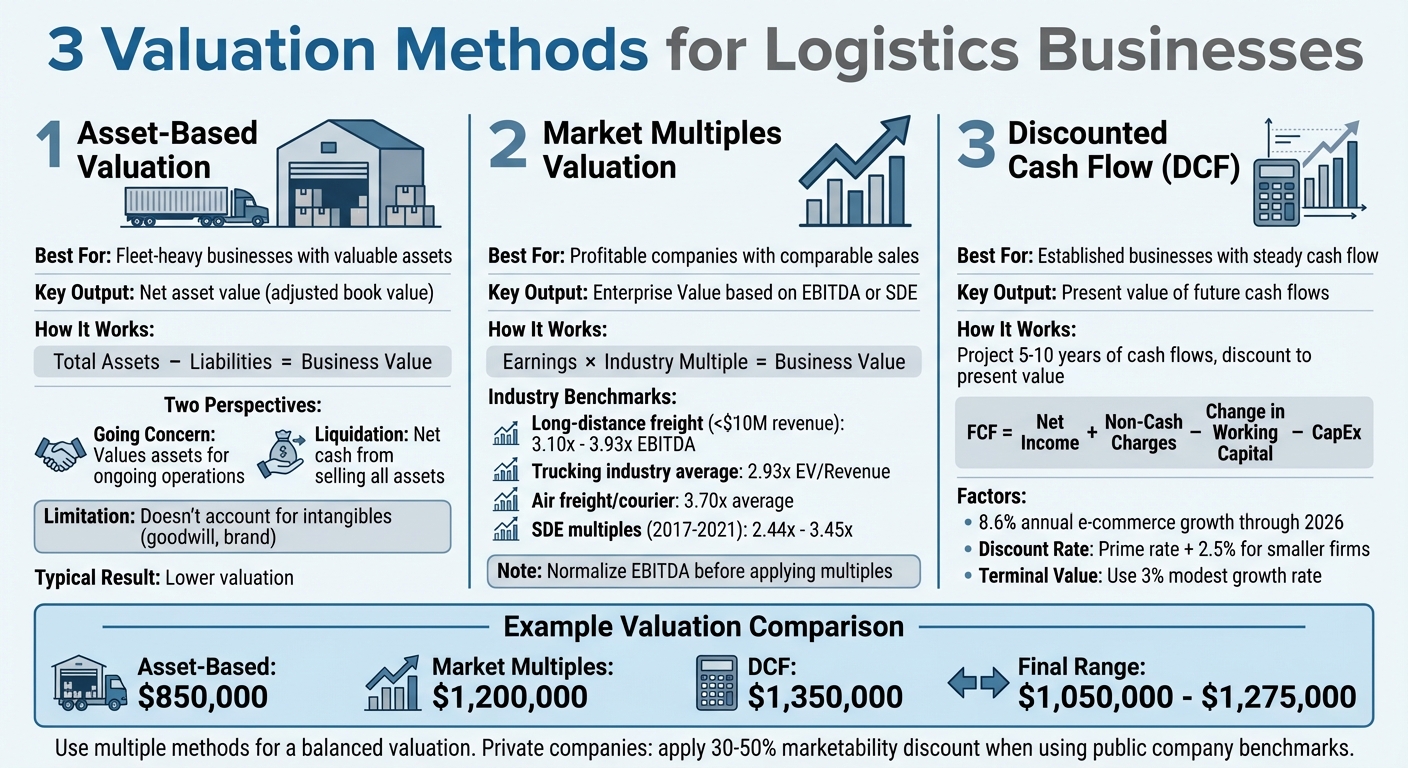
3 Methods for Valuing a Logistics Business: Comparison Guide
After gathering your financial and operational data, the next step is to apply specific valuation methods. These methods take the raw data and translate it into meaningful valuation figures. Each approach offers a unique perspective, providing a more rounded understanding of your logistics business's worth.
Asset-Based Valuation
This method calculates value by subtracting liabilities from the total asset value. It’s particularly effective for logistics companies where physical assets, like fleets and equipment, often hold more value than the cash flow they generate. Instead of relying on historical costs, this approach uses an adjusted book value to reflect current market conditions. For example, if you purchased a warehouse in 2018 for $800,000 and it’s now worth $1.2 million, the updated value should be used.
There are two main perspectives here:
- Going Concern: Assumes the business will continue operating, valuing assets based on their ongoing utility.
- Liquidation: Estimates the net cash from selling all assets and paying off debts.
As Rogerson Business Services explains:
"With this business valuation method, your trucking company's selling price will be based more on the adjusted book value, the market value, than how much money it puts in the owners' pockets".
One limitation of this method is that it doesn’t account for intangibles like brand reputation or customer relationships (often referred to as "goodwill"). As a result, it typically yields a lower valuation. For businesses reliant on heavy machinery or warehousing, regular appraisals of equipment and machinery are advisable, especially if your balance sheet is used as collateral for loans.
Market Multiples Valuation
The market multiples method takes a different approach by comparing your business to similar companies that have recently been sold. It applies industry-specific multiples to your earnings, offering a valuation based on market trends.
For mid-to-large logistics firms, EBITDA multiples are commonly used, while smaller operations where the owner is actively involved often rely on SDE multiples. For instance, long-distance freight trucking companies with less than $10 million in revenue typically see EBITDA multiples ranging from 3.10x to 3.93x. As of December 2025, the average EV/Revenue multiple for the trucking industry is approximately 2.93x, with air freight and courier services averaging around 3.70x.
Before applying these multiples, normalize your EBITDA by adjusting for factors like owner compensation above market rates, personal expenses, and one-time costs. This ensures a more accurate comparison to industry peers.
Discounted Cash Flow (DCF) Valuation
The Discounted Cash Flow (DCF) method focuses on your business’s future earning potential. It projects cash flows over a 5- to 10-year period and discounts them back to their present value. Start by reviewing 3–5 years of financials to identify trends, then project future revenue based on historical growth and market dynamics. For example, you might factor in the expected 8.6% annual growth in e-commerce through 2026. Don’t forget to estimate expenses, including logistics-specific costs like fuel, insurance, and labor.
To calculate Free Cash Flow (FCF), use this formula:
FCF = Net Income + Non-Cash Charges (Depreciation & Amortization) – Change in Working Capital – Capital Expenditures.
Depreciation, being a non-cash charge, is added back to net income, but future depreciation should align with planned capital expenditures, such as fleet replacements. You’ll also need to determine your discount rate (WACC). For smaller firms, using the prime rate plus 2.5% is a common practice. Finally, calculate a terminal value using a modest growth rate, such as 3%.
While the DCF method requires more effort, it provides a detailed look at your business’s future earning potential. As Rogerson Business Services puts it:
"The DCF business valuation method basically determines the value of a logistics business's investment based on the money it can generate in the future".
| Valuation Method | Best For | Key Output |
|---|---|---|
| Asset-Based | Fleet-heavy businesses with valuable assets | Net asset value (adjusted book value) |
| Market Multiples | Profitable companies with comparable sales | Enterprise Value based on EBITDA or SDE |
| DCF | Established businesses with steady cash flow | Present value of future cash flows |
sbb-itb-97ecd51
Logistics-Specific Factors That Affect Valuation
Beyond the usual financial and operational metrics, there are unique logistics-specific elements that play a big role in determining valuation. These include factors like the condition of your fleet, strength of customer contracts, and the extent of your market reach. These elements help refine valuation insights, complementing traditional measures.
Fleet and Equipment Condition
The condition and age of your fleet directly influence both asset value and cash flow. Trucks and trailers are significant depreciable assets, and their upkeep impacts your overall valuation. A well-maintained fleet not only retains higher asset value but also contributes to better cash flow through improved fuel efficiency, reduced maintenance costs, and compatibility with modern systems like ELDs (Electronic Logging Devices) and route optimization tools.
Karen R. Shenk, CPA, CVA at Trout CPA highlights:
"multiples may be affected by regulatory changes, significant changes in economic conditions, fuel price volatility, labor shortages, or advances in fleet technology".
Outdated fleet technology can increase operating costs and reduce valuation. To counter this, maintain detailed records of repairs, engine overhauls, and maintenance schedules to demonstrate the extended life and reliability of your equipment. Such documentation not only helps stabilize financial projections but also reassures buyers about predictable future expenses. If the market value of your fleet surpasses its cash flow contributions, you might focus on an asset-based valuation rather than an income-based one. Fleet condition can also influence the stability of your contracts and your market reach, which we’ll explore next.
Contracts and Customer Relationships
Strong customer relationships and long-term contracts are key drivers of value. Companies with diversified revenue streams and high customer retention often achieve higher valuation multiples, typically falling in the 3x to 4x range. On the other hand, over-reliance on a single customer or a small group introduces significant risk, which can drag down valuation because losing just one contract could cause a major revenue hit.
A diverse customer base minimizes revenue risk. Shifting from informal "handshake agreements" to formalized long-term contracts can stabilize earnings projections and justify higher multiples during a sale.
| Factor | Impact on Valuation | Typical Multiplier Range |
|---|---|---|
| High Customer Concentration | Negative (High Risk) | 1.0x - 2.0x |
| Diverse Customer Base | Positive (Low Risk) | 2.5x - 4.0x |
| Long-term Contracts | Positive (Predictable) | 3.0x - 4.0x |
| Spot Market Reliance | Negative (Volatile) | 1.5x - 2.5x |
In addition to customer contracts, your company’s operational footprint significantly affects its valuation.
Geographic Coverage and Market Reach
The scope of your operations - whether regional, national, or global - has a direct impact on revenue stability and growth potential. Companies with established geographic coverage and consistent routes tend to generate more predictable cash flow, making them attractive for income-based valuations. However, a heavy concentration in one geographic area poses risks similar to customer concentration.
For context, the long-distance freight trucking industry is valued at around $239 billion, with e-commerce revenue expected to grow by 8.6% annually through 2026. Logistics companies that can tap into high-growth sectors across multiple regions usually command stronger valuations. For example, trucking companies sold between 2020 and 2024 reported a median revenue of $1,779,914 and an average earnings multiple of 3.01. By contrast, freight routes had a lower average multiple of just 1.84 due to their narrower focus.
Diversifying your client base across regions and services not only reduces risk but also enhances value. Companies offering multiple services and engaging with multiple industries tend to be more resilient and attractive to buyers than those dependent on a single route or customer segment.
How to Calculate Your Final Valuation
Using the asset-based, market multiples, and DCF methods discussed earlier, this section focuses on consolidating these insights into a final valuation range. Each method yields a different result, which is why professionals recommend using multiple approaches. As BizBuySell puts it:
"Valuing a business requires a multilayered approach, so owners combine more than one business valuation method to get to a realistic range".
Combining Multiple Valuation Methods
To determine your final valuation, assign weights to each method based on your business's unique characteristics. For instance, if you run a profitable logistics company with steady growth and strong customer contracts, market multiples might carry more weight. This method reflects what buyers are currently paying for similar businesses, while the discounted cash flow (DCF) method helps confirm the valuation by looking at future financial projections. On the other hand, asset-heavy trucking companies with large fleets may rely more on asset-based valuations.
For context, freight trucking companies with revenues under $10 million reported SDE multiples ranging from 2.44x to 3.45x between 2017 and 2021. If your valuation falls far outside these ranges, you’ll need to justify why your business deserves a premium or discount. Use this integrated range as a foundation for comparing your valuation to industry benchmarks in the next step.
Building a Valuation Comparison Table
Creating a side-by-side comparison table can clarify your results and highlight which method aligns best with your business. Here's an example:
| Valuation Method | Result | Best For | Key Limitation |
|---|---|---|---|
| Asset-Based | $850,000 | Companies with large fleets and equipment | Ignores future earning potential and goodwill |
| Market Multiples (EBITDA) | $1,200,000 | Established firms with steady profitability | Requires comparable recent sales data |
| Discounted Cash Flow | $1,350,000 | Businesses with predictable contracts | Relies heavily on future projections |
| Valuation Range | $1,050,000 - $1,275,000 | Final negotiation range | - |
In this scenario, the market multiples and DCF methods - given more weight - lead to a final range of $1,050,000 to $1,275,000. For private logistics companies, remember to apply a marketability discount of 30% to 50% when using benchmarks from publicly traded companies. After comparing methods, verify the range by referencing industry benchmarks.
Checking Your Valuation Against Benchmarks
Before finalizing your valuation, compare it to industry standards. Begin by normalizing your earnings - convert your income statement into Seller's Discretionary Earnings (SDE) by adding back non-recurring expenses and personal perks, such as family travel or personal vehicle use. Then, review recent sales of similar businesses in your market and region. In 2024, the national average for all businesses was 2.57x annual earnings and 0.67x annual revenue.
If your valuation differs significantly from these averages, be prepared to explain the discrepancy. Factors like exceptional driver retention, efficient fuel cost management, or niche services can justify higher multiples. For more complex valuations, consider hiring a professional with an Accredited in Business Valuation (ABV) designation.
Conclusion
Determining the value of a logistics business isn’t just about crunching numbers - it’s about maintaining accurate, GAAP-compliant records to ensure precise calculations for SDE and EBITDA. These figures, combined with industry multiples, provide a solid foundation for valuation.
Each method of valuation brings something different to the table. By using a combination of approaches, you can achieve a more balanced and reliable estimate. As Jan H. Raymond from Logisyn Advisors points out, averaging multiple methods helps offset the strengths and weaknesses of each. For instance, the asset-based method focuses on the tangible value of your fleet, market multiples show what buyers are paying for similar businesses, and discounted cash flow highlights your future earning potential. Together, these methods produce a well-rounded valuation, offering a defensible range rather than a single, potentially misleading figure.
Beyond the numbers, industry-specific factors play a crucial role in refining your valuation. Strong customer relationships and diversified contracts lower risk. The condition of your fleet affects capital expenditure forecasts, and operational metrics like Days Sales Outstanding (around 40 days) and a Gross Profit Margin of about 16% reveal how effectively your business is managed.
Operational independence is another critical factor in maintaining value. A structured management team and documented processes show that the business can run smoothly without heavy reliance on the owner, reducing risk for potential buyers. Jason Burns of Dropoff recommends consulting with specialized advisors to fine-tune your valuation estimates.
FAQs
What are the key factors that impact the valuation of a logistics business?
The value of a logistics business hinges on several important elements, including financial performance, operational strengths, and market dynamics. Financial metrics like revenue, profit margins, and EBITDA (earnings before interest, taxes, depreciation, and amortization) are especially critical. To estimate a company's worth, EBITDA multiples are often used - larger companies or those with steady profitability generally achieve higher multiples.
But it’s not all about the numbers. The range of services and asset quality also carry significant weight. Companies that provide end-to-end supply chain solutions - such as warehousing, freight forwarding, and last-mile delivery - are typically valued more highly than those focusing on niche services. Investments in modern tools, like real-time tracking systems or AI-based routing, along with well-maintained equipment, can further enhance a business's appeal.
Growth potential and market conditions also play a big role. Factors like securing long-term customer contracts, entering fast-growing sectors like e-commerce, or taking advantage of favorable industry trends can drive up valuation. Broader economic influences, including fluctuating fuel prices and changes in regulations, also impact how buyers perceive value. Platforms like Kumo simplify the process of identifying logistics businesses with strong financials and promising growth, making it easier to assess acquisition opportunities.
How does the condition of a fleet affect the valuation of a logistics business?
The state of a fleet is a key factor in shaping the value of a logistics business. A modern, well-kept fleet is considered a strong asset, boosting the company’s value by minimizing operational risks and drawing interest from potential buyers. On the flip side, an older or neglected fleet can hurt the business’s worth due to increased maintenance expenses, lower efficiency, and possible safety issues.
Committing to regular maintenance and upgrading vehicles as needed doesn’t just improve daily operations - it also enhances the company’s standing in the market and makes it more appealing to investors or buyers.
Why should you use multiple valuation methods when assessing a logistics business?
Using several valuation methods is crucial because each one sheds light on different facets of a logistics business, such as earnings, assets, and future growth possibilities. By leveraging multiple approaches, you can develop a more complete and precise picture of the business’s actual worth.
Depending solely on one method might result in an incomplete or biased estimate. Cross-referencing results from various methods helps factor in industry-specific nuances, ensuring you make better-informed decisions - whether you're buying, selling, or investing in a logistics business.