

Codely v2.0 public release is here
Lorem ipsum dolor sit amet, consectetur adipiscing elit lobortis arcu enim urna adipiscing praesent velit viverra sit semper lorem eu cursus vel hendrerit elementum morbi curabitur etiam nibh justo, lorem aliquet donec sed sit mi dignissim at ante massa mattis.
- Neque sodales ut etiam sit amet nisl purus non tellus orci ac auctor
- Adipiscing elit ut aliquam purus sit amet viverra suspendisse potent i
- Mauris commodo quis imperdiet massa tincidunt nunc pulvinar
- Adipiscing elit ut aliquam purus sit amet viverra suspendisse potenti
What has changed in our latest release?
Vitae congue eu consequat ac felis placerat vestibulum lectus mauris ultrices cursus sit amet dictum sit amet justo donec enim diam porttitor lacus luctus accumsan tortor posuere praesent tristique magna sit amet purus gravida quis blandit turpis.
All new features available for all public channel users
At risus viverra adipiscing at in tellus integer feugiat nisl pretium fusce id velit ut tortor sagittis orci a scelerisque purus semper eget at lectus urna duis convallis. porta nibh venenatis cras sed felis eget neque laoreet suspendisse interdum consectetur libero id faucibus nisl donec pretium vulputate sapien nec sagittis aliquam nunc lobortis mattis aliquam faucibus purus in.
- Neque sodales ut etiam sit amet nisl purus non tellus orci ac auctor
- Adipiscing elit ut aliquam purus sit amet viverra suspendisse potenti
- Mauris commodo quis imperdiet massa tincidunt nunc pulvinar
- Adipiscing elit ut aliquam purus sit amet viverra suspendisse potenti
Coding collaboration with over 200 users at once
Nisi quis eleifend quam adipiscing vitae aliquet bibendum enim facilisis gravida neque. Velit euismod in pellentesque massa placerat volutpat lacus laoreet non curabitur gravida odio aenean sed adipiscing diam donec adipiscing tristique risus. amet est placerat in egestas erat imperdiet sed euismod nisi.
“Nisi quis eleifend quam adipiscing vitae aliquet bibendum enim facilisis gravida neque velit euismod in pellentesque massa placerat”
Real-time code save every 0.1 seconds
Eget lorem dolor sed viverra ipsum nunc aliquet bibendum felis donec et odio pellentesque diam volutpat commodo sed egestas aliquam sem fringilla ut morbi tincidunt augue interdum velit euismod eu tincidunt tortor aliquam nulla facilisi aenean sed adipiscing diam donec adipiscing ut lectus arcu bibendum at varius vel pharetra nibh venenatis cras sed felis eget dolor cosnectur drolo.
Negotiating an SMB acquisition isn’t just about agreeing on a price - it’s about managing concessions wisely. Every adjustment you make, whether on price, terms, or support, directly affects the value of your investment. Give too much, and you risk overpaying or accepting poor terms. Offer too little, and the deal could fail.
Here’s what you need to know:
- Concessions are tools, not losses: Tie every concession to a clear benefit. For example, agree to a higher price only if the seller provides financing or extended support.
- Preparation is key: Research the business thoroughly, understand the seller’s motivations, and define your boundaries (e.g., maximum price, acceptable terms) before negotiations.
- Start small: Offer incremental concessions to maintain leverage and momentum. Always label concessions clearly and expect reciprocity.
- Creative deal structures help: Consider earn-outs, seller financing, or equity rollovers to bridge gaps without raising the upfront price.
- Track and document everything: Keep a record of all concessions and confirm agreements in writing to avoid confusion or last-minute changes.
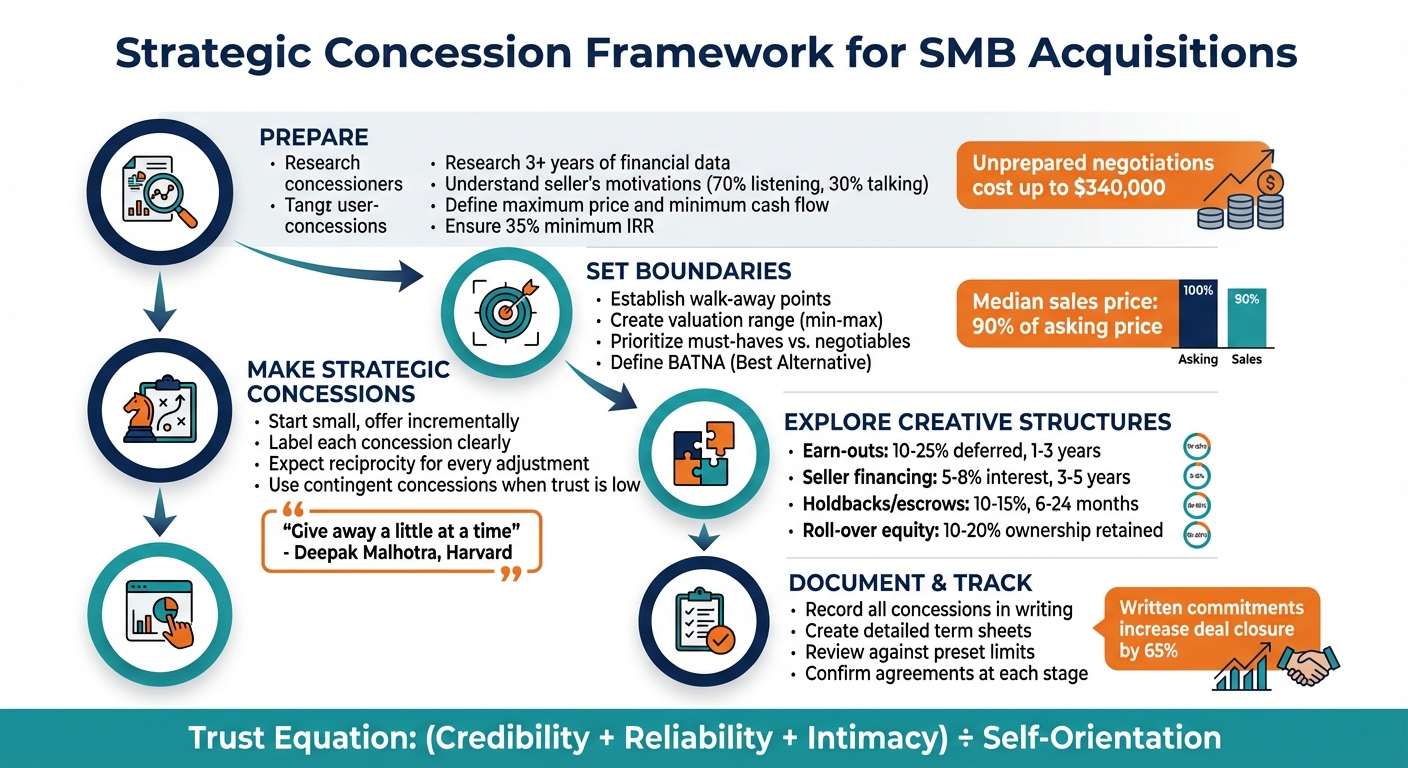
5-Step Framework for Balancing Concessions in SMB Acquisitions
The Role of Concessions in Deal Negotiations
What Concessions Mean in SMB Acquisitions
In the world of small and medium-sized business (SMB) acquisitions, concessions are the adjustments made to deal terms to close the gap between what buyers want and what sellers are willing to accept. These adjustments can cover a wide range of areas, including the purchase price, financing terms, payment schedules, asset inclusions, training commitments, or non-compete agreements. Essentially, concessions are the backbone of the give-and-take process that helps both parties find common ground.
Negotiations often involve conflicting priorities. Buyers aim for lower prices and more favorable terms, while sellers focus on protecting the business's value and maximizing their payout. Historically, the median sales price for businesses sold across the U.S. has hovered around 90% of the median asking price, showing just how central compromise is to the process. When pricing becomes a sticking point, alternative strategies like earnouts, seller financing, or retention agreements can add value without impacting the headline price.
Understanding how concessions work sets the stage for exploring strategies to use them effectively.
Core Principles for Making Concessions
One fundamental rule in negotiation is reciprocity: every concession you make should yield a benefit in return. As Deepak Malhotra, a Harvard Business School professor, explains:
"Concessions are often necessary in negotiation... But they often go unappreciated and unreciprocated".
To avoid this, clearly label each concession you offer and specify the benefit you expect in return. For instance, if trust between parties is shaky, you could tie your concession to a specific action from the seller. You might say, "I’ll agree to this price, but only if you provide 20% seller financing". This ensures that your concession translates into something valuable for you, rather than simply making things easier for the other side.
Another effective tactic is to deliver concessions in smaller, incremental steps. Research shows that people respond more favorably when positive developments are spread out, which can help maintain momentum without giving away too much. Finally, it’s critical to establish your walk-away points - both on price and terms - before negotiations begin. This helps prevent impulsive decisions that could lead to overconceding.
sbb-itb-97ecd51
How To Actually Negotiate Business Acquisitions (Step By Step)
Prepare Your Negotiation Strategy Before Discussions Begin
To succeed in negotiations, preparation is everything. Without it, you risk leaving money on the table - or worse, overpaying. In fact, unprepared negotiations can result in concessions costing as much as $340,000. Laying the groundwork ahead of time ensures every concession you make is deliberate and tied to tangible value.
Research the Business and What Motivates the Seller
Start by diving into the numbers. Analyze at least three years of financial data, including income statements, balance sheets, and cash flow statements, to get a solid grasp of the business's value. For owner-operated businesses, focus on Seller's Discretionary Earnings (SDE), which reveals the true income potential. Use multiple valuation methods - like EBITDA multiples, asset-based calculations, and market comparisons - to establish a realistic valuation range. As Clearly Acquired puts it:
"Knowing what a business is truly worth turns negotiation from a tug-of-war into a math problem you can both solve."
But numbers alone don’t tell the whole story. Dig deeper into the seller’s motivations. Are they retiring? Facing health challenges? Burnt out? Or maybe they’re eager to start a new venture[1, 18, 19]. Emotional factors matter, too. Many sellers are deeply invested in their businesses and care about their employees and the legacy they’ve built[1, 5]. By adopting a 70/30 listening approach - listening 70% of the time and talking only 30% - you can uncover what truly matters to them. The better you understand their motivations, the easier it is to structure proposals that align with their goals while protecting your bottom line.
Define Your Objectives and Walk-Away Points
Once you’ve gathered all the data, it’s time to set clear boundaries. Before entering negotiations, decide on your maximum purchase price and minimum acceptable cash flow[1, 10]. As Elliott Holland from Written By advises:
"Decide your limits ahead of time when you have a clear head... Thinking through your strategy will help you abide by your own rationale rather than impulsively making poor decisions."
Instead of locking yourself into a single figure, create a valuation range with a minimum and maximum price. This not only gives you flexibility but also keeps your decisions grounded. Remember, price isn’t the only factor. Consider other deal terms like seller financing, earn-outs, non-compete clauses, and protections against post-closing issues. When setting your maximum price, make sure the deal still delivers at least a 35% Internal Rate of Return (IRR) to leave room for adjustments during negotiations.
Prioritize what matters most to you. Identify your "must-haves" versus areas where you’re willing to compromise[1, 20]. For example, you might agree to retain a seller’s family member or extend the transition period in exchange for a lower price or better financing terms. Finally, determine your Best Alternative to a Negotiated Agreement (BATNA) - your fallback plan if the deal doesn’t work out[11, 21]. Having these boundaries in place ensures you can negotiate confidently while keeping concessions strategic and purposeful.
How to Offer Concessions During Negotiations
With your goals and boundaries clearly defined, the next step is to approach concessions with strategy. Once negotiations are underway, how you offer concessions can be just as important as what you concede. The objective is to demonstrate flexibility while holding onto leverage. This requires making sure every concession is acknowledged, valued, and reciprocated by the other party. With this in mind, let’s explore how to execute concessions effectively and keep track of them throughout the process.
Make Small Concessions to Build Progress
Start small - don’t give away your best offer upfront. For example, if you’re prepared to increase your bid by $40,000, begin with a $30,000 adjustment and save the remaining $10,000 for later. Breaking larger concessions into smaller steps can help you preserve your negotiation power. As Malhotra puts it:
"When you give away a little at a time, you might get everything you want in return before using up your entire concession-making capacity. Whatever is left over is yours to keep."
Incremental moves like these not only show flexibility but also create momentum. However, it’s critical to label each concession clearly. Use language that highlights the effort behind your offer, such as: “This wasn’t an easy adjustment, but we’ve made changes to the price to address your concerns.” This ensures the other party understands the value of your concession. Without this clarity, there’s a risk they’ll undervalue your effort.
Once you’ve labeled your concession, set clear expectations for reciprocity. For instance, you might say, “We’ve adjusted the price; in return, we expect more flexibility on the closing date”. If you don’t communicate these expectations, you leave the door open for the other party to decide what’s fair - which may not align with your interests.
In situations where trust is low, consider offering contingent concessions. For example, you could say, “We can adjust the price if you agree to a longer transition period”. Conditional offers like these help protect your interests while still moving the negotiation forward.
Track All Concessions as Negotiations Progress
Once you’ve started offering concessions, it’s equally important to keep a close eye on their cumulative impact. Negotiations can become complex, and it’s easy to lose track of what’s already been offered. Overlooking these details could cost you significant amounts of money. Keep a detailed record of every adjustment, whether it’s related to price, financing terms, timelines, or employee agreements.
This tracking isn’t just for organization - it also protects you from “re-trading.” This is when the other party tries to renegotiate terms at the last minute, after you’ve already made several concessions.
To safeguard against this, confirm key terms in writing at every stage of the negotiation. For example, once a party agrees to terms in a letter of intent or similar document, they’re 65% more likely to follow through with the deal. Written commitments hold both sides accountable and help you stay clear on what’s already been agreed upon. Without documentation, you might find yourself blindsided by the cumulative effect of your concessions when it’s too late to walk away.
Finally, stick to your pre-set limits. Before agreeing to any new terms, compare them against the objectives and thresholds you established during your preparation. For instance, ensure the deal still meets a 35% internal rate of return and aligns with your original goals. Tracking isn’t just about keeping records - it’s about staying disciplined and avoiding hasty decisions under pressure.
Use Alternative Deal Structures to Close Gaps
When negotiations hit a snag over price, consider shifting the discussion toward creative deal structures. Instead of focusing solely on upfront cash, look at the total package - cash, deferred payments, and other benefits. This approach helps maintain your negotiation leverage while ensuring both sides find value in the deal. These methods not only help resolve valuation disagreements but also set the stage for a collaborative relationship after the deal is closed.
Alternative Structures for Making Concessions
Earn-outs are a popular method to defer a portion of the purchase price, typically 10% to 25%, tying the payment to future performance targets like revenue or EBITDA over one to three years. For instance, if you’re buying a business valued at $2 million but can’t agree on the price, you could pay $1.6 million upfront and defer $400,000, contingent on meeting specific revenue milestones. Revenue-based metrics are often preferred over EBITDA for earn-outs. As David Tobin, Founder of TobinLeff Advisors, points out:
"These top-line metrics are less controllable by new ownership. You're concerned about whether you truly control the P&L statement during the earnout period".
Seller financing is another option, where the seller provides a loan for part of the purchase price, typically at 5% to 8% interest, over three to five years. This keeps the seller invested in the business’s future success.
Holdbacks and escrows involve setting aside 10% to 15% of the purchase price with a neutral third party for six to 24 months. These funds are used to cover any post-closing liabilities. Other creative options include royalty agreements or above-market rent, which align the interests of both parties without altering the headline price.
Keep the Seller Engaged After the Sale
Beyond financial terms, structuring the deal to keep the seller involved can significantly boost the business’s long-term success. Retention agreements and transition plans are effective ways to tie the seller’s ongoing role to the company’s post-sale performance. For example, if the seller stays on as a consultant or employee during an earn-out period, they have a direct incentive to help achieve performance goals. Ryan Hammon of Cronkhite Capital highlights this approach:
"Maintaining equity ownership may be appropriate when a seller anticipates staying involved as a board member, executive, or consultant after the sale".
Roll-over equity is another strategy, allowing the seller to retain 10% to 20% ownership in the business. This aligns their interests with the buyer’s for a future exit, especially in cases where the seller plans to stay involved. For larger small-to-medium businesses (SMBs) with EBITDA exceeding $2 million, equity rollovers are increasingly replacing earn-outs as the go-to structure. To avoid potential conflicts, it’s crucial to establish clear expectations about the seller’s role, decision-making authority, and exit timeline from the outset.
Build Trust to Enable Reciprocal Concessions
Trust is the backbone of successful negotiations, especially when aiming for reciprocal concessions. Sellers are far more likely to compromise when they trust you. A helpful way to think about trust is through the Trust Equation: trust equals (Credibility + Reliability + Intimacy) divided by Self-Orientation. Here's how it breaks down:
- Credibility shows you have the financial capability to close the deal.
- Reliability reflects your consistent follow-through on commitments.
- Intimacy demonstrates that you truly understand the seller's unique needs and priorities.
When sellers feel you're prioritizing their concerns over self-interest, trust grows, paving the way for smoother negotiations. Research even shows that a structured negotiation process can significantly increase post-acquisition success. Plus, once terms are committed to writing, parties are 65% more likely to follow through. This psychological commitment helps both sides work collaboratively toward finalizing the deal. Trust is the cornerstone that supports all strategies for achieving reciprocal concessions.
Maintain Open Communication with the Seller
Building rapport early in the process creates a positive foundation for negotiations. Visiting the seller's headquarters early on can provide valuable insights into their company culture and motivations. During discussions, practice active listening: focus on what the seller is saying, ask clarifying questions, and summarize their key points to show understanding. Jacob Orosz, President of Morgan & Westfield, offers this perspective:
"It's easier to work out problems with a friend than a foe."
Approach negotiations as a shared challenge - "us vs. the problem" - instead of a head-to-head battle. This mindset can reduce defensive reactions by as much as 34%. After presenting a proposal, embrace strategic silence. This often encourages the seller to share more or even make a counter-concession, revealing their true priorities.
Also, avoid making unacknowledged compromises, like rounding numbers in the seller's favor without pointing it out. Every concession should be visible and acknowledged. With open communication established, you’ll be better positioned to align your proposals with what matters most to the seller.
Frame Your Proposals Around Mutual Benefits
When presenting concessions, frame them as solutions that address the seller's key concerns. Many small business owners care deeply about their employees' job security and their brand's legacy - sometimes just as much as the sale price. Tailoring your proposals to these emotional priorities can strengthen trust and build a more collaborative relationship. For instance, if you're negotiating a lower purchase price, explain how the savings will be reinvested to protect jobs and grow the business.
Make sure to label each concession clearly. Harvard Business School Professor Deepak Malhotra emphasizes:
"Concessions are often necessary in negotiation... But they often go unappreciated and unreciprocated."
For example, explicitly state, "We're offering a 5% discount in exchange for faster payment terms", and diplomatically outline what you expect in return. Breaking a larger concession into smaller steps can also make the seller feel like they’re gaining multiple wins, while protecting your negotiation leverage.
Document Agreements and Maintain Discipline
After building trust and making headway through concessions, it’s crucial to document every agreement. Written agreements aren’t just formalities - they create a sense of commitment, boosting the chances of closing a deal by 65%. They also prevent misunderstandings and reinforce accountability, laying the foundation for precise term sheets and disciplined decision-making as negotiations progress.
One of the most important reasons for documentation is to avoid silent concessions. These occur when adjustments - such as rounding numbers in the seller’s favor or agreeing to flexible payment terms - are made without explicit acknowledgment. Jacob Orosz, President of Morgan & Westfield, highlights this point:
"Never make a silent concession. In other words, never give the buyer something without them being aware of it."
Without proper documentation, silent concessions can weaken your position and erode leverage.
Create and Review Term Sheets
A term sheet, often called a Letter of Intent (LOI), acts as the technical blueprint for the deal. While most provisions in an LOI (about 90%) are non-binding, they establish the framework for the final purchase agreement. The term sheet should clearly define material terms, including:
- Purchase price and consideration structure: Specify details like cash at close, seller notes, or earnouts.
- Price adjustments: Include exact formulas for working capital and debt/cash adjustments.
- Indemnification provisions: Outline liability caps and survival periods.
- Conditions to closing: Address financing and regulatory approvals.
Avoid vague language. Ambiguity can lead to costly disputes, with legal fees averaging $127,000 to resolve such issues. For instance, instead of saying "reasonable working capital", use a precise formula like: "Purchase price will be adjusted dollar-for-dollar based on the difference between actual working capital at closing and a predefined target".
Track changes diligently by maintaining version control. This ensures every new term aligns with your predetermined boundaries and avoids confusion as the deal evolves.
Review Your Limits Before Accepting New Terms
When new terms are introduced, take a step back to evaluate them against your original limits. Elliott Holland from Guardian Due Diligence advises:
"Decide your limits ahead of time when you have a clear head. No matter how much planning you do, it can be hard to stick to your limits when under pressure."
If unexpected terms arise, don’t feel pressured into immediate decisions. Instead, request time to compare the proposal with your preset walk-away points and maximum concession levels. This approach ensures you remain disciplined and deliberate in your decision-making.
To uphold discipline, consider using contingent escalation. For example, you might agree to a higher offer if a Quality of Earnings review verifies that EBITDA meets a specific threshold. By tying concessions to concrete milestones, you can protect your interests while keeping negotiations on track.
Conclusion
Navigating concessions in SMB acquisitions takes careful planning, self-control, and mutual trust. Before stepping into negotiations, it’s crucial to establish your financial boundaries and walk-away points - this helps you steer clear of emotionally driven decisions. Understanding the seller’s priorities is equally important. Their motivations often extend beyond the price tag, focusing instead on preserving their legacy or ensuring their employees' well-being. As Andy Cagnetta, CEO of Transworld Business Advisors, puts it:
"Continuing a legacy, taking care of employees and honoring the brand are often more important than price".
Once your goals are set, approach the negotiation table with a clear strategy. Make concessions gradually, ensuring you receive explicit reciprocation for every adjustment, and document each change to avoid misunderstandings. If price becomes a sticking point, consider creative solutions like earnouts, seller financing, or retention agreements. These approaches can help bridge valuation gaps without inflating costs.
Taking a collaborative approach rather than an adversarial one can make a big difference. Framing negotiations as a shared problem to solve reduces defensive reactions by 34%.
Finally, streamline your efforts to focus on what truly matters. Tools like Kumo can simplify the process by consolidating business listings and offering AI-driven search filters, deal alerts, and data analytics. This minimizes time spent on manual research, allowing you to dedicate more energy to strategic decision-making.
In many cases, deals across the country tend to close near the asking price. By preparing thoroughly, you can secure favorable terms while building the trust needed for a smooth transition.
FAQs
What are the best strategies for managing concessions during SMB acquisitions?
Making smart concessions during small and medium business (SMB) acquisitions takes thoughtful planning and a strategic approach to ensure both parties feel they’ve reached a fair deal.
Start by focusing on concessions that are low-cost for you but offer high perceived value to the seller. These early gestures can help establish goodwill. Save any bigger trade-offs for later in the process, once trust has been built. Always connect your concessions to specific, measurable benefits - like adjustments tied to due diligence findings or flexible earn-outs linked to future cash flow. This helps keep the process transparent and fair.
When you offer a concession, make sure to ask for something in return. For example, you could request a quicker closing timeline, seller financing, or a non-compete agreement. This keeps the negotiation balanced and avoids giving up too much without gaining something meaningful in return. Take time to understand the seller’s key priorities - whether it’s cash, speed, or preserving their legacy. This insight allows you to craft concessions that align with their goals while protecting your own key terms.
Leveraging tools like Kumo can give you access to data on comparable deals and seller motivations, helping you negotiate with confidence and a solid foundation of information.
What are the benefits of using earn-outs and seller financing in SMB acquisitions?
Earn-outs let buyers postpone part of the purchase price, linking it to how the business performs after the sale. This approach lowers the buyer's initial risk while offering the seller the chance to earn additional money if the business thrives post-sale.
Seller financing works differently by allowing the buyer to pay over time, often with interest. This setup lightens the buyer's upfront cash needs and provides the seller with a steady stream of income after the sale is completed. Both methods can offer flexible arrangements that align the goals of buyers and sellers in small business transactions.
Why should you keep a detailed record of concessions during SMB acquisition negotiations?
Keeping a thorough record of concessions during negotiations is crucial for ensuring clarity and building trust among all parties involved. By documenting every agreement or trade-off, you minimize the chances of misunderstandings or conflicts down the line.
Having a written record also gives you a clear view of the overall value of the concessions you've made. This helps you stay informed and make smarter decisions as the negotiation progresses. It’s a straightforward way to promote transparency and keep the process running smoothly.