

Codely v2.0 public release is here
Lorem ipsum dolor sit amet, consectetur adipiscing elit lobortis arcu enim urna adipiscing praesent velit viverra sit semper lorem eu cursus vel hendrerit elementum morbi curabitur etiam nibh justo, lorem aliquet donec sed sit mi dignissim at ante massa mattis.
- Neque sodales ut etiam sit amet nisl purus non tellus orci ac auctor
- Adipiscing elit ut aliquam purus sit amet viverra suspendisse potent i
- Mauris commodo quis imperdiet massa tincidunt nunc pulvinar
- Adipiscing elit ut aliquam purus sit amet viverra suspendisse potenti
What has changed in our latest release?
Vitae congue eu consequat ac felis placerat vestibulum lectus mauris ultrices cursus sit amet dictum sit amet justo donec enim diam porttitor lacus luctus accumsan tortor posuere praesent tristique magna sit amet purus gravida quis blandit turpis.
All new features available for all public channel users
At risus viverra adipiscing at in tellus integer feugiat nisl pretium fusce id velit ut tortor sagittis orci a scelerisque purus semper eget at lectus urna duis convallis. porta nibh venenatis cras sed felis eget neque laoreet suspendisse interdum consectetur libero id faucibus nisl donec pretium vulputate sapien nec sagittis aliquam nunc lobortis mattis aliquam faucibus purus in.
- Neque sodales ut etiam sit amet nisl purus non tellus orci ac auctor
- Adipiscing elit ut aliquam purus sit amet viverra suspendisse potenti
- Mauris commodo quis imperdiet massa tincidunt nunc pulvinar
- Adipiscing elit ut aliquam purus sit amet viverra suspendisse potenti
Coding collaboration with over 200 users at once
Nisi quis eleifend quam adipiscing vitae aliquet bibendum enim facilisis gravida neque. Velit euismod in pellentesque massa placerat volutpat lacus laoreet non curabitur gravida odio aenean sed adipiscing diam donec adipiscing tristique risus. amet est placerat in egestas erat imperdiet sed euismod nisi.
“Nisi quis eleifend quam adipiscing vitae aliquet bibendum enim facilisis gravida neque velit euismod in pellentesque massa placerat”
Real-time code save every 0.1 seconds
Eget lorem dolor sed viverra ipsum nunc aliquet bibendum felis donec et odio pellentesque diam volutpat commodo sed egestas aliquam sem fringilla ut morbi tincidunt augue interdum velit euismod eu tincidunt tortor aliquam nulla facilisi aenean sed adipiscing diam donec adipiscing ut lectus arcu bibendum at varius vel pharetra nibh venenatis cras sed felis eget dolor cosnectur drolo.
A deal can close on paper and still fail on day one if the buyer can’t use the licenses needed to run the business. In plain terms: a stock purchase often lets licenses stay with the same company, while an asset purchase often means new filings, transfer requests, or brand-new licenses. That difference can add 10 to 30 days, or in some cases 30 to 120+ days, to the path to close.
If I were sizing up this issue fast, I’d focus on four things:
- Deal structure comes first. Stock and asset deals do not lead to the same license result.
- Not every license moves. Some need only notice, some need agency approval, and some do not move at all.
- Person-held licenses are a separate risk. If a qualifier, doctor, plumber, or contractor leaves, the business may not be able to keep working.
- Day-one access matters. Liquor, food, healthcare, contractor, transport, and finance-related approvals can block sales, billing, or job work right after closing.
The main takeaway is simple: inventory every license early, sort each one by transfer path, assign filing duties, and tie high-priority items to closing terms. If I wait until the last week before close, I risk delays, added fees, lost revenue, or a short shutdown.
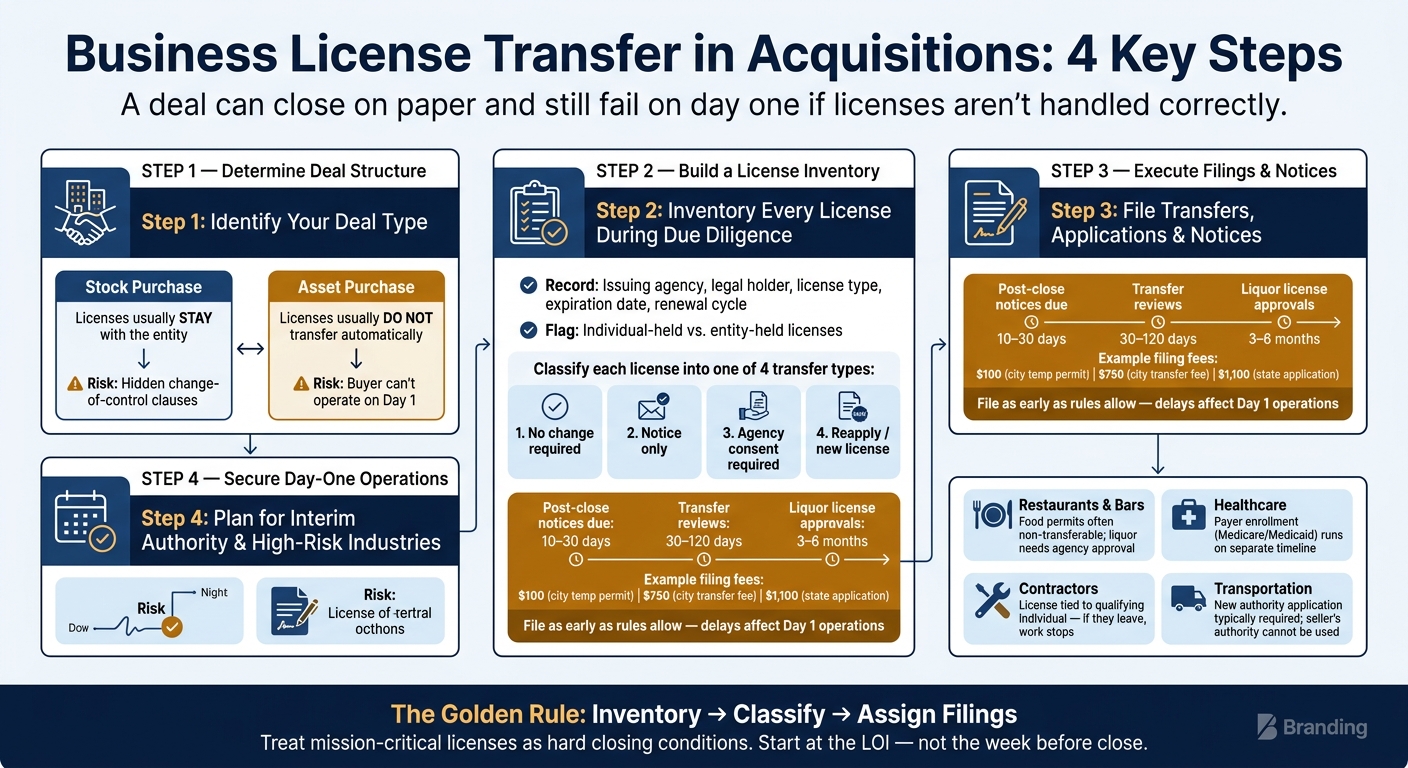
Business License Transfer Process in Acquisitions: 4-Step Guide
Quick Comparison
| Deal type | What usually happens | Main filing path | Main risk |
|---|---|---|---|
| Stock purchase | Licenses often stay with the same entity | Change-of-control notice or ownership update | Hidden consent rules in contracts, leases, or agency records |
| Asset purchase | Licenses often do not move with the assets | Transfer request, amendment, or new application | Buyer cannot lawfully operate on day one |
| Person-held license case | License stays with the licensed person, not the business sale | New qualifier, new hire, or interim staffing plan | Work stops if the licensed person exits |
| Temporary permit case | Short-term authority may bridge the gap | Interim permit plus full application | Permit ends before final approval arrives |
A few numbers in the article show why timing matters: some post-close notices are due within 10 to 30 days, some transfer reviews take 30 to 120 days, and some liquor matters can take 3 to 6 months. There are also filing costs in some places, such as $100, $750, and $1,100 fees in the alcohol-license example.
So the article’s message is clear: do the license work during diligence, not after signing, and treat mission-critical approvals as hard closing items when needed.
sbb-itb-97ecd51
1. Determine how deal structure changes the transfer path
Deal structure tells you what happens to each license after the sale. That matters right away. Some licenses stay put. Some need notice. Others need a brand-new filing. Once you know the deal structure, you can match each license to the filing it needs.
Stock purchase: licenses usually stay with the entity, but change-of-control rules still apply
In a stock purchase, you're buying the target entity itself. So in most cases, the licenses and permits stay with that entity.
Still, don't treat that as automatic. A lot of licenses, leases, and contracts require change-of-control notice or consent, especially in franchised businesses and regulated sectors. For example, franchise agreements often require franchisor approval before a sale closes. Permits in fields like auto repair, dry cleaning, manufacturing, and gas stations may also call for notice or a new review when ownership changes. Professional licenses, along with some state or local business licenses, may be tied to one person or may need updated filings when ownership percentages change.
Asset purchase: most licenses do not transfer automatically
In an asset purchase, you buy the assets, not the entity. That means the seller's licenses usually stay with the seller. To keep operating, those licenses often need to be transferred, amended, or reissued.
In plain English: don't assume the licenses move with the assets. In many cases, you'll need a new application or a transfer request. Agencies often ask for a formal transfer application, a new license application, or an amendment, depending on the approval involved.
That license inventory comes next.
Comparison table: stock vs. asset purchase license outcomes
| Stock Purchase | Asset Purchase | |
|---|---|---|
| Default license result | Licenses usually remain with the target entity. | Most licenses do not transfer automatically; new applications are often required. |
| Typical filings | Change-of-control notices; ownership update filings. | Formal transfer forms; new license applications; amendments. |
| Common approval triggers | Assignment consent clauses in contracts/leases; franchisor consent. | New entity/EIN; ownership change; agency-specific transfer rules. |
| Execution risk | Hidden assignment consent clauses in existing contracts. | Operational downtime if new licenses aren't issued by day one. |
With the transfer path mapped, the next step is building a full license inventory by agency, holder, and expiration date.
2. Build a complete license and permit inventory during due diligence
Once you’ve mapped the transfer path, the next job is building the license inventory that will shape filings and closing conditions. After you know how the deal is set up, pull together a full inventory of every approval the target needs to operate legally at the federal, state, county, and city level.
List every approval by agency, holder, location, and expiration date
Start with the seller. If you are still in the early stages, you can find every business for sale online to identify potential targets. Ask for copies of all licenses, permits, registrations, and certifications. Then check each one against government records instead of taking the file at face value. Put everything into one tracking table with the same fields for every item. At a minimum, record the issuing agency, registered legal holder, license type, authorized activities, facility address, license number, current status, expiration date, such as August 5, 2026, and renewal cycle.
That single table makes it much easier to spot gaps, upcoming renewals, and anything that has to happen before close.
| Field | What to Record |
|---|---|
| Issuing agency | City licensing office, state department of revenue, county health department, EPA |
| Legal holder | Registered legal holder |
| License type | Business license, health permit, sales tax permit, occupancy certificate |
| Facility address | Street, city, state, ZIP for each covered location |
| Status | Active, pending, suspended, or expired |
| Expiration date | August 5, 2026 |
| Renewal cycle | Annual, biennial, every three years |
Once the inventory is built, sort each approval by transfer path and operating priority.
Flag transferability, consent requirements, and individual-held licenses
Not every license moves the same way, and this is where deals can get messy. Add a Transfer type column with four options:
- No change required
- Notice only
- Agency consent
- Reapply/new license
This one column helps separate true closing conditions from items the team can handle right after signing or close.
Then split approvals into two groups: those that stay with the entity and those that need a new filing or a new owner sign-off.
Just as important, separate licenses held by individuals from those held by the business entity. A plumbing contractor license held by the owner personally, a physician's professional license, or an electrician's trade license does not follow the business in the same way an entity-held permit might. If that person leaves after close, operations may stop until someone else gets licensed. Add a Holder type field, using Individual or Entity, and flag any case where the licensed person plans to exit.
Tie each license to revenue and day-one continuity
The inventory starts to matter when you connect it to how the business makes money. For each approval, note the location it covers, the revenue activity it allows, and any major customer contracts tied to it. A liquor license tied to a bar’s main sales is mission-critical. A local permit used for occasional outdoor events sits much lower on the list.
Add a Priority column with High, Medium, or Low based on whether losing that approval would stop day-one operations. Put closing conditions and action plans around the high-priority items first.
Use the inventory to assign filings, notices, and deadlines before closing.
3. Execute transfers, new applications, and required notices before and after closing
Turn your license inventory into a working filing plan. Each license should have a clear owner, a deadline, and a next step. That sounds simple, but it keeps deals from drifting when approvals start piling up.
Pre-signing: assign filing responsibilities and set approval timelines in the purchase agreement
Spell out filing duties, fees, and approval deadlines in the purchase agreement. It helps to attach a license schedule as an exhibit that ties each license to its issuing agency, transfer path, estimated processing time, and the party in charge.
For mission-critical licenses, treat approval as a hard gate to closing. If you're buying a bar, that might mean the state liquor license. If you're buying a clinic, that could be the healthcare facility license. In those cases, make transfer or issuance a formal closing condition. Add an outside date too, so the parties can walk away if approvals don't show up in time.
For lower-stakes permits with routine filing steps, standard cooperation covenants are often enough.
Timing matters here. Some agencies move fast. Others move at a glacial pace. If an approval can take months, that delay needs to show up in the closing schedule from day one.
The agreement should also include interim operating covenants. The seller should be required to keep licenses in good standing, handle renewals, avoid unapproved operating changes, and quickly alert the buyer to any regulatory inquiry or violation.
Once the agreement locks in the timing, move those items into the closing checklist so nothing gets lost.
Closing workflow: file notices, transfer forms, and new license applications
At closing, the job shifts from planning to filing. File the required notices and transfer forms at closing or right after. In many cases, agencies want the same core package: change-of-ownership forms, entity documents, and ownership charts.
Change-of-ownership forms usually kick off the process. They list the old and new owner names, the transaction type, the effective date, and the percentage ownership being transferred. Agencies also often ask for certificates of good standing dated within 30–60 days of filing, plus ownership charts that show beneficial owners above a set threshold, often 5–25%.
In regulated sectors, the file set can get heavier. You may need personal history forms, criminal background checks, fingerprints, and sometimes credit reports for owners and officers. Contractors, motor vehicle dealers, and similar businesses often need insurance certificates and surety bond proof with the right obligee wording. Restaurants, healthcare facilities, and childcare operations may also need site-level materials, such as floor plans, health and safety plans, or equipment lists.
Right after closing, file any change-of-control notices with short deadlines. Some agencies require those filings within 10–30 days after the ownership change. During the first 30–90 days after closing, confirm that insurance certificates and bonds have been updated to show the new owner's name and license numbers.
Process table: four common paths for handling licenses in acquisitions
Use the table below to match each license to the right filing path.
| Path | When Used | Typical Timeline | Key Documents | Main Risk |
|---|---|---|---|---|
| Automatic carry-over | Stock purchase; license generally stays with the entity, subject to any notice or change-of-control rules | Same day at closing | Change-of-control notice, if required; updated ownership records | Hidden compliance issues or an undisclosed change-of-control trigger that jeopardizes the license |
| Regulator-approved transfer | Asset or stock purchase; transferable license, such as some liquor licenses, contractor licenses, or local permits | 30–120 days; up to 3–6 months for liquor in some states | Transfer application, ownership chart, background forms, insurance or bond evidence, good-standing certificates | Regulator denial or delay pushes closing or creates a gap in operating authority |
| New license application | Asset purchase; non-transferable license that must be issued to the buyer in a fresh application | Several weeks to months, depending on the agency and industry | Full application, organizational documents, EIN, financial statements, facility documents, background checks | Approval is not received before closing, so the buyer cannot legally operate on day one |
| Temporary permit + new application | Regulated industries where the agency offers interim authority | Short interim period; full license often takes 60–90+ days depending on the agency | Emergency change-of-ownership request, interim operating plan, full application filed concurrently | The temporary permit expires before the full license is approved, or the full application is denied after operations have started |
Use one tracker across all license paths. Give one person the job of keeping it current through closing.
4. Plan for temporary permits, day-one operations, and industry-specific exceptions
Once the filing plan is in place, the last big risk is simple: can the business stay legal and keep operating while approvals are still pending?
Use temporary permits and interim operating plans where allowed
If a license can't transfer cleanly by closing, temporary authority may keep things moving. Some states offer temporary permits or provisional licenses, but the rules change by jurisdiction and license type.
Alcohol licenses are a good example. The filing window can be tight, and missing it can throw off day-one operations. Colorado allows a temporary permit within five working days after filing. That permit is valid for up to 120 days, with a possible 60-day extension for good cause. In Denver, the city-level temporary permit costs $100, on top of a $1,100 state application fee and a $750 city transfer fee. California ABC is stricter. It only issues temporary permits for transfers between individuals, and only if the premises was operating under a license within 30 days of filing. Original licenses and premises-to-premises transfers don't qualify.
That means timing matters. File the transfer request as early as the rules allow. If you miss the filing window, or if the premises was inactive during the required lookback period, interim authority may disappear.
When temporary permits aren't available, a management agreement or transition services arrangement can sometimes cover the gap. In that setup, the seller keeps the license and legal responsibility for regulated activity, while the buyer handles day-to-day work under a written contract. This tends to work best when the arrangement is short, tied to a clear licensing milestone, and disclosed to regulators when needed. The licensed party still has to keep real control over regulated decisions.
Watch high-risk sectors: restaurants, healthcare, and contractor-based businesses
These timing gaps get tighter in heavily regulated industries.
Restaurants and bars often deal with two separate approval tracks. Food service permits and liquor licenses may follow different rules. Food service permits are often non-transferable. In Georgia, a provisional food service permit may be issued after inspection if there are no major menu or layout changes and no imminent public health hazard. But it lasts only 60 days and can't be renewed. A safe approach is to assume the food permit won't transfer unless the local health department says otherwise, and to schedule the inspection before closing.
Healthcare deals bring a different kind of delay: payer enrollment. State facility license change-of-ownership approvals and Medicare/Medicaid enrollment changes often move on separate timelines. Federal Medicare rules require timely filing of change-of-information and revalidation forms. File late, and the business may lose the ability to bill Medicare or Medicaid. That can also disrupt commercial reimbursement and trigger temporary management in long-term care. In some cases, agencies may issue provisional licenses while surveys or background checks are still in process.
Contractor deals have their own trap. Licenses are often tied to a specific qualifying individual, not just the company. If that person leaves before a new qualifier is approved by the state contractor board, the business may be blocked from bidding on new work or continuing regulated projects. The practical fix is to lock in that person's commitment before signing, usually through an employment or consulting agreement. Short-term subcontracting can also help keep jobs moving until the new qualifier is approved.
Industry table: where transfer rules are most restrictive
The industries below tend to have the toughest transfer limits, and each one can affect closing in a different way.
| Industry | Common License Types | Transfer Typically Limited or Prohibited? | Practical Impact on Closing and Operations |
|---|---|---|---|
| Restaurants & bars | Liquor license, food service permit | Food permits often non-transferable; liquor licenses require agency approval | Closing may depend on liquor approval, and food permits may require pre-close inspection |
| Healthcare facilities | State facility license, Medicare/Medicaid enrollment | Change-of-ownership approval required; payer enrollment changes run separately | Billing interruptions are possible if filings are late; provisional licenses may be issued during review |
| Contractor & construction trades | Contractor license, trade certifications | Often tied to a qualifying individual; entity changes require board approval | Operations may pause if the qualifier leaves; short-term subcontracting can keep work moving until a new qualifier is approved |
| Transportation & logistics | Motor carrier authority, hazmat permits | New authority application is typically required | The buyer generally cannot operate under the seller's authority on day one |
| Financial & professional services | Insurance producer license, CPA firm registration | Licenses are often tied to individuals; firm-level registrations vary by state | Seller's licensed professionals may need to stay involved, and the buyer may need its own licensed staff in place |
One more practical point: avoid major operating changes until approvals are final. Keeping the seller involved for a short period after closing can help with continuity tasks like inventory handoff, staff onboarding, and regulator communications.
Conclusion: Use a license transfer checklist to protect closing and post-close operations
Once your inventory and filing plan are set, use this checklist to clean up the last loose ends. License transfers usually go off track when diligence begins too late. That’s why they need to be treated as a core workstream starting at the LOI.
Use the LOI window to confirm every license, who holds it, and what needs to be filed. At that point, you should already know:
- which licenses stay with the entity
- which ones need new applications
- which ones are tied to a specific person
That classification drives the filing path.
Ownership of each task matters just as much as timing. Every license-related item should have a named owner in the purchase agreement, including who files, who sends required notices, and who handles transfer forms. Boiled down, the process is simple: inventory → classify → assign filings.
The checklist below covers the items most likely to slow closing or disrupt day-one operations.
| Checklist Category | Key Items to Include |
|---|---|
| Inventory | State/local licenses, professional certifications, health permits, liquor licenses, environmental permits |
| Filing | Assigned filing parties, required notice periods, consent deadlines, new application fees |
| Day-One Coverage | Transferability status, interim permits, renewal dates, owner responsibility for each approval |
If a license is mission-critical, make it a closing condition. If not, assign the filing and deadline before close.
FAQs
Which licenses can transfer in a business acquisition?
It depends on the deal structure and the regulator.
In a stock purchase, the legal entity stays the same. That means most licenses, permits, and certifications usually carry over without much trouble.
In an asset purchase, it’s a different story. Many licenses don’t transfer, so the buyer usually has to reapply.
Some professional licenses work under their own rules. In fields like healthcare or accounting, licenses are often non-transferable no matter how the deal is set up, because they must be held by qualified individuals.
How early should license transfer work start in the deal process?
Start early in due diligence. License and permit transfer rules differ by jurisdiction and industry, and some require new applications, background checks, or public hearings that can take months.
Reach out to issuing authorities right away. Bring in legal and compliance professionals early too. They can flag non-transferable licenses, help map out backup plans, and reduce the risk of operational disruptions at closing.
What happens if a key person-held license doesn’t carry over?
If a license is tied to one person and doesn’t transfer, the buyer may not be able to legally run the business after the deal closes.
This comes up a lot with professional licenses in fields like healthcare, accounting, and legal services. In many cases, those licenses are non-transferable. That means the new owner may need to reapply, or put a qualified person in place to hold the license.
The key is to spot this early during due diligence. Then, build transfer contingencies into the purchase agreement so the deal doesn’t hit a wall after closing.