

Codely v2.0 public release is here
Lorem ipsum dolor sit amet, consectetur adipiscing elit lobortis arcu enim urna adipiscing praesent velit viverra sit semper lorem eu cursus vel hendrerit elementum morbi curabitur etiam nibh justo, lorem aliquet donec sed sit mi dignissim at ante massa mattis.
- Neque sodales ut etiam sit amet nisl purus non tellus orci ac auctor
- Adipiscing elit ut aliquam purus sit amet viverra suspendisse potent i
- Mauris commodo quis imperdiet massa tincidunt nunc pulvinar
- Adipiscing elit ut aliquam purus sit amet viverra suspendisse potenti
What has changed in our latest release?
Vitae congue eu consequat ac felis placerat vestibulum lectus mauris ultrices cursus sit amet dictum sit amet justo donec enim diam porttitor lacus luctus accumsan tortor posuere praesent tristique magna sit amet purus gravida quis blandit turpis.
All new features available for all public channel users
At risus viverra adipiscing at in tellus integer feugiat nisl pretium fusce id velit ut tortor sagittis orci a scelerisque purus semper eget at lectus urna duis convallis. porta nibh venenatis cras sed felis eget neque laoreet suspendisse interdum consectetur libero id faucibus nisl donec pretium vulputate sapien nec sagittis aliquam nunc lobortis mattis aliquam faucibus purus in.
- Neque sodales ut etiam sit amet nisl purus non tellus orci ac auctor
- Adipiscing elit ut aliquam purus sit amet viverra suspendisse potenti
- Mauris commodo quis imperdiet massa tincidunt nunc pulvinar
- Adipiscing elit ut aliquam purus sit amet viverra suspendisse potenti
Coding collaboration with over 200 users at once
Nisi quis eleifend quam adipiscing vitae aliquet bibendum enim facilisis gravida neque. Velit euismod in pellentesque massa placerat volutpat lacus laoreet non curabitur gravida odio aenean sed adipiscing diam donec adipiscing tristique risus. amet est placerat in egestas erat imperdiet sed euismod nisi.
“Nisi quis eleifend quam adipiscing vitae aliquet bibendum enim facilisis gravida neque velit euismod in pellentesque massa placerat”
Real-time code save every 0.1 seconds
Eget lorem dolor sed viverra ipsum nunc aliquet bibendum felis donec et odio pellentesque diam volutpat commodo sed egestas aliquam sem fringilla ut morbi tincidunt augue interdum velit euismod eu tincidunt tortor aliquam nulla facilisi aenean sed adipiscing diam donec adipiscing ut lectus arcu bibendum at varius vel pharetra nibh venenatis cras sed felis eget dolor cosnectur drolo.
A bad lease can sink a deal even when the business looks strong. In many U.S. acquisitions, lease problems hit in 3 places fast: price, financing, and closing time. If the landlord blocks an assignment, resets rent, or asks for a new guarantee, the deal can stall or the numbers can stop working.
Here’s the short version:
- I check whether the lease can transfer
- I confirm the remaining term fits the loan, especially SBA loans that often run 10 years
- I review rent, CAM/NNN, escalations, and repair costs
- I look for change-of-control clauses, defaults, cure periods, and guarantee issues
- I make sure landlord consent, estoppels, and SNDAs are handled early
A few facts drive the whole review:
- Landlord consent can add 30 to 90 days to closing
- Small business deals often take about 170 days
- Buyers often use 5% to 15% escrow holdbacks for 12 to 24 months when lease risk is still open
If I can’t answer these questions before signing, I stop and build the lease file first:
- Can the lease be assigned?
- Does the term support the loan and hold period?
- Will the sale trigger a rent reset or new deposit?
- Is the seller already in default?
- Will the landlord need to sign off on the sale?
This guide lays out a simple process: get the full lease package, pull the terms that hit cash flow, test transfer risk, and turn each lease problem into a price cut, escrow, or closing condition.
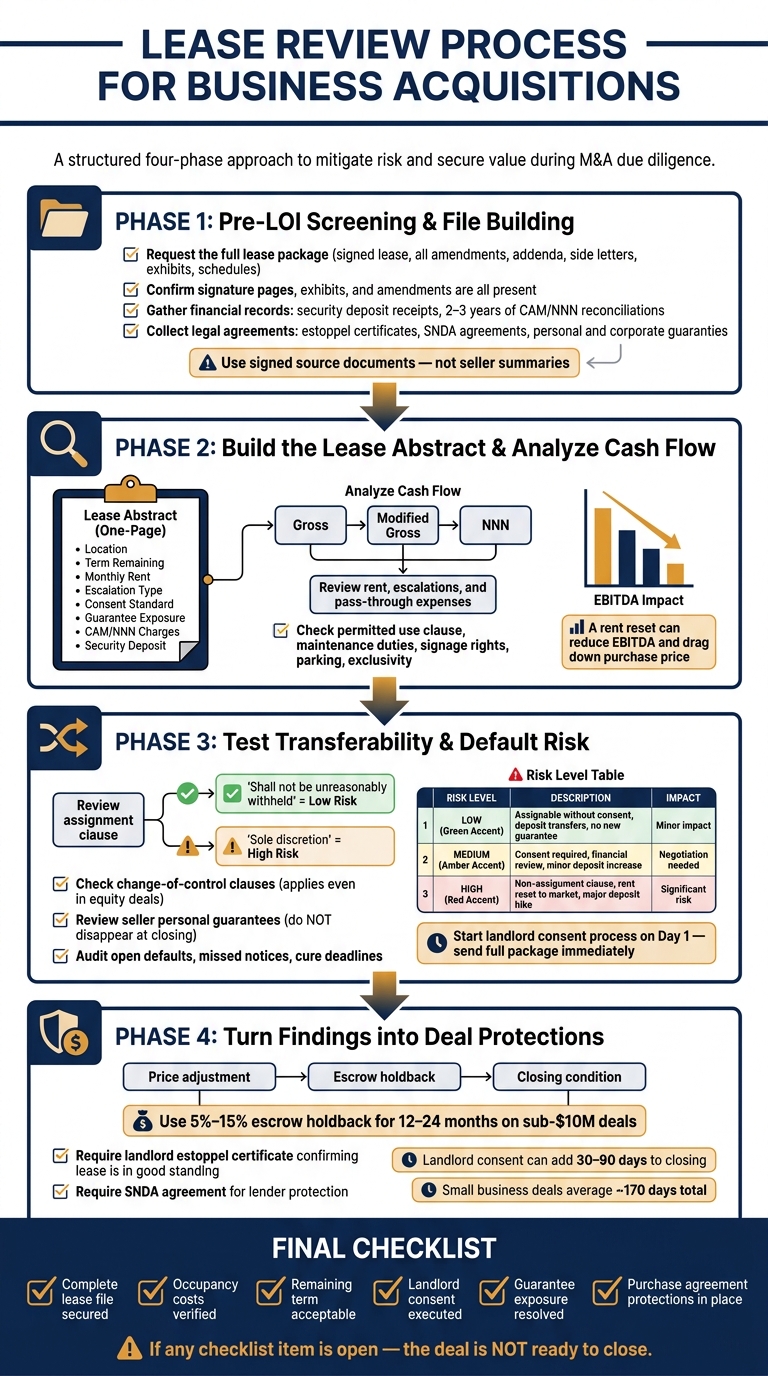
Lease Review Process for Business Acquisitions: Step-by-Step Guide
Commercial Lease Red Flags Every Business Owner Should Know
sbb-itb-97ecd51
Build the Lease Diligence File Before Analyzing Risk
After the LOI review, get the signed lease package and turn it into a working abstract. Use signed source documents, not seller summaries. That matters more than it might seem. A seller summary can miss a side letter, soften a consent issue, or skip a rent change that shows up only in an amendment.
Request the Full Lease Package and Confirm Nothing Is Missing
Start with a formal document request to the seller. Then review every signed page to confirm the actual terms.
| Document Category | Specific Items to Request |
|---|---|
| Primary Lease Docs | Signed lease, all amendments, addenda, side letters, exhibits, schedules |
| Financial Records | Security deposit receipts, letters of credit, last 2–3 years of CAM/NNN reconciliations |
| Legal Agreements | Estoppel certificates, SNDA agreements, personal and corporate guaranties |
| Correspondence | Landlord notices, default and cure notices, any consent applications |
Once the package arrives, check for the basics first:
- Signature pages are included
- Every exhibit named in the lease body is attached
- Every amendment is present
This step is easy to rush, and that’s where people get burned. A missing amendment can change rent or assignment rights. Incomplete documents can skew rent, transfer rights, and closing timing.
Pay close attention to CAM and NNN reconciliations from the last two to three years. These records show whether the landlord has billed pass-through expenses correctly and whether any catch-up charges are still lurking in the file. Use the full package to build the abstract below.
Build a One-Page Lease Abstract
Once the file is complete, pull out the few terms that affect price, transferability, and closing risk. Use a one-page abstract for single-site deals. For multi-site deals, use a comparison table so you can spot differences fast.
| Abstract Field | Diligence Focus | Key Fact to Confirm |
|---|---|---|
| Location | Operational | Confirm site-level operating limits and permitted use. |
| Term Remaining | Financial/Lender | Ensure the lease term aligns with or exceeds the loan maturity, including options when applicable. |
| Monthly Rent | Financial | Verify against bank statements and profit and loss statements. |
| Escalation Type | Financial | Identify whether increases are fixed, percentage-based, or tied to CPI. |
| Consent Standard | Legal | Determine whether landlord consent can be unreasonably withheld or is subject to sole discretion. |
| Guarantee Exposure | Legal/Financial | Identify existing seller guarantees and any new buyer requirements. |
| CAM/NNN Charges | Financial | Review recent reconciliations to ensure no catch-up payments are due. |
| Security Deposit | Financial | Confirm the amount held and whether the landlord requires an increase. |
The abstract should make transfer, cash flow, and closing risk easy to see at a glance. Confirm each field against the lease, and flag anything that still needs third-party verification.
Review the Lease Terms That Affect Cash Flow and Operations
With the lease abstract done, the next step is to read the lease terms that directly affect cash flow. This is where lease review turns into a plain cash-flow check. Two areas matter most: what you're paying and what you're allowed to do on-site. Those terms set the baseline for the next step: testing transferability and landlord approval.
Analyze Rent, Escalations, and Pass-Through Expenses
Base rent is only the starting point. Your total occupancy cost also includes annual escalations, taxes, insurance, CAM charges, utilities, and, in some leases, percentage rent.
A sale can trigger a rent reset, new guarantees, or a higher deposit demand. If rent resets upward, EBITDA can drop, and that can drag down price. Fixed escalators need a close look too, because they push occupancy cost up year after year.
| Lease Type | Buyer Pays | Diligence Focus |
|---|---|---|
| Gross Lease | Landlord usually covers most operating expenses. | Confirm the base year for expense stops |
| Modified Gross | Costs are split; confirm responsibility for HVAC and interior repairs. | Define the split for major system replacements |
| NNN (Triple Net) | Tenant often pays taxes, insurance, CAM, and many repairs. | Inspect roof, HVAC, and parking lot condition |
Track every lease-driven cost in your valuation.
Check Permitted Use, Maintenance, and Site-Level Operating Limits
Before you assume you can run the business the same way after closing, read the permitted use clause with care. It spells out exactly what activities are allowed at the premises. If that language is narrow, it can stop you from adding product lines or changing the business model after the deal closes.
Maintenance duties matter just as much, especially in NNN leases. If the lease puts HVAC replacement, roof repairs, or parking lot resurfacing on the tenant, those costs become yours after closing. An older HVAC unit or another neglected building system can create immediate post-closing capital needs, even if the seller's past financials don't show the problem.
And it doesn't stop with the big-ticket items. Also check:
- Signage rights
- Parking allocations
- Delivery access
- Hours-of-operation limits
- Exclusivity
Once cash flow and operating limits are clear, test assignment, default, and negotiation leverage.
Test Transferability, Default Risk, and Negotiation Options
Once you know what the lease costs and what it lets you do, the next step is simple: can you even take it over?
That’s where a lot of deals start to wobble. On paper, the business may look fine. Then the lease gets a close read, and suddenly the sale depends on landlord consent, old defaults, or a guarantee that never went away. Start with the assignment and change-of-control language. After that, check any limits on subletting.
Assignment, Subletting, and Change-of-Control Provisions
The assignment clause tells you whether the landlord has to approve the sale. Two phrases matter most:
- Consent "shall not be unreasonably withheld"
- Consent at the landlord’s "sole discretion"
That difference can change the whole deal. One gives you some room to push forward. The other gives the landlord broad control and can stop a closing cold.
Check the change-of-control clause too. Even if you structure the purchase as an equity deal, landlord approval may still be required. Franchise and ground leases can add their own approval rules or non-assignment limits. And yes, landlords sometimes use the consent process to renegotiate the economics.
Start the consent process on Day 1. Don’t dribble documents in one at a time. Send the full package right away: financial statement, credit authorization, business plan, and recent tax returns.
Guarantees, Security Deposits, Defaults, and Cure Rights
Consent is only part of the story. You also need to know which money risks stay alive after closing.
Seller personal guarantees do not disappear just because the deal closes. The landlord may refuse to release the seller unless the buyer gives a replacement guarantee. That can change the risk profile of the deal in a hurry.
Also check how the security deposit will transfer. Then look for any open defaults, missed notices, or cure deadlines under the current lease. If those items are still hanging out there before closing, they can land in your lap. Pull the default and notice history before you lock in your offer. If there’s an unresolved guarantee, deposit issue, or default, put a dollar figure on it before you negotiate the purchase agreement.
| Risk Level | Consent Language / Conditions | Guarantee & Deposit Exposure |
|---|---|---|
| Low Transfer Risk | Lease is assignable without consent or "shall not be unreasonably withheld." | No new personal guarantee required; existing security deposit transfers to buyer. |
| Medium Transfer Risk | Consent required; landlord demands buyer's financial statements and credit checks. | Landlord may request an updated personal guarantee or a minor increase in the security deposit. |
| High Transfer Risk | Explicit non-assignment clause; franchisor approval required; landlord that resists assignments or re-trades terms. | Landlord demands rent reset to market rates, significant security deposit hike, or refuses to release seller's guarantee. |
Turn Lease Findings into Price Adjustments and Landlord Requests
Each lease issue should turn into a pricing item, a closing item, or a landlord ask.
A rent reset to market rates can push occupancy costs up month after month. A larger security deposit hits you as an immediate cash need at closing. Neither should be treated as small print.
Buyers usually deal with lease risk through purchase price cuts, seller-funded escrow holdbacks, and closing conditions tied to landlord consent. For sub-$10M deals, use a 5% to 15% escrow holdback for 12 to 24 months. You can also negotiate straight with the landlord for a lease amendment during the consent process, such as revised escalation language or updated guarantee terms.
Lenders often want a landlord estoppel certificate stating that the lease is in good standing. They may also require a Subordination, Non-Disturbance, and Attornment (SNDA) agreement to protect the lender’s position if the landlord forecloses. Put the estoppel certificate and SNDA on the closing checklist alongside consent items and cure items.
Conclusion: A Lease Review Process Buyers Can Repeat
Treat lease diligence like a workflow you can run again and again, not a rushed review at the end. The process is simple: pre-LOI screening, financial and operational review, transferability testing, and purchase-agreement protections. Each step sets up the next.
After that work is done, the job becomes clear: close every open gap before anyone signs. Small business deals often take 170 days, and landlord consent can take 30 to 90 days. That’s why lease review needs to start early, not when the clock is already ticking.
With that timing in view, the last move is to turn every lease risk into a closing item. If your team is looking at multiple deals at once, Kumo can keep listings, diligence notes, and lease status in one place, so a key lease term doesn’t slip through the cracks.
The Final Checklist Before Closing
Use this checkpoint to spot any lease issue that still needs attention before signatures. Before closing, confirm these six items are done:
- Complete lease file: Master lease, amendments, and exhibits are signed and in hand.
- Verified occupancy costs: Rent, escalations, and pass-throughs match the model.
- Acceptable remaining term: Lease term and options support financing and the hold period.
- Executed landlord consent: Assignment or change-of-control approval is signed.
- Resolved guarantee exposure: Seller release and buyer obligation are clearly defined.
- Purchase agreement protections: Reps, indemnities, and escrows match the lease risk.
If even one item is still open, the deal is not ready to close.
FAQs
What if the landlord refuses consent?
If the landlord refuses consent, they may treat the sale as a chance to reset rent to market rates, ask for personal guarantees, or require a larger security deposit. And even if the lease says consent can’t be unreasonably withheld, they may still try to push through more expensive terms.
To lower that risk, start the landlord conversation on day one of the letter of intent. Then build a 30- to 90-day consent window into your deal calendar and line up a backup location plan. That way, you’re not scrambling if the process drags out or the terms shift late in the deal.
Can SBA financing fail because of the lease?
Yes. For location-based businesses like restaurants, gyms, and retail stores, lease assignment is a common deal killer.
Here’s the issue: a landlord can use the sale as leverage to ask for higher rent, a bigger security deposit, or a personal guarantee.
And if the lease limits assignment, or the landlord won’t give consent, the acquisition may stall or fall apart. That can also derail SBA financing.
Should I renegotiate the lease before closing?
Yes - if due diligence turns up unfavorable terms or risks, try to renegotiate before closing.
During assignment, landlords may push to reset rent to market rates, ask for personal guarantees, or increase security deposits.
Those changes can materially reprice the deal. So it’s smart to spot restrictive assignment clauses early. If problems show up, you can:
- negotiate a lower purchase price
- ask the seller to fix the issue
- walk away