

Codely v2.0 public release is here
Lorem ipsum dolor sit amet, consectetur adipiscing elit lobortis arcu enim urna adipiscing praesent velit viverra sit semper lorem eu cursus vel hendrerit elementum morbi curabitur etiam nibh justo, lorem aliquet donec sed sit mi dignissim at ante massa mattis.
- Neque sodales ut etiam sit amet nisl purus non tellus orci ac auctor
- Adipiscing elit ut aliquam purus sit amet viverra suspendisse potent i
- Mauris commodo quis imperdiet massa tincidunt nunc pulvinar
- Adipiscing elit ut aliquam purus sit amet viverra suspendisse potenti
What has changed in our latest release?
Vitae congue eu consequat ac felis placerat vestibulum lectus mauris ultrices cursus sit amet dictum sit amet justo donec enim diam porttitor lacus luctus accumsan tortor posuere praesent tristique magna sit amet purus gravida quis blandit turpis.
All new features available for all public channel users
At risus viverra adipiscing at in tellus integer feugiat nisl pretium fusce id velit ut tortor sagittis orci a scelerisque purus semper eget at lectus urna duis convallis. porta nibh venenatis cras sed felis eget neque laoreet suspendisse interdum consectetur libero id faucibus nisl donec pretium vulputate sapien nec sagittis aliquam nunc lobortis mattis aliquam faucibus purus in.
- Neque sodales ut etiam sit amet nisl purus non tellus orci ac auctor
- Adipiscing elit ut aliquam purus sit amet viverra suspendisse potenti
- Mauris commodo quis imperdiet massa tincidunt nunc pulvinar
- Adipiscing elit ut aliquam purus sit amet viverra suspendisse potenti
Coding collaboration with over 200 users at once
Nisi quis eleifend quam adipiscing vitae aliquet bibendum enim facilisis gravida neque. Velit euismod in pellentesque massa placerat volutpat lacus laoreet non curabitur gravida odio aenean sed adipiscing diam donec adipiscing tristique risus. amet est placerat in egestas erat imperdiet sed euismod nisi.
“Nisi quis eleifend quam adipiscing vitae aliquet bibendum enim facilisis gravida neque velit euismod in pellentesque massa placerat”
Real-time code save every 0.1 seconds
Eget lorem dolor sed viverra ipsum nunc aliquet bibendum felis donec et odio pellentesque diam volutpat commodo sed egestas aliquam sem fringilla ut morbi tincidunt augue interdum velit euismod eu tincidunt tortor aliquam nulla facilisi aenean sed adipiscing diam donec adipiscing ut lectus arcu bibendum at varius vel pharetra nibh venenatis cras sed felis eget dolor cosnectur drolo.
If you buy a business, goodwill usually means a 15-year tax write-off. If you sell one, it can mean capital gain or, for some C corporations, two layers of tax.
I’d boil the whole topic down to three questions:
- Did the deal create tax goodwill?
- How was the price split across the assets?
- Who gets the tax result: the buyer, the seller, or both?
Here’s the short answer:
- In an asset purchase, goodwill can be created and amortized over 180 months
- In a stock purchase, there is usually no new tax goodwill
- In a deemed asset deal like a Section 338(h)(10) or Section 336(e) election, goodwill can be created even though the legal deal is a stock sale
- Buyers usually report goodwill deductions on Form 4562
- Buyers and sellers in asset deals usually report the price split on Form 8594
- In closely held companies, personal goodwill and enterprise goodwill can lead to very different seller tax results
A simple example: if $180,000 is allocated to goodwill, the buyer generally deducts $1,000 per month for 180 months. At a 21% tax rate, that is about $2,520 per year in tax savings during a full year of amortization.
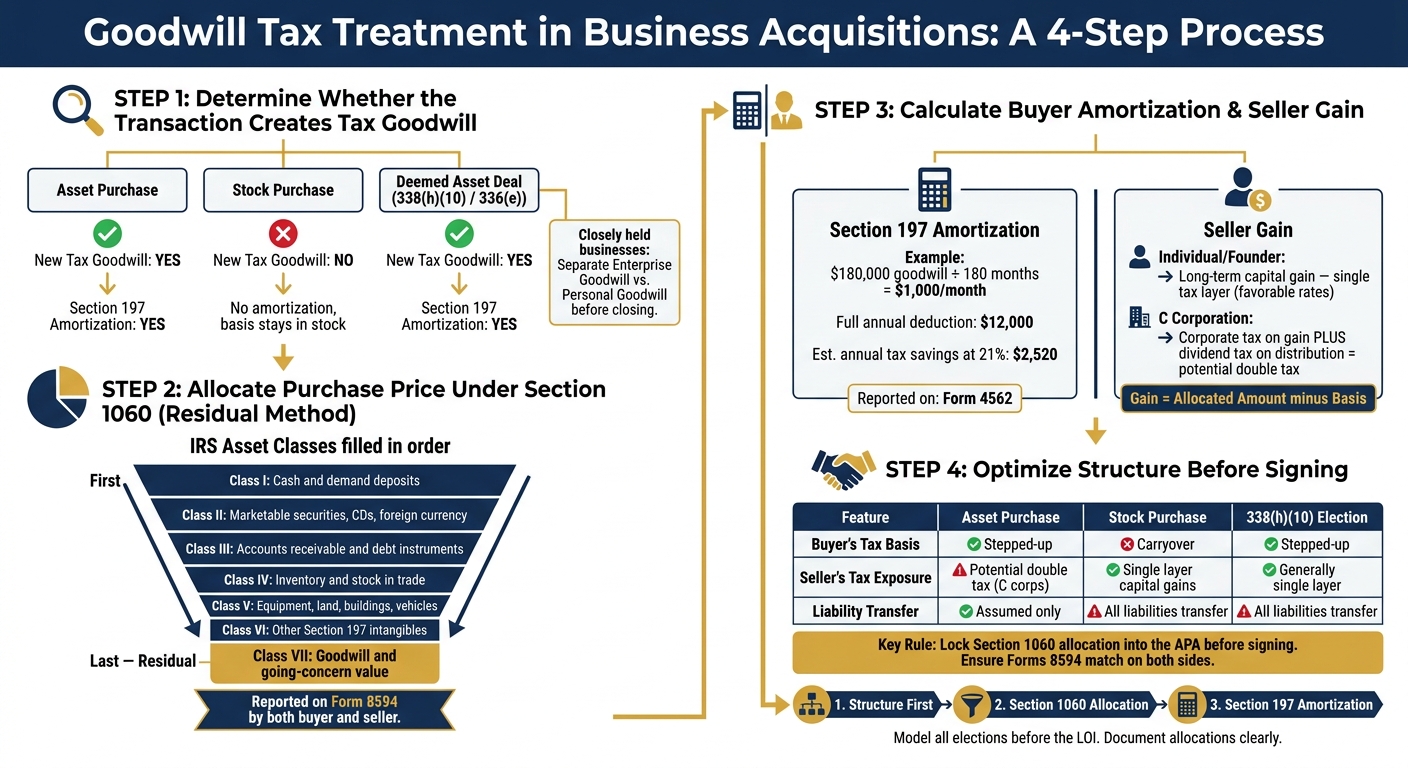
Goodwill Tax Treatment in Business Acquisitions: 4-Step Process
How Is Goodwill Taxed In A Business Sale? - Tax and Accounting Coach
sbb-itb-97ecd51
Quick comparison
| Deal type | New tax goodwill? | Buyer amortization? | Main tax point |
|---|---|---|---|
| Asset purchase | Yes | Yes, 180 months | Buyer gets a step-up in asset basis |
| Stock purchase | No | No | Basis stays in the stock |
| Deemed asset deal | Yes | Yes, 180 months | Taxed like an asset sale |
The main takeaway: structure comes first. I’d check the deal form, lock down the Section 1060 allocation before signing, and make sure the reporting matches on both sides.
Step 1: Determine whether the transaction creates tax goodwill
Next, figure out whether the deal creates tax goodwill. This comes down to how the transaction is structured.
Asset deals, stock deals, and deemed asset deals compared
In a direct asset purchase, the buyer purchases the business assets themselves and gets a new tax basis in those assets. That setup can create tax goodwill.
A stock purchase works in a different way. The buyer purchases equity, not the assets underneath it, so the assets inside the company keep their original basis. Because of that, no new tax goodwill is created.
A deemed asset deal, such as one under Section 338(h)(10) or Section 336(e), is taxed like an asset sale. That means there is a step-up in basis, which can create amortizable goodwill, even though the legal form of the deal is still a stock transfer.
| Deal Type | Does Tax Goodwill Arise? | Section 197 Amortization? | Key Tax Filings |
|---|---|---|---|
| Asset Purchase | Yes | Yes (180 months) | Form 8594, Form 4562 |
| Stock Purchase | No | No | Basis stays in the stock |
| Deemed Asset Deal (338(h)(10) or 336(e)) | Yes | Yes (180 months) | Form 8023, Form 8594 |
Enterprise goodwill vs. personal goodwill in closely held businesses
In closely held businesses, you need to separate enterprise goodwill from personal goodwill. Enterprise goodwill belongs to the business itself. Personal goodwill belongs to the owner and should be documented before closing.
Once you've confirmed that tax goodwill exists, allocate the purchase price under Section 1060.
Step 2: Allocate the purchase price under Section 1060
For asset deals, Section 1060 splits the purchase price across IRS asset classes in a set order. That split becomes the tax basis used for Form 8594.
How the residual method works across asset classes
The IRS uses the residual method. It fills each asset class in order, up to fair market value. Whatever is left goes to Class VII goodwill and going-concern value.
| Asset Class | What It Covers | Allocation Order |
|---|---|---|
| Class I | Cash and demand deposits | First |
| Class II | Marketable securities, CDs, foreign currency | Second |
| Class III | Accounts receivable and debt instruments | Third |
| Class IV | Inventory and stock in trade | Fourth |
| Class V | Equipment, land, buildings, vehicles | Fifth |
| Class VI | Other Section 197 intangibles | Sixth |
| Class VII | Goodwill and going-concern value | Last (residual) |
That order matters. It decides how much of the price ends up in goodwill, and it shapes how both sides report the deal.
How to report the allocation on Form 8594
Both the buyer and the seller must file Form 8594 (Asset Acquisition Statement Under Section 1060) to show how the purchase price is split across the seven asset classes.
If $2,500,000 remains after Classes I through VI, that amount is allocated to Class VII goodwill and reported on Form 8594 by both parties.
Attach the agreed allocation schedule to the APA before signing. That schedule drives the buyer's amortization and the seller's gain in Step 3.
Step 3: Calculate the buyer's amortization and the seller's gain
Once the Form 8594 allocation is locked in, the tax effect splits in two directions: the buyer gets deductions, and the seller recognizes gain.
Buyer: How to amortize goodwill over 180 months under Section 197
Under Section 197, the buyer amortizes goodwill over 180 months, or 15 years. That means the deduction is spread out evenly over that period.
If the deal closes on March 1, the buyer gets 10 months of amortization in the first year.
| Item | Value / Calculation |
|---|---|
| Goodwill Basis | $180,000 |
| Amortization Period | 180 months (15 years) |
| Monthly Amortization | $1,000 ($180,000 ÷ 180) |
| First-Year Deduction (March 1 close - 10 months) | $10,000 ($1,000 × 10) |
| Full Annual Amortization | $12,000 |
| Est. Annual Tax Savings (21% rate) | $2,520 |
The buyer reports this deduction on Form 4562, including the asset description, start date, basis, and annual amount.
Section 197 also has a pooling rule. All intangibles bought in the same deal are grouped together. So you can't give one intangible a shorter write-off period and another a longer one in that same purchase. The remaining basis stays in the pool and keeps being amortized over what is left of the original 180-month schedule.
That same allocation drives both sides of the deal: the buyer's deduction and the seller's taxable gain.
Seller: Capital gain treatment vs. double tax on goodwill
For the seller, gain on goodwill is the allocated amount minus basis.
For an individual seller or founder, goodwill gain is usually treated as long-term capital gain, which often means lower tax rates. That's usually the best tax result for the seller.
A C corporation asset sale works very differently. If the corporation sells goodwill, the corporation pays tax at the corporate level on that gain. Then, if the after-tax cash is distributed to shareholders, the shareholders pay dividend tax on that distribution. Same money, taxed twice before it lands with the owner.
| Feature | Personal Goodwill | Enterprise Goodwill |
|---|---|---|
| Tax Character | Generally single-level capital gain | Potential corporate-level tax plus shareholder tax |
| Federal Tax Outcome | Favorable capital gains rates | Potential double tax (corporate level + dividend tax on distribution) |
| Buyer Benefit | Amortizable over 15 years | Amortizable over 15 years |
Reporting has to line up with the allocation because each asset class gets different tax treatment. Form 8594 must match the agreed allocation, and assets like inventory and equipment follow their own tax rules. A mismatch on Form 8594 can trigger IRS scrutiny.
Step 4: Improve after-tax outcomes through structure and diligence
After allocation and amortization, structure and diligence are the last levers that can change the after-tax result. And in practice, the biggest goodwill tax decisions happen before closing, while the deal is still being negotiated.
Negotiate structure, allocations, and elections before signing
Negotiate the deal structure, election, and allocation before signing. Those choices decide who gets the step-up, who bears the tax, and how much goodwill can be amortized.
The trade-off is straightforward: buyer deductions vs. seller tax cost.
| Feature | Asset Purchase | Stock Purchase | Section 338(h)(10) Election |
|---|---|---|---|
| Buyer's Tax Basis | Stepped-up to purchase price | Carryover basis | Stepped-up (treated as asset sale) |
| Seller's Tax Exposure | Potential double tax for C corps | Single layer of capital gains | Generally single layer |
| Liability Transfer | Only assumed liabilities | All entity liabilities transfer | All entity liabilities transfer |
Model any Section 338(h)(10) election before the LOI. It gives the buyer an asset-sale result, but the seller may need compensation for the added tax.
Lock the Section 1060 allocation into the APA before signing, and make sure the Forms 8594 match. If they don’t, that mismatch can create trouble later.
Use deal screening to find transactions where goodwill has the most impact
Before diligence starts, screen for targets where goodwill is likely to matter most. Use Kumo to review targets early and flag deals where goodwill is likely to drive the after-tax result.
That early screen can save time. It helps you spot which deals may deserve extra modeling before the process gets deeper.
Conclusion: Key rules to apply before closing a deal
Once those choices are set, the remaining tax work is mostly documentation and reporting. Goodwill tax treatment follows three steps: structure, Section 1060 allocation, and Section 197 amortization. Model them before signing, and document the allocation clearly.
FAQs
Can goodwill arise in a stock deal?
Usually, no. In a standard stock deal, the buyer doesn’t get goodwill because the company’s assets keep their current tax basis. There’s no step-up to fair market value.
But there’s an exception: the parties can make a Section 338 election. For federal tax purposes, that treats the transaction like a deemed asset purchase. That lets the buyer step up the basis of the assets, including goodwill, and amortize it over 15 years.
How is goodwill separated from other intangible assets?
Goodwill is separated using the residual method of purchase price allocation. In an acquisition, the total purchase price is first assigned to identifiable assets at fair market value.
Any amount left over is then assigned to goodwill and going concern value. That’s what sets goodwill apart from other intangible assets, like customer lists or trademarks, which are each valued on their own first.
When does personal goodwill help the seller tax-wise?
Personal goodwill can help the seller on the tax side because that part of the sale may be taxed at long-term capital gains rates instead of ordinary income rates.
That difference can make a sale more tax-efficient, especially in asset sales.
But this isn't something to handle casually. Proper valuation and documentation matter. If the numbers or paperwork don't hold up, the tax treatment may not either.
That’s why sellers should work with a tax advisor on their specific deal.