

Codely v2.0 public release is here
Lorem ipsum dolor sit amet, consectetur adipiscing elit lobortis arcu enim urna adipiscing praesent velit viverra sit semper lorem eu cursus vel hendrerit elementum morbi curabitur etiam nibh justo, lorem aliquet donec sed sit mi dignissim at ante massa mattis.
- Neque sodales ut etiam sit amet nisl purus non tellus orci ac auctor
- Adipiscing elit ut aliquam purus sit amet viverra suspendisse potent i
- Mauris commodo quis imperdiet massa tincidunt nunc pulvinar
- Adipiscing elit ut aliquam purus sit amet viverra suspendisse potenti
What has changed in our latest release?
Vitae congue eu consequat ac felis placerat vestibulum lectus mauris ultrices cursus sit amet dictum sit amet justo donec enim diam porttitor lacus luctus accumsan tortor posuere praesent tristique magna sit amet purus gravida quis blandit turpis.
All new features available for all public channel users
At risus viverra adipiscing at in tellus integer feugiat nisl pretium fusce id velit ut tortor sagittis orci a scelerisque purus semper eget at lectus urna duis convallis. porta nibh venenatis cras sed felis eget neque laoreet suspendisse interdum consectetur libero id faucibus nisl donec pretium vulputate sapien nec sagittis aliquam nunc lobortis mattis aliquam faucibus purus in.
- Neque sodales ut etiam sit amet nisl purus non tellus orci ac auctor
- Adipiscing elit ut aliquam purus sit amet viverra suspendisse potenti
- Mauris commodo quis imperdiet massa tincidunt nunc pulvinar
- Adipiscing elit ut aliquam purus sit amet viverra suspendisse potenti
Coding collaboration with over 200 users at once
Nisi quis eleifend quam adipiscing vitae aliquet bibendum enim facilisis gravida neque. Velit euismod in pellentesque massa placerat volutpat lacus laoreet non curabitur gravida odio aenean sed adipiscing diam donec adipiscing tristique risus. amet est placerat in egestas erat imperdiet sed euismod nisi.
“Nisi quis eleifend quam adipiscing vitae aliquet bibendum enim facilisis gravida neque velit euismod in pellentesque massa placerat”
Real-time code save every 0.1 seconds
Eget lorem dolor sed viverra ipsum nunc aliquet bibendum felis donec et odio pellentesque diam volutpat commodo sed egestas aliquam sem fringilla ut morbi tincidunt augue interdum velit euismod eu tincidunt tortor aliquam nulla facilisi aenean sed adipiscing diam donec adipiscing ut lectus arcu bibendum at varius vel pharetra nibh venenatis cras sed felis eget dolor cosnectur drolo.
I judge an acquisition by whether cash covers bills and debt payments - not EBITDA alone. Before setting price or debt, I test a verified monthly forecast for five shocks and check when cash drops below the reserve, a covenant breaks, or a payment goes unfunded.
Here’s what I test:
- Revenue decline: Cut sales by 10%, 20%, and 30%, keeping fixed costs until savings can take effect.
- Margin compression: Test three levels of higher costs or lower margins.
- Slower collections: Push receipts back 30, 60, and 90 days without changing invoiced sales.
- Higher interest costs: Increase rates on debt that can reprice.
- Customer loss: Remove each of the three largest customers separately, using their actual margins and collection timing.
Quick Comparison
| Scenario | What puts cash under pressure? | What I check first |
|---|---|---|
| Revenue decline | Fewer sales, with fixed costs still due | Cash reserve and debt coverage |
| Margin compression | Less cash from each sales dollar | Margin cushion and covenant limits |
| Slower collections | Cash arrives later | Payment dates and credit-line access |
| Higher interest costs | Debt payments increase | Rate resets and debt coverage |
| Customer loss | Lost receipts before costs fall | Account exposure and replacement timing |
I then test the shocks together, without counting the same loss twice. <u>The earliest breach - not average earnings - guides my decision.</u> I use the funding gap to adjust price, debt, closing cash, and working-capital terms, verify the assumptions during diligence, and track actual results after closing.
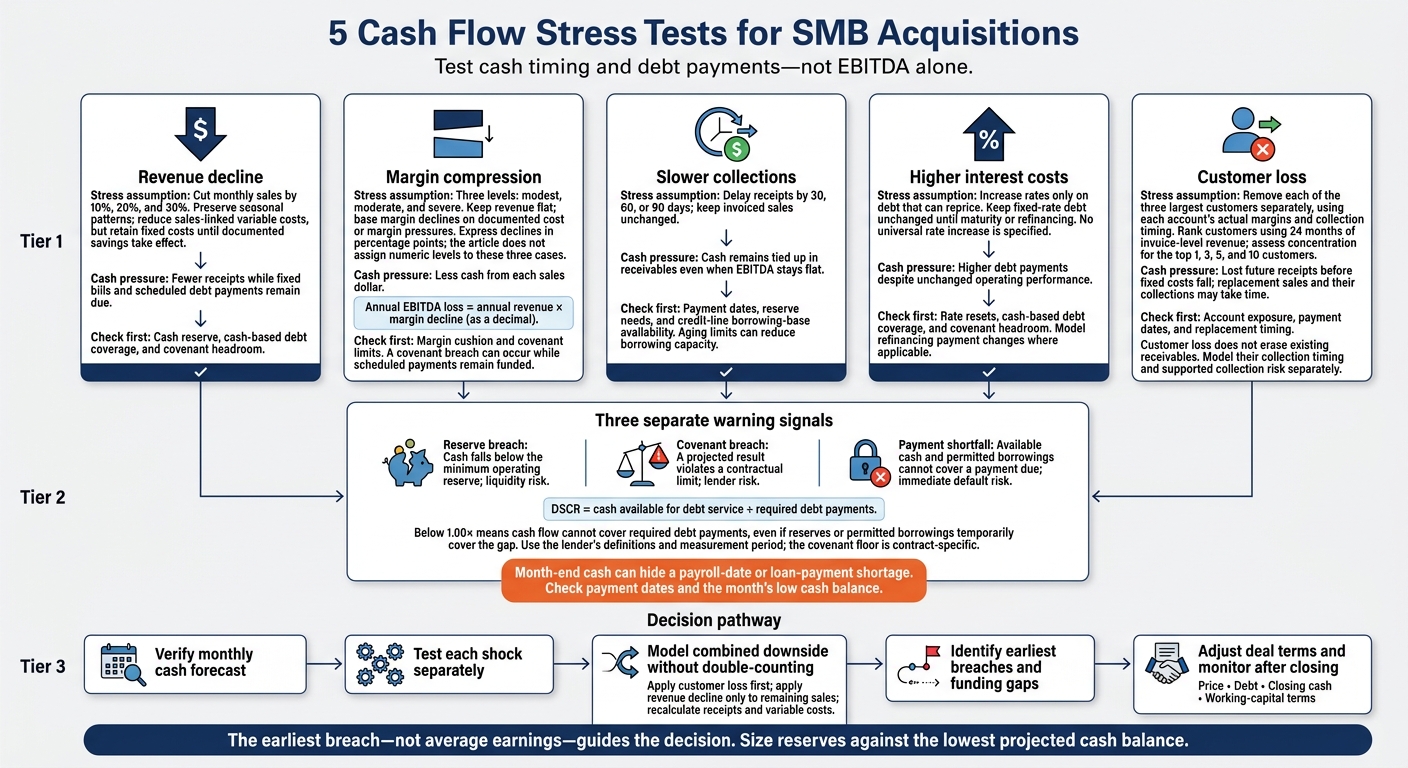
5 Cash Flow Stress Tests for SMB Acquisitions
Stress Testing Your Deal: Will Your Business Survive Real-World Shocks?
sbb-itb-97ecd51
Build a Verified Monthly Cash-Flow Forecast
Before projecting cash, reconcile monthly statements with customer invoices, supplier bills, and receivables aging. Check for duplicate billing and related-party transactions. Measure customer concentration using external customer revenue, not intercompany totals.
Define Adjusted EBITDA and document each permitted add-back. Include supporting records for one-time transaction costs or litigation settlements. Then reflect those add-backs in the cash forecast below.
Base monthly receipts on seasonal sales, actual collection patterns, and receivables aging. A customer with 90- to 120-day payment terms shouldn't produce cash in the month you issue the invoice. Use actual cash timing - not accrual timing - for collections, inventory, and supplier payments. Include capital spending and integration costs, and confirm that the purchase agreement delivers the normalized working capital assumed in the forecast.
Create a schedule for every debt instrument, recording its terms and how it will be handled at closing. Set beginning cash from the closing funds flow and identify a minimum operating reserve. Label each column by month and year, and clearly mark illustrative figures as hypothetical U.S. dollars.
Calculate ending cash as beginning cash plus receipts and financing received, minus operating outflows, capex, integration costs, and debt service. Use this baseline to test the five downside scenarios below.
Set Cash and Debt-Service Warning Levels
Add a warning panel to each monthly forecast showing beginning cash, ending cash, operating cash flow, cash after capex, required debt payments, and the month’s low cash balance. This helps flag when debt service becomes unsafe. Month-end cash can look fine while hiding a shortage on a payroll or loan-payment date. Apply these warning levels to each downside scenario below.
Set a minimum operating reserve to cover near-term fixed obligations. Flag each month that falls below it and show the dollar gap. Track accounts receivable alongside cash, too: late collections can signal pressure before a debt payment is missed.
Calculate DSCR as cash available for debt service ÷ required debt payments, using the lender’s definitions and measurement period. A ratio below 1.00× means cash flow cannot cover required debt payments - even if reserves or permitted borrowings cover the gap temporarily. For covenant analysis, follow the loan agreement’s definitions rather than a generic ratio. Track covenant headroom separately: the distance between each projected result and its contractual limit.
Use three clear labels to distinguish the failure modes:
- Reserve breach: Liquidity risk because cash falls below the minimum operating reserve.
- Covenant breach: Lender risk because a projected result violates a contractual limit.
- Payment shortfall: Immediate default risk because available cash and permitted borrowings cannot cover a payment due.
A business can breach a covenant before it misses a payment. Keep these labels separate to show which scenario breaks cash first, which breaks covenants first, and which threatens payment.
1. Revenue Decline
Stress Assumptions
Use 24 months of invoice-level revenue to model 10%, 20%, and 30% monthly revenue cuts, keeping seasonal patterns intact. Reduce variable costs that track sales. Keep fixed expenses, including dedicated staff and specialized equipment, unchanged until you can document actual savings.
Calculate stressed EBITDA by subtracting adjusted operating costs from reduced revenue. Then test each cut level against cash balances, debt service, and covenants below.
Cash Balances and Reserve Breaches
Run each scenario through the monthly cash forecast. Record the first month cash falls below the reserve requirement, the lowest cash balance, and the shortfall for each case.
Debt Payments and DSCR
Keep scheduled principal and interest payments unchanged. Test debt service using cash flow, not EBITDA. Show monthly coverage and DSCR over the lender’s measurement period. Check whether covenant limits are breached before cash becomes insufficient to make payments.
Covenant Headroom and Corrective Actions
After debt service, check whether each revenue cut leaves covenant headroom intact. Compare each scenario with the loan’s contractual limits, and apply cost cuts only from the date they can take effect.
If cash stays tight, test higher closing liquidity or revised terms. Include any earn-out or seller-financed vendor take-back (VTB) payments in the stressed forecast.
2. Margin Compression
If revenue holds steady but costs climb, test margin compression next.
Stress Assumptions
Keep revenue flat and test EBITDA margin at three shock levels: modest, moderate, and severe. Base the percentage-point declines on historical margin volatility, labor pressure, supplier quotes, discounting, mix changes, or low utilization. Link each decline to a specific cause, such as higher recruiting and training costs, weaker mix, or underused staff and equipment.
Annual EBITDA loss = annual revenue × margin decline (expressed as a decimal).
Cash Balances and Reserve Breaches
Add the higher costs to the monthly cash forecast to see how quickly each scenario uses up the reserve. Keep collections unchanged. Slow-pay terms belong in the slower-collections scenario.
Debt Payments and DSCR
Use the lender’s DSCR definition to check whether lower operating cash flow still covers required debt service. Margin pressure can cause a covenant breach even when cash is sufficient to make scheduled payments.
Covenant Headroom and Corrective Actions
Translate EBITDA headroom into margin points by dividing the covenant cushion by annual revenue. Compare that cushion with historical margin volatility.
Test documented supplier savings, staffing changes, or customer repricing before counting on them. If headroom remains thin, tie earn-outs or VTB notes to margin maintenance or retention.
If margin holds but cash still tightens, test slower collections next.
3. Slower Collections
Stress Assumptions
Delay collections by 30, 60, or 90 days while keeping invoiced revenue unchanged. Use receivables aging and actual payment history to shift monthly cash receipts. Model disputes or declining credit quality separately as a nonpayment case.
Cash Balances and Reserve Breaches
Calculate how much cash stays tied up in receivables even though sales haven’t changed. Then use the monthly forecast to find the first reserve breach and the peak funding gap.
Debt Payments and DSCR
Compare delayed receipts against each scheduled debt payment. EBITDA can stay flat while cash available for debt service falls. When covenant calculations include working-capital changes, higher receivables can also reduce covenant coverage.
Covenant Headroom and Corrective Actions
Recalculate the borrowing base each month using aging limits, advance rates, and exclusions. Don’t assume the full credit line will remain available. Aging limits can cut borrowing capacity before revenue changes.
Review overdue balances with customers, resolve disputes, and confirm promised payment dates. Add enough cash reserves or committed financing to cover the remaining gap.
4. Higher Interest Costs
Steady operations don’t guarantee steady cash flow. When debt rates rise, monthly payments increase. That can trigger reserve or covenant breaches even if EBITDA hasn’t changed.
Stress Assumptions
Stress only debt that can reprice, such as variable-rate SBA 7(a) loans and vendor take-back (VTB) notes. Keep fixed-rate debt unchanged until maturity or refinancing.
Cash Balances and Reserve Breaches
Recalculate monthly interest and total debt service using the revised debt balance. Higher interest costs leave less cash for operations and debt service. Track month-end cash balances and payment timing to spot reserve breaches. If the plan includes refinancing, model the new payment rather than carrying forward the old one.
Debt Payments and DSCR
Update the monthly model’s total debt service, including interest, principal, and any payment changes tied to refinancing. Test DSCR against scheduled debt service using the lender’s definitions. DSCR can fall even when operating performance stays flat because debt payments have increased.
Covenant Headroom and Corrective Actions
Test rate sensitivity before closing - not after it becomes a problem. Increase the modeled rate until DSCR reaches the covenant floor, then record the first month it falls below that limit. Before closing, test a higher-rate scenario and consider more equity at closing, less debt, or performance-based VTB notes or earn-outs.
5. Customer Loss
Even steady margins can’t protect cash flow when too much revenue comes from too few customers.
Stress Assumptions
Use 24 months of invoice-level revenue to rank customers by revenue share. Then test the loss of the largest customer and each of the next two largest separately. Calculate revenue concentration for the top 1, 3, 5, and 10 customers.
Remove only variable costs that would disappear. Keep unavoidable payroll, rent, and other fixed commitments in the forecast. Model the timing of replacement sales separately from the timing of cash collections.
Review the top 10 customer contracts for assignment terms and change-of-control provisions. Check each account’s margins and collection history. Flag assumptions that lack support, especially those about replacement-sales timing and cost savings. Use conservative ranges rather than assuming a fast recovery.
Build these assumptions into the monthly forecast to see when customer concentration creates a cash shortfall.
Cash Balances and Reserve Breaches
Lost future sales and unpaid invoices are separate issues. Losing a customer does not erase existing receivables. Model when those invoices will be collected and include any collection risk supported by the facts.
Show the monthly cash gap caused by lost receipts, delays in cost savings, and expenses tied to replacement sales.
Debt Payments and DSCR
Customer loss leaves less cash for debt service, but scheduled payments stay the same. Recalculate EBITDA using each account’s actual margin. Then update cash available for debt service and DSCR using the lender’s definitions.
Check payment dates - not just month-end balances. The timing of receivable collections can leave a debt payment unfunded before the monthly forecast shows a deficit.
Covenant Headroom and Corrective Actions
Identify which account losses would push DSCR below the covenant floor. Also check whether those customer relationships depend on the seller personally.
Before closing, resolve assignment and change-of-control issues, fund the forecasted cash gap, and consider a customer-attrition escrow or earnout. For owner-dependent accounts, budget for a 12- to 24-month seller transition with a phased handoff of customer relationships.
Compare Separate and Combined Downside Scenarios
Test each shock separately, then compare the base case, five shock cases, and combined downside on the same timeline. This shows which risk puts cash under pressure first. Report monthly minimum cash separately from payment-date shortfalls. Place the reserve threshold, covenant floor, and DSCR measurement period beside the table.
Scenario (hypothetical U.S. dollars) Minimum cash Ending cash First reserve breach First payment shortfall DSCR (LTM) Covenant breach Additional funding needed to maintain reserve Base case $150,000 $250,000 None None 1.50x None $0 Revenue decline (-20%) $110,000 $180,000 Month 8 None 1.25x None $40,000 Margin compression (-5 percentage points) $95,000 $140,000 Month 6 None 1.15x DSCR below covenant floor $55,000 Slower collections (+30 days) $40,000 $210,000 Month 3 None 1.70x None $110,000 Higher interest (+2 percentage points) $220,000 $390,000 None None 1.55x None $0 Customer loss (major account) $60,000 $85,000 Month 2 Month 11 0.95x DSCR below floor and reserve breach $140,000 Combined downside ($45,000) ($120,000) Month 2 Month 5 0.65x Reserve breach, covenant breach, and payment shortfall $350,000
This table is a hypothetical reporting layout, not a validated funding calculation. DSCR uses a last-twelve-month (LTM) measurement period. Before using it for a deal, define the reserve threshold and covenant floor, then recalculate every breach date and funding amount.
Run the combined downside through the model rather than adding the separate losses. Apply the customer loss first, then apply the revenue decline only to remaining sales. Recalculate receivables using stressed sales and collection timing, and adjust variable costs for changes in volume and margins. Express margin compression and higher interest as percentage-point changes.
Use the earliest breach date to trigger action. Track reserve risk, covenant risk, and payment risk separately. Slower collections may call for early funding even when LTM DSCR is strong. Customer loss or margin compression may breach covenants before a payment is missed. Record that covenant pressure, and carry the earliest breach date and funding gap into deal terms and diligence.
Apply Stress Tests to Deal Terms and Diligence
Use the earliest breach date and funding gap to set deal terms before closing. Negotiate price, debt, and reserve terms that leave room under the covenants and protect the deal against downside risk.
Set the working-capital peg using trailing 12-month normalized working capital. The purchase agreement should define which accounts are included, the accounting rules, true-up mechanics, and procedures for resolving disputes through an independent accountant.
Next, test the assumptions behind the numbers. Split diligence into three checks:
- Financial diligence: Have an independent accountant check revenue cut-off, add-backs, margins, and receivables against invoices, bank records, and subsequent collections.
- Customer diligence: Verify concentration and retention using customer records and contracts.
- Financing diligence: Confirm debt terms, covenant definitions, amortization, and facility restrictions with the lender.
Use Kumo to screen acquisition candidates before diligence begins. It does not replace target records, independent diligence, or a deal-specific cash-flow model.
Conclusion: Match Deal Terms to Downside Cash Needs
Each shock cuts the cash available for debt service in a different way.
Use the model’s worst month to set deal terms. Size reserves against the lowest projected cash balance - not average earnings - and identify the earliest reserve breach, covenant breach, and payment shortfall. Compare the funding gap and DSCR with lender limits, then adjust price, leverage, and working-capital terms. If revenue is concentrated, consider retention-linked earn-outs or vendor take-back notes.
Count only corrective actions that can take effect before the first cash shortfall. Model when customer-specific fixed costs will actually drop out of the forecast.
Update the model when diligence changes earnings, concentration, or financing terms. After closing, use that same monthly model to track performance. Each month, compare actual collections, cash, and debt payments with the forecast.
FAQs
How much cash should I reserve for an acquisition?
Set your cash reserve using a 13-week cash flow model, not rules of thumb. Review past working capital needs, then stress-test the model for revenue declines, tighter margins, slower collections, higher interest costs, and customer loss. Check whether you can keep the business running and make debt payments under those conditions.
Consider escrow or holdback funds - typically 5%–15% of the purchase price - to cover potential liabilities or revenue shortfalls. Review forecasts quarterly and adjust them monthly.
How do I choose realistic stress-test assumptions?
Build business-specific, driver-based models instead of relying on simple trend lines. Review 3–5 years of historical data to identify seasonality and changes in how the business runs. Check assumptions against industry benchmarks, and account for both external economic pressures and steps to limit their impact before they occur.
Prioritize a 13-week cash flow forecast. Test changes of at least 2% in revenue, 100 basis points in contribution margins, or 50 basis points in covenant headroom.
When should stress-test results make me walk away?
Consider walking away if stress tests show the business can’t stay financially stable. Warning signs include a debt service coverage ratio that can’t support debt payments after losing a major customer, or trouble making those payments at 70% of projected revenue.
Customer concentration can also rule out financing. A single customer accounting for more than 40% of revenue often disqualifies a business; buyers typically walk away when the top three customers account for more than 50%.