

Codely v2.0 public release is here
Lorem ipsum dolor sit amet, consectetur adipiscing elit lobortis arcu enim urna adipiscing praesent velit viverra sit semper lorem eu cursus vel hendrerit elementum morbi curabitur etiam nibh justo, lorem aliquet donec sed sit mi dignissim at ante massa mattis.
- Neque sodales ut etiam sit amet nisl purus non tellus orci ac auctor
- Adipiscing elit ut aliquam purus sit amet viverra suspendisse potent i
- Mauris commodo quis imperdiet massa tincidunt nunc pulvinar
- Adipiscing elit ut aliquam purus sit amet viverra suspendisse potenti
What has changed in our latest release?
Vitae congue eu consequat ac felis placerat vestibulum lectus mauris ultrices cursus sit amet dictum sit amet justo donec enim diam porttitor lacus luctus accumsan tortor posuere praesent tristique magna sit amet purus gravida quis blandit turpis.
All new features available for all public channel users
At risus viverra adipiscing at in tellus integer feugiat nisl pretium fusce id velit ut tortor sagittis orci a scelerisque purus semper eget at lectus urna duis convallis. porta nibh venenatis cras sed felis eget neque laoreet suspendisse interdum consectetur libero id faucibus nisl donec pretium vulputate sapien nec sagittis aliquam nunc lobortis mattis aliquam faucibus purus in.
- Neque sodales ut etiam sit amet nisl purus non tellus orci ac auctor
- Adipiscing elit ut aliquam purus sit amet viverra suspendisse potenti
- Mauris commodo quis imperdiet massa tincidunt nunc pulvinar
- Adipiscing elit ut aliquam purus sit amet viverra suspendisse potenti
Coding collaboration with over 200 users at once
Nisi quis eleifend quam adipiscing vitae aliquet bibendum enim facilisis gravida neque. Velit euismod in pellentesque massa placerat volutpat lacus laoreet non curabitur gravida odio aenean sed adipiscing diam donec adipiscing tristique risus. amet est placerat in egestas erat imperdiet sed euismod nisi.
“Nisi quis eleifend quam adipiscing vitae aliquet bibendum enim facilisis gravida neque velit euismod in pellentesque massa placerat”
Real-time code save every 0.1 seconds
Eget lorem dolor sed viverra ipsum nunc aliquet bibendum felis donec et odio pellentesque diam volutpat commodo sed egestas aliquam sem fringilla ut morbi tincidunt augue interdum velit euismod eu tincidunt tortor aliquam nulla facilisi aenean sed adipiscing diam donec adipiscing ut lectus arcu bibendum at varius vel pharetra nibh venenatis cras sed felis eget dolor cosnectur drolo.
Not every SBA loan requires a Phase I ESA. I’d start by checking the business’s NAICS code, the property’s past uses, and your lender’s screening results - not just the loan amount.
Here’s what I’d confirm before ordering a report:
- Industry and property history: SBA-listed industries require a Phase I regardless of loan size. Past fuel sales, dry cleaning, or industrial use can also trigger review.
- Screening findings: Other properties may need a Phase I based on risk. Its findings may lead to Phase II testing.
- Lender rules: SBA requirements are the minimum. Ask which SOP applies and whether your lender requires more.
- Report acceptance: Get written instructions on scope, consultant requirements, report age, reliance documents, and deadlines. An existing ESA is not automatically acceptable.
With a Phase I typically costing $1,500–$5,000, I’d <u>confirm the lender’s requirements before paying for a report</u> - and ask what must be completed before closing or disbursement.
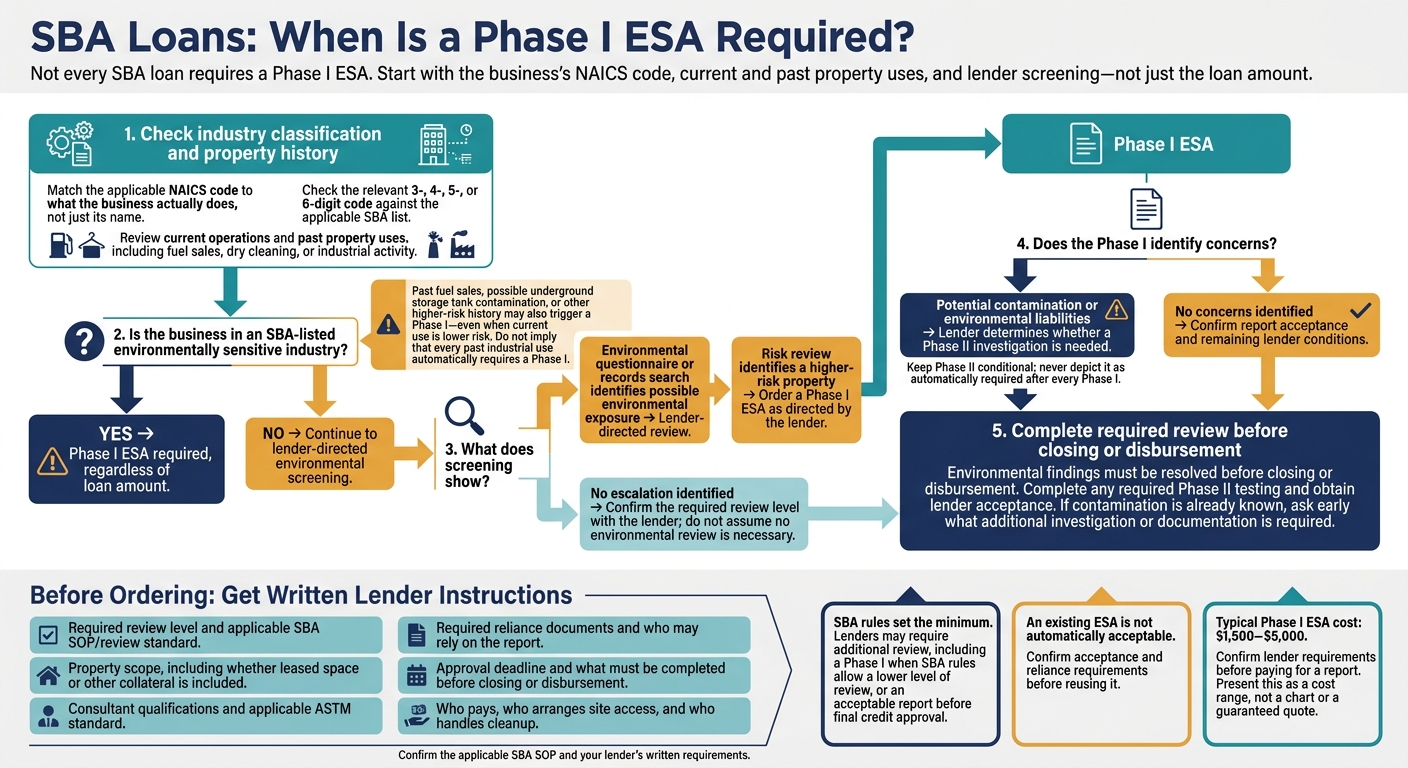
SBA Loans: When Is a Phase I ESA Required?
Property Uses and Industry Codes That Trigger a Phase I
Current Use, Past Use, and NAICS Codes
Lenders review both current and past property use. Buyers should check the business’s industry classification and available property-history records early. An office today may still carry risks from past uses.
Match the applicable NAICS code to what the business actually does, not just its name. These history checks also help determine whether the file needs deeper environmental review.
| Screening factor | Information to verify | Potential investigation escalation |
|---|---|---|
| Current use | Actual operations and industry category | Phase I if current operations fall within a listed NAICS code |
| Past use | Prior fuel sales, dry cleaning, or industrial activity | Phase I may be required even with lower-risk current use |
| NAICS classification | Relevant 3-, 4-, 5-, or 6-digit code | A listed classification triggers a Phase I ESA |
Fuel Sales, Storage Tanks, and Known Contamination
A former fuel-dispensing site needs close review. Past fuel sales and possible underground storage tank contamination can still trigger a Phase I ESA at a former gas station. If the Phase I identifies concerns, the lender may require a Phase II ESA.
If contamination is already known, ask early what additional investigation or documentation the lender requires before closing. At that point, the question shifts from what triggers a review to how much investigation is needed, moving the file into the next review step.
sbb-itb-97ecd51
Phase I vs Phase II Environmental Assessment Explained | Commercial Real Estate Due Diligence
Screening Results That Require Further Investigation
Screening results determine whether a file stops at initial review or moves to Phase I or Phase II. The lender considers the business type and environmental exposure to decide how much review is needed. Environmental findings must be resolved before closing or disbursement.
When Screening Leads to Phase I or Phase II
If screening flags a deal, the lender decides whether it needs Phase I or Phase II review. Even nonlisted deals may require a Phase I if the property poses higher environmental risk.
| Investigation or screening method | Finding | Next step |
|---|---|---|
| Environmental questionnaire or records search | Possible environmental exposure | Move to lender-directed review |
| Risk review | Higher-risk property | Order a Phase I ESA |
| Phase I ESA | Potential contamination or environmental liabilities | Lender determines whether a Phase II investigation is needed |
If the Phase I identifies concerns, budget for or pursue a Phase II environmental investigation as directed by the lender.
When an Existing ESA Report Can Be Reused
Already have an ESA? Confirm that the lender will accept it for the SBA file. A prior report does not automatically qualify.
SBA Requirements vs. Lender Conditions
When screening flags a deal, lenders can require more environmental review than SBA rules alone call for. SBA rules set the minimum. A lender may require a Phase I ESA even when the SBA allows a lower level of review.
| Requirement area | SBA baseline | Lender-specific condition |
|---|---|---|
| Investigation triggers | NAICS-listed environmentally sensitive industries require a Phase I ESA, regardless of loan amount. | May require a Phase I for higher-risk properties or businesses. |
| Collateral scope | Environmental review applies to the relevant commercial real estate collateral. | May extend the review to leased space or other collateral. |
| Report standards | The report and supporting documents must meet SBA environmental review requirements. | May require certain consultant qualifications, ASTM-compliant work, or a Phase II if the Phase I flags concerns. Confirm lender reliance requirements before hiring the consultant. |
| Timing | The review must meet SBA requirements for the loan. | May require an acceptable report before final credit approval. |
Why Lenders May Require More Than SBA Rules
Lenders may set extra conditions based on transaction risk and their internal standards. Separate SBA requirements from lender conditions: ask which SBA review standard applies and what else the lender requires, including review of leased space or other collateral.
What Buyers Should Confirm Before Ordering a Report
Get the lender’s requirements in writing before hiring a consultant. Confirm the review level, property scope, consultant qualifications, applicable ASTM standard, maximum acceptable report age, required reliance documents, and approval deadline.
Also confirm who pays for the report, who arranges site access, and who handles cleanup. A Phase I ESA typically costs $1,500 to $5,000. Checking the scope first can help you avoid paying for a report the lender won’t accept.
Conclusion: Confirm Requirements Before Ordering an ESA
If the file is still unresolved, run this final check before ordering an ESA.
Use property history, NAICS code, and screening results to determine whether a Phase I ESA is required.
Before placing an order:
- Verify the requirement: Confirm whether the deal needs a Phase I ESA.
- Get written lender instructions: Separate SBA requirements from any additional lender conditions.
- Check report acceptance and reliance: Confirm whether an existing ESA report is acceptable and who may rely on it. Complete any required Phase II testing before closing.
This review helps prevent unnecessary costs and ordering the wrong level of environmental work.
FAQs
How do I verify past property uses and NAICS codes?
Review aerial photographs and topographic maps, then speak with previous owners or local officials to learn how the property was used in the past. Look for possible concerns, such as underground storage tanks.
Check the business’s NAICS code against the SBA’s List of Environmentally Sensitive Industries. Businesses in listed industries - including auto repair, dry cleaning, machine shops, gas stations, and manufacturing - need a Phase I ESA regardless of the loan amount [3].
How can I distinguish SBA rules from lender conditions?
SBA requirements are mandatory standards set out in Standard Operating Procedure (SOP) 50 10 8. They cover loan eligibility, environmental compliance, and documentation needed to protect the SBA guaranty [3].
Lender conditions are extra requirements a lender sets internally. These may include underwriting criteria, documentation preferences, or risk management policies [4][5]. You must meet SBA requirements for the guaranty, but your lender may also ask for more information or impose stricter terms before approving your loan [4].
Can I get an SBA loan if Phase II finds contamination?
Yes, but the process takes more work. You must provide detailed remediation plans that cover planned and completed activities, methods, estimated costs, and effects on collateral value.
Lenders must submit environmental documents through E-Tran and notify the SBA at EnvironmentalReviews@sba.gov. The SBA’s Office of General Counsel reviews the materials to decide whether the loan can proceed or more information is needed.
Related Blog Posts
- SBA 7(a) Loan Basics for Business Buyers
- SBA Loan Terms: What Buyers Need to Know
- Top things to know about the June 1, 2025, the U.S. Small Business Administration (SBA) has implemented significant changes to its Standard Operating Procedure (SOP) 50 10 8, which governs the 7(a) and 504 loan programs
- SBA Loans and Environmental Compliance Explained