

Codely v2.0 public release is here
Lorem ipsum dolor sit amet, consectetur adipiscing elit lobortis arcu enim urna adipiscing praesent velit viverra sit semper lorem eu cursus vel hendrerit elementum morbi curabitur etiam nibh justo, lorem aliquet donec sed sit mi dignissim at ante massa mattis.
- Neque sodales ut etiam sit amet nisl purus non tellus orci ac auctor
- Adipiscing elit ut aliquam purus sit amet viverra suspendisse potent i
- Mauris commodo quis imperdiet massa tincidunt nunc pulvinar
- Adipiscing elit ut aliquam purus sit amet viverra suspendisse potenti
What has changed in our latest release?
Vitae congue eu consequat ac felis placerat vestibulum lectus mauris ultrices cursus sit amet dictum sit amet justo donec enim diam porttitor lacus luctus accumsan tortor posuere praesent tristique magna sit amet purus gravida quis blandit turpis.
All new features available for all public channel users
At risus viverra adipiscing at in tellus integer feugiat nisl pretium fusce id velit ut tortor sagittis orci a scelerisque purus semper eget at lectus urna duis convallis. porta nibh venenatis cras sed felis eget neque laoreet suspendisse interdum consectetur libero id faucibus nisl donec pretium vulputate sapien nec sagittis aliquam nunc lobortis mattis aliquam faucibus purus in.
- Neque sodales ut etiam sit amet nisl purus non tellus orci ac auctor
- Adipiscing elit ut aliquam purus sit amet viverra suspendisse potenti
- Mauris commodo quis imperdiet massa tincidunt nunc pulvinar
- Adipiscing elit ut aliquam purus sit amet viverra suspendisse potenti
Coding collaboration with over 200 users at once
Nisi quis eleifend quam adipiscing vitae aliquet bibendum enim facilisis gravida neque. Velit euismod in pellentesque massa placerat volutpat lacus laoreet non curabitur gravida odio aenean sed adipiscing diam donec adipiscing tristique risus. amet est placerat in egestas erat imperdiet sed euismod nisi.
“Nisi quis eleifend quam adipiscing vitae aliquet bibendum enim facilisis gravida neque velit euismod in pellentesque massa placerat”
Real-time code save every 0.1 seconds
Eget lorem dolor sed viverra ipsum nunc aliquet bibendum felis donec et odio pellentesque diam volutpat commodo sed egestas aliquam sem fringilla ut morbi tincidunt augue interdum velit euismod eu tincidunt tortor aliquam nulla facilisi aenean sed adipiscing diam donec adipiscing ut lectus arcu bibendum at varius vel pharetra nibh venenatis cras sed felis eget dolor cosnectur drolo.
When acquiring a business, you inherit not just its assets but also its legal and compliance risks, including potential sanctions violations. Failing to address sanctions issues during mergers and acquisitions (M&A) can lead to severe penalties, business losses, and reputational damage. Here's what you need to know upfront:
- Sanctions Risks: Violations can result from dealings with restricted countries, entities, or individuals. Successor liability means you may be held accountable for the target's past violations.
- Key Steps:
- Early Risk Assessment: Screen high-risk geographies, industries (e.g., defense, oil and gas), and ownership structures.
- Due Diligence: Investigate the target's counterparties, compliance history, and operations for exposure to sanctions.
- Deal Structuring: Use specific clauses, closing conditions, and indemnities to manage risks.
- Post-Closing Compliance: Within 90 days, integrate the target into your compliance program, rescreen relationships, and address risks.
Tools like Kumo can streamline the process by flagging red flags early, helping you avoid costly mistakes. Sanctions compliance isn’t just about avoiding penalties - it’s about protecting your business and ensuring smooth transactions.
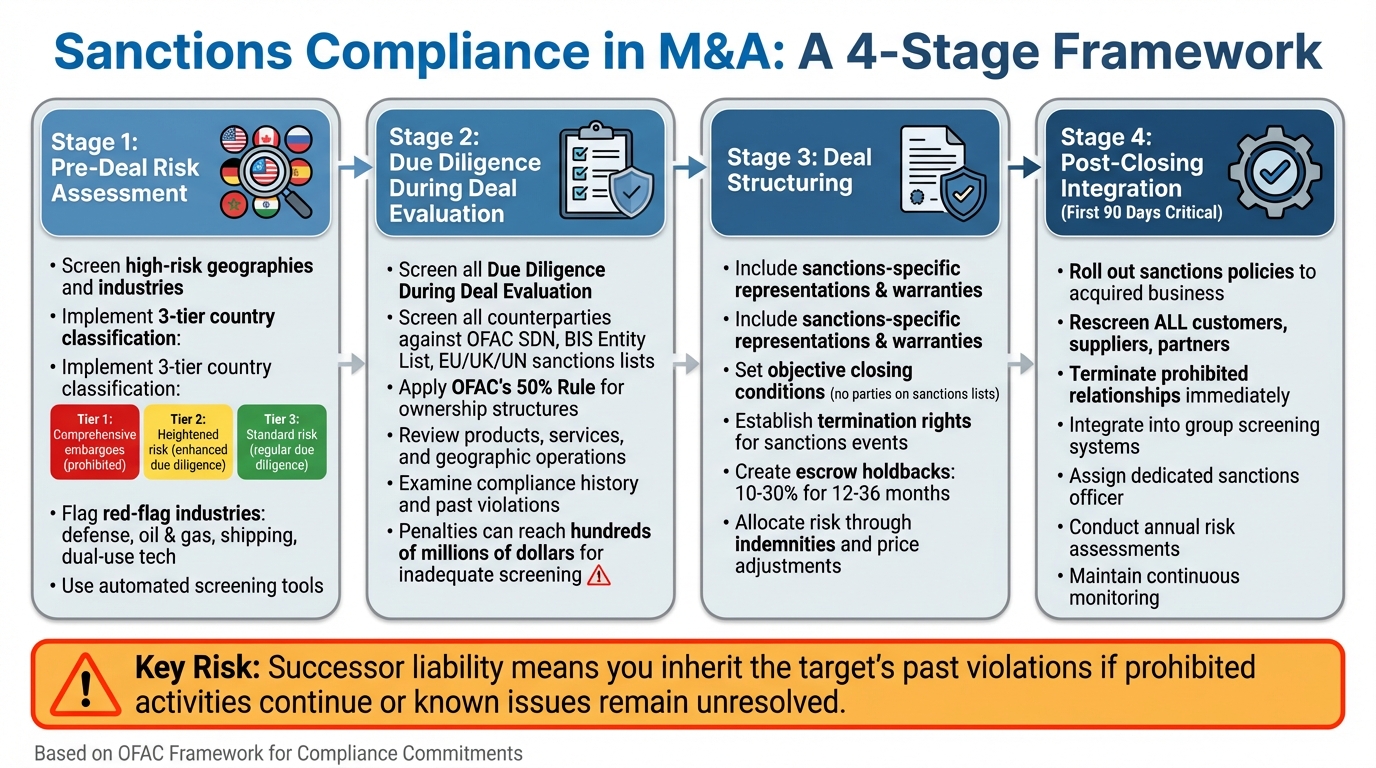
4-Stage Sanctions Compliance Framework for M&A Transactions
Sanctions Risk Assessment Before Sourcing Deals
Identifying High-Risk Countries and Industries
Before diving into negotiations with potential sellers, it’s crucial to pinpoint the geographies and industries that either require extra caution or are outright off-limits. According to OFAC's Framework for Compliance, M&A activities are a frequent source of sanctions violations. To mitigate this, integrating sanctions risk assessment into your deal-sourcing process is a must.
A practical starting point is setting up a three-tier country classification system:
- Tier One: These are jurisdictions under comprehensive U.S. embargoes. M&A activity here is essentially prohibited unless you're planning to wind down operations.
- Tier Two: Countries in this group pose heightened risks and demand enhanced due diligence. This includes regions near sanctioned states or those with a high presence of specially designated nationals (SDNs).
- Tier Three: These are standard-risk countries where regular due diligence is sufficient.
For U.S. buyers, OFAC generally sets the baseline, but EU and UK sanctions rules can add additional layers of complexity.
When it comes to industries, some sectors are under more scrutiny than others. Defense, oil and gas, shipping and logistics, dual-use technology, advanced electronics, aerospace, and financial services are often targeted by sanctions and export control regimes. For instance, a defense contractor with government clients in high-risk regions or a maritime logistics company operating near sanctioned ports should immediately trigger further legal and compliance reviews.
Be on the lookout for warning signs that suggest elevated risk, such as:
- Operations or customers near sanctioned areas.
- Significant revenue in U.S. dollars from high-risk countries, which could bring transactions under U.S. jurisdiction.
- A large number of government or state-owned enterprise customers, especially in energy, defense, or infrastructure sectors.
- Links to sanctioned intermediaries in shipping, trading, or logistics.
- A history of export licenses, re-export activities, or dealings in dual-use goods.
Spotting these red flags early on can help you decide whether to walk away or include specific sanctions-related protections before moving forward. This classification system is a valuable tool for your initial risk assessment.
Initial Risk Scoping Checklist
An efficient checklist can help you capture key risks without overwhelming your deal team. Start by evaluating the target’s corporate structure, ownership (including ultimate beneficial owners and government connections), and geographic footprint. Pay special attention to incorporation, operational hubs, and key financial flows, as these can reveal potential sanctions risks. Under OFAC's "50 Percent Rule", any entity owned at least 50% by one or more blocked persons is treated as blocked, even if it’s not explicitly listed. This makes opaque offshore structures or unexplained holding companies immediate red flags.
Next, review revenue streams to identify exposure to U.S. dollars, which could trigger U.S. jurisdiction. After ownership and geography are verified, examine operational aspects like products, services, and compliance history. This includes checking for activities in sensitive sectors and assessing any reliance on U.S. employees, management, servers, or banking systems. Even non-U.S. targets with these touchpoints can face enforcement actions.
Finally, evaluate the target's existing compliance measures. Look for any prior government inquiries or penalties related to sanctions, export controls, anti-money laundering, or bribery. This checklist should be concise enough to complete using a teaser, a confidential information memorandum (CIM), or a brief seller questionnaire. Any red flags should immediately prompt a deeper review by legal and compliance experts.
Leveraging Technology to Minimize Risk
Technology can streamline your risk assessment process, helping you identify high-risk deals before investing too much time or money. Screening tools that integrate OFAC, EU, and UN sanctions lists can flag risky countries, entities, and individuals based on basic information like the target’s name, jurisdiction, key shareholders, and trading partners.
Platforms with batch screening capabilities and custom rules can automatically flag high-risk entities. For example, you can block companies incorporated in specific high-risk jurisdictions or flag those that exceed a set risk threshold. Integrating these tools with your CRM or deal pipeline systems can also trigger alerts when a target’s risk profile changes, such as when new sanctions are imposed on a country.
Kumo is one such tool that embeds sanctions risk into your sourcing workflow. It allows you to filter out listings from countries on your internal "do not pursue" list and flag high-risk industries like defense, oil and gas, or maritime logistics. With its global coverage and data analytics, Kumo can help you analyze regions or sectors in your pipeline that show higher risk factors, such as proximity to sanctioned jurisdictions or significant U.S.-dollar cross-border flows. This approach helps you focus on acquisitions that align with your compliance standards and risk appetite.
Mastering Sanctions Risk Assessment: Key Components and Methodologies
Sanctions Due Diligence During Deal Evaluation
Careful sanctions due diligence is a must to avoid hefty penalties and successor liability. Once you've identified a promising target, it's time to dig deeper. At this stage, you're not just skimming the surface; you're building a thorough risk profile of the target's ownership, business operations, customer relationships, and transaction flows. This process typically runs alongside legal and compliance reviews, and any red flags you uncover should influence valuation, deal terms, or even the decision to walk away.
It's critical to determine if the target has any current or past sanctions exposure that could result in successor liability or enforcement actions post-closing. Data from the Office of Foreign Assets Control (OFAC) shows penalties for sanctions violations can climb into the hundreds of millions of dollars, often due to inadequate due diligence and screening. To mitigate these risks, your diligence process should include counterparty screening, a review of product and location risks, and an analysis of the target's compliance history. This more in-depth review builds on earlier risk assessments and helps shape how the deal is structured.
Screening Counterparties and Assessing Risk
Start by gathering detailed information about everyone the target does business with. This includes:
- Ownership structures: Direct and indirect shareholders, ultimate beneficial owners, and politically exposed persons (PEPs).
- Key business relationships: Major customers, suppliers, distributors, agents, and logistics providers, along with their locations and ownership details.
- Key personnel: Employees and managers, especially those involved in international sales or financial operations.
Run these names through OFAC's SDN and Consolidated Sanctions Lists, as well as other U.S. lists like the BIS Entity List. Depending on the regions involved, you may also need to check EU, UK, and UN sanctions lists. Pay close attention to ownership thresholds, including OFAC's 50 Percent Rule. If you encounter opaque ownership structures or incomplete beneficial ownership data, treat these as serious warning signs.
Next, evaluate the target's sanctions screening processes. Request documentation outlining how and when they screen customers, vendors, and transactions. Check what tools they use - manual or automated - and how often they update their screening lists. Scrutinize how they handle potential matches and false positives, and look for evidence of audits or quality checks. Automated screening systems should support fuzzy matching, transliteration, and detailed logging of reviews and decisions. If their practices are inconsistent, it could signal undetected sanctions risks.
Reviewing Products, Services, and Locations
Once you've screened counterparties, shift your focus to the target's operations and product offerings. Hidden sanctions risks often lurk in geography and product mix. Map out where the target operates and analyze revenue by country to identify high-risk markets. Pay special attention to sales involving resellers, distributors, or freight forwarders, as they could indirectly involve sanctioned countries. Transactions routed through third-party countries like Turkey, the UAE, or Hong Kong may also obscure final destinations.
Check for any dealings with comprehensively sanctioned countries or regions such as Cuba, Iran, North Korea, Syria, or specific areas in Ukraine and Russia. Review shipping records and logistics documentation for signs of misrepresented goods, end-use details, or end-user information that might indicate sanctions evasion.
On the product side, determine whether the target's offerings include dual-use or defense-related technology regulated under U.S. Export Administration Regulations (EAR) or the International Traffic in Arms Regulations (ITAR). Request export classifications (ECCNs), commodity jurisdiction determinations, and licenses the target holds. Assess whether the target has solid export compliance policies, including screening for denied parties and end-use restrictions, license management, and geographic controls integrated into their systems. Products involving controlled software, encryption, or technical assistance to sensitive users or regions demand extra scrutiny.
Examining Past Compliance and Violations
A target's track record with regulators can reveal a lot about its approach to compliance. Request all communications with OFAC, BIS, DDTC, DOJ, and foreign regulators related to sanctions or export controls. This includes voluntary disclosures, subpoenas, and inquiries. Also, review internal investigation reports, audit findings, and minutes from board or committee meetings that discuss sanctions or export risks.
Look for any resolved or ongoing enforcement actions, such as settlements, monitorships, or remedial agreements. Internal violations often expose gaps in controls. It's equally important to check if the target has implemented remedial measures like updating policies, increasing staff, or upgrading technology - and whether these changes were sustained over time.
Finally, evaluate the target's compliance culture. Does leadership prioritize sanctions and export compliance? Are resources allocated appropriately? Review the frequency and scope of compliance training and whether the target conducts regular risk assessments to update its controls. OFAC's Framework highlights five key pillars of an effective compliance program: management commitment, risk assessment, internal controls, testing and auditing, and training. Your diligence process should examine each pillar closely, as this history will directly influence post-deal compliance efforts.
sbb-itb-97ecd51
Structuring Deals to Minimize Sanctions Risk
After conducting thorough sanctions due diligence, the next step is structuring your deal to turn those risk assessments into actionable safeguards within the contract. The way you structure the transaction - whether it’s an asset purchase, stock deal, or carve-out - can significantly reduce sanctions exposure. The aim here is to limit what you're acquiring, manage when and how you assume risks, and establish clear measures to deal with sanctions issues that may arise before or after the deal closes.
Sanctions Clauses in Deal Documents
Your transaction agreement should include detailed sanctions-specific representations and warranties that go beyond standard compliance language. For instance, all parties should confirm that neither they nor their subsidiaries or key owners appear on U.S., EU, UK, or UN sanctions lists, and they are not majority-owned by sanctioned entities. They must also confirm they haven’t engaged in transactions with sanctioned individuals, embargoed countries, or restricted sectors unless authorized by valid licenses.
The agreement should also address the target’s sanctions compliance program, including screening tools, internal controls, and training aligned with OFAC’s guidelines. Sellers should disclose any past or ongoing sanctions investigations, enforcement actions, or penalties. These disclosures, often referred to as "bring-down reps", must hold true both at the time of signing and at closing. While historical issues may include qualifiers like knowledge or materiality thresholds, representations about sanctions list status should remain unqualified.
Between signing and closing, the agreement should require the target to maintain normal operations and adhere to sanctions compliance. Sellers should commit to avoiding new dealings with sanctioned parties or high-risk regions without buyer approval and promptly notify the buyer of any sanctions-related investigations, list designations, or adverse media coverage. These covenants should be backed by access to compliance reports, key records, and the ability to conduct supplemental due diligence as necessary.
Once these representations are in place, the next step is to establish closing conditions that address emerging risks.
Closing Conditions and Protections
Closing conditions are critical for managing sanctions risks that might arise before the deal is finalized. These conditions should include: (1) confirmation that sanctions representations remain true, (2) no significant sanctions law changes that could block the transaction, (3) assurance that no parties involved have been added to sanctions lists, and (4) receipt of any required licenses.
To avoid disputes, these conditions should rely on objective triggers. For example, specify that closing is contingent on none of the parties (e.g., the target, seller, or key subsidiaries) appearing on official sanctions lists like OFAC's SDN List. You might also include a "sanctions MAE" (material adverse effect) clause that explicitly covers sanctions-related events. Clearly referencing official lists, laws, or designations helps eliminate subjective interpretations.
Termination rights should allow you to exit the deal if sanctions issues make closing illegal or commercially unfeasible. Common triggers include:
- The target or seller being designated as a sanctioned party.
- New sanctions that prohibit U.S. persons from acquiring the target’s assets or securities.
- Denial or revocation of required licenses.
- A sanctions-related material adverse effect.
The agreement should specify whether a termination fee applies or is waived in these scenarios and clearly define the evidence - such as an OFAC listing or a published regulation - that triggers this right.
For deals involving substantial sanctions risks, consider staged or deferred closings for high-risk subsidiaries or business operations. This approach gives you more time to conduct additional due diligence or secure necessary licenses. Payment structures can also be adjusted, with key disbursements tied to securing licenses or resolving high-risk contracts. Subsequent payments can be made contingent on avoiding enforcement actions.
Once closing conditions are addressed, focus on allocating any remaining risks through well-crafted deal terms.
Allocating Risk Through Deal Terms
For known risks, include specific indemnities to cover fines, legal fees, and remediation costs. Escrow holdbacks of 10–30% of the purchase price for 12–36 months are a common approach.
You can also structure purchase price adjustments to account for anticipated costs, such as exiting contracts tied to sanctioned entities, shutting down operations in embargoed regions, or implementing enhanced compliance measures like third-party audits. For risks that are harder to predict, general compliance and sanctions warranties should be backed by broader indemnification clauses, with caps and survival periods tailored to the elevated regulatory risks. It’s often wise to set separate caps for sanctions-related claims, as regulatory penalties can be disproportionately large compared to the deal size.
Tie additional payments to specific compliance milestones, such as implementing a sanctions program or passing a third-party audit. Escrow accounts should have clear release conditions, such as the completion of regulatory review periods, absence of enforcement actions, or receipt of comfort letters. It’s also useful to allocate separate escrow funds for sanctions liabilities versus other claims.
Incorporating a sanctions risk scoring model into your acquisition process can help you identify high-risk targets early. Tools like Kumo allow you to filter businesses by geography and industry, helping you prioritize or exclude targets before investing significant resources into due diligence.
Post-Closing Sanctions Compliance
The post-closing phase is where the real work of integrating sanctions compliance begins. Building on the groundwork laid during due diligence, this stage solidifies your risk management and compliance strategy. Regulators will be paying close attention to how quickly and effectively you integrate the acquired business into your sanctions compliance program and address any violations inherited from the acquisition. Keep in mind, successor liability means you could be held responsible for pre-closing violations if prohibited activities continue or known issues are left unresolved. The first 90 days are especially critical for establishing control, identifying risks, and proving that compliance is a top priority.
First 90 Days After Closing
Your first move after closing should be to extend your sanctions compliance policies to the acquired business and eliminate any prohibited relationships. During this 90-day window, focus on these key steps to ensure compliance:
- Roll out your sanctions policies to all employees of the acquired business, and secure written acknowledgments from key management.
- Rescreen all customers, suppliers, and business partners using the latest OFAC, UN, EU, and UK sanctions lists. If you find dealings with sanctioned entities or embargoed jurisdictions, terminate those relationships immediately and document your corrective actions. For any transactions under U.S. jurisdiction, you may also need to freeze accounts and file blocking or rejection reports with OFAC.
- Conduct a thorough post-closing risk assessment. This should focus on the acquired entity’s geographic footprint, industry exposure, product applications, and the ownership structures of key counterparties. Use this assessment to identify high-risk areas and allocate your compliance resources accordingly.
- Integrate the acquired business into your group’s screening systems for customer onboarding, payment filtering, and third-party due diligence. Automating these processes will help ensure consistent sanctions checks.
- Assign a dedicated sanctions officer or team to oversee compliance, reporting directly to senior leadership.
Setting Up a Compliance Program
Once initial risks are addressed, it’s time to formalize your compliance framework. Develop a Sanctions Compliance Program (SCP) that aligns with the core elements outlined by OFAC: management commitment, risk assessment, internal controls, testing and auditing, and training. Your written policies should cover key areas like counterparty screening, payment monitoring, escalation procedures, blocking and reporting requirements, license management, and recordkeeping.
Training plays a vital role in embedding a compliance-first mindset across the acquired business. Offer general awareness training for all employees, along with specialized sessions for high-risk roles like sales, procurement, logistics, finance, and management. Employees should not only understand the rules but also grasp the consequences of violations and know the proper channels for reporting concerns. Set up confidential reporting systems - such as hotlines or online portals - so employees can raise potential issues without fear of retaliation. Additionally, establish clear reporting and disciplinary procedures, and tie performance incentives to compliance efforts.
Ongoing Monitoring and Risk Reviews
Sanctions compliance doesn’t end after the initial integration - it’s an ongoing process that requires continuous monitoring and regular reassessments. These efforts help maintain the safeguards put in place during deal structuring. Conduct formal risk assessments at least once a year, or more often if your business enters new markets, launches new products, or expands its customer base. Keep your screening systems updated with the latest sanctions lists from OFAC, UN, EU, and UK.
Implement continuous or frequent batch screening of customers, beneficial owners, and payments. Leverage data analytics to identify emerging risks, such as increased exposure to high-risk jurisdictions or unusual payment patterns. Regular internal audits are also essential for testing your controls. These audits should include sampling screened transactions, reviewing escalation workflows, and validating data quality.
For businesses actively pursuing acquisitions, tools like Kumo can help monitor exposure to high-risk geographies and sanctioned sectors. Kumo’s data analytics and custom search features can flag potential targets with significant ties to restricted areas and keep you informed about how evolving sanctions might impact future deals. Additionally, establish a process for tracking regulatory changes so that new sanctions programs can be quickly incorporated into your internal rules and business practices. Finally, document all decisions, risk assessments, and remediation efforts thoroughly - this documentation will be essential if regulators later review your compliance program.
Conclusion
Navigating sanctions compliance in M&A requires a thorough, step-by-step approach that begins at deal sourcing and continues through post-closing integration. Leading acquirers treat sanctions risk as a fundamental governance issue, embedding controls throughout the process. This means screening potential targets early - considering geography, industry, and ownership - before committing significant resources. During due diligence, layered screening of counterparties is essential, along with using tailored representations, warranties, and closing conditions to manage risk and guard against successor liability. Once the deal closes, integrating the target into your compliance program within the first 90 days and maintaining ongoing monitoring ensures a smooth transition and mitigates future risks.
Technology has become a game-changer in this process, making compliance efforts faster and more reliable. Automated screening tools, data analytics, and centralized platforms help standardize sanctions checks across multiple deals, cut down on manual work, and provide the audit trails regulators demand. For example, tools like Kumo can filter opportunities by geography and sector, flagging potential targets tied to sanctioned regions before deeper due diligence begins. While technology simplifies risk identification, the stakes remain high.
The risks are clear: OFAC's 2019 Framework highlights that "failure to exercise due caution or care in screening and due diligence" and poor integration of acquired entities can result in multi-million-dollar penalties and lengthy remediation efforts. When you acquire a company, you also take on its sanctions risks. Successor liability means inheriting the target’s violations if prohibited activities persist or known issues remain unresolved.
Effective sanctions compliance doesn’t hinder dealmaking - it enhances it. Standardized playbooks and technology streamline the process, helping you avoid wasting time on legally problematic targets. Clear risk allocation in contracts reduces uncertainty, making you a more appealing bidder to sellers, lenders, and co-investors concerned with regulatory exposure. By integrating sanctions considerations into your investment strategy, due diligence, and post-deal plans, you safeguard value, minimize enforcement risks, and position your organization for compliant, successful growth through M&A.
FAQs
What steps should you take to ensure sanctions compliance during an M&A transaction?
To maintain compliance with sanctions during mergers and acquisitions, the first step is to perform detailed due diligence on the target company's sanctions status. This includes screening all parties involved against up-to-date sanctions lists to spot any potential red flags. It's also essential to create and adhere to internal compliance policies specific to the transaction, and seek advice from legal professionals to navigate the intricate regulatory landscape.
Additionally, keep a close watch for any changes in sanctions that might affect the deal. Make sure to document every compliance measure taken to establish a clear and traceable audit trail. These steps can help safeguard your transaction from potential legal or financial pitfalls.
How can Kumo simplify sanctions compliance in mergers and acquisitions?
Kumo streamlines the complex process of sanctions compliance in mergers and acquisitions by bringing together real-time business data from global sources into one centralized platform. This setup helps quickly pinpoint potential risks and ensures essential information is always at your fingertips.
Equipped with tools like AI-powered filtering, automated change tracking, and tailored search options, Kumo minimizes manual work while improving the precision of compliance checks. This means you can spend less time on tedious tasks and more time assessing opportunities, all while staying on top of regulatory demands.
What are the risks of not addressing sanctions compliance in M&A transactions?
Ignoring sanctions compliance during mergers and acquisitions can lead to severe consequences. Companies risk facing substantial fines, legal action, and reputational harm. Beyond these immediate impacts, transactions may encounter delays, cancellations, or even regulatory roadblocks, disrupting operations and shaking stakeholder confidence.
Neglecting these obligations could also result in the loss of crucial licenses or operating rights, complicating future business opportunities. Prioritizing compliance is not just a legal necessity - it’s key to safeguarding your business and ensuring deals proceed without unnecessary hurdles.