

Codely v2.0 public release is here
Lorem ipsum dolor sit amet, consectetur adipiscing elit lobortis arcu enim urna adipiscing praesent velit viverra sit semper lorem eu cursus vel hendrerit elementum morbi curabitur etiam nibh justo, lorem aliquet donec sed sit mi dignissim at ante massa mattis.
- Neque sodales ut etiam sit amet nisl purus non tellus orci ac auctor
- Adipiscing elit ut aliquam purus sit amet viverra suspendisse potent i
- Mauris commodo quis imperdiet massa tincidunt nunc pulvinar
- Adipiscing elit ut aliquam purus sit amet viverra suspendisse potenti
What has changed in our latest release?
Vitae congue eu consequat ac felis placerat vestibulum lectus mauris ultrices cursus sit amet dictum sit amet justo donec enim diam porttitor lacus luctus accumsan tortor posuere praesent tristique magna sit amet purus gravida quis blandit turpis.
All new features available for all public channel users
At risus viverra adipiscing at in tellus integer feugiat nisl pretium fusce id velit ut tortor sagittis orci a scelerisque purus semper eget at lectus urna duis convallis. porta nibh venenatis cras sed felis eget neque laoreet suspendisse interdum consectetur libero id faucibus nisl donec pretium vulputate sapien nec sagittis aliquam nunc lobortis mattis aliquam faucibus purus in.
- Neque sodales ut etiam sit amet nisl purus non tellus orci ac auctor
- Adipiscing elit ut aliquam purus sit amet viverra suspendisse potenti
- Mauris commodo quis imperdiet massa tincidunt nunc pulvinar
- Adipiscing elit ut aliquam purus sit amet viverra suspendisse potenti
Coding collaboration with over 200 users at once
Nisi quis eleifend quam adipiscing vitae aliquet bibendum enim facilisis gravida neque. Velit euismod in pellentesque massa placerat volutpat lacus laoreet non curabitur gravida odio aenean sed adipiscing diam donec adipiscing tristique risus. amet est placerat in egestas erat imperdiet sed euismod nisi.
“Nisi quis eleifend quam adipiscing vitae aliquet bibendum enim facilisis gravida neque velit euismod in pellentesque massa placerat”
Real-time code save every 0.1 seconds
Eget lorem dolor sed viverra ipsum nunc aliquet bibendum felis donec et odio pellentesque diam volutpat commodo sed egestas aliquam sem fringilla ut morbi tincidunt augue interdum velit euismod eu tincidunt tortor aliquam nulla facilisi aenean sed adipiscing diam donec adipiscing ut lectus arcu bibendum at varius vel pharetra nibh venenatis cras sed felis eget dolor cosnectur drolo.
If you buy a business, these two clauses do different jobs. A confidentiality clause controls how shared deal information gets used. A non-compete clause limits whether the seller can compete after closing.
Here’s the short version:
- Confidentiality covers data like customer lists, employee records, pricing, trade secrets, and financial details.
- Non-compete covers market behavior, like starting a rival business, soliciting customers, or hiring away staff.
- Timing is different: confidentiality often starts during diligence, while non-compete usually matters after closing.
- Duration is different: confidentiality may last several years or longer for trade secrets, while sale-of-business non-competes often run 3 to 5 years.
- State law matters: as of September 26, 2026, U.S. non-compete review still turns mainly on state law, not the FTC’s 2024 nationwide rule.
- One clause is not enough: if you only use confidentiality, the seller may still compete; if you only use a non-compete, deal data may still be misused.
If I had to reduce the whole topic to one line, it would be this: confidentiality protects information; non-compete restricts conduct.
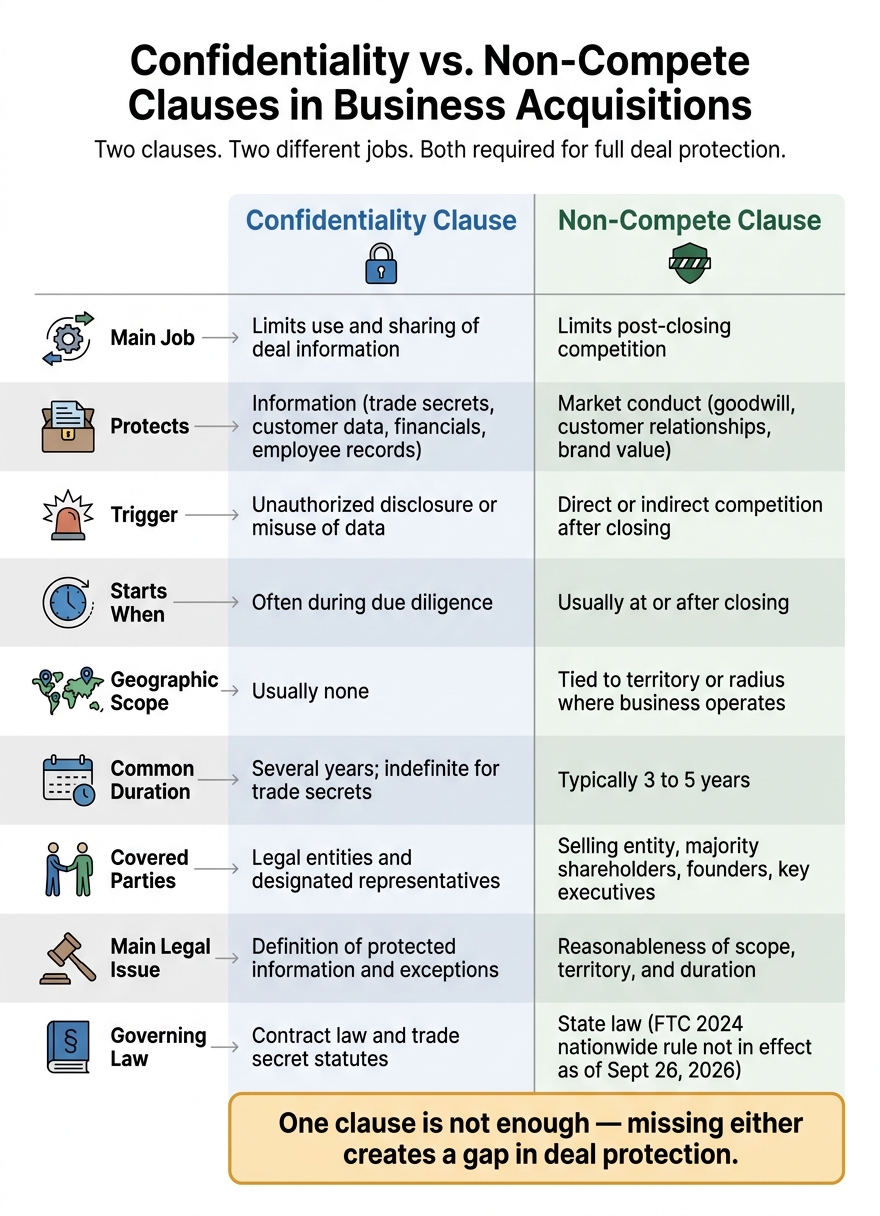
Confidentiality vs. Non-Compete Clauses: Key Differences in Business Acquisitions
Non-Compete vs. NDA: What's the Difference and Why It Matters?
sbb-itb-97ecd51
Quick Comparison
| Point | Confidentiality | Non-Compete |
|---|---|---|
| Main job | Limits use and sharing of deal information | Limits post-closing competition |
| Usual trigger | Misuse or disclosure of protected data | Direct or indirect competition |
| Starts when | Often during diligence | Usually at or after closing |
| Common scope | Data, records, know-how, trade secrets | Customers, employees, territory, business activity |
| Geography | Usually none | Often tied to where the business operates |
| Common term | Several years; trade secrets may last longer | Often 3 to 5 years |
| Main legal issue | What counts as protected information, plus exceptions | Whether scope, territory, and duration are reasonable |
I’d review these clauses as a pair, not in isolation. That’s the simplest way to spot gaps before signing.
Confidentiality clauses: What they protect and how they work
A confidentiality clause sets the rules for how protected information can be used and shared. In plain English, it says the information can be used only for the deal and disclosed only to approved recipients. That risk is different from a non-compete. A non-compete restricts market activity, while a confidentiality clause restricts the use of information.
In U.S. deals, protected information often includes trade secrets, customer data, employee data, and financial information. In SMB deals, sellers often hold back the most sensitive data until the buyer shows serious intent.
Core obligations, exceptions, and post-closing survival
The receiving party usually has two main duties:
- Use the information only for the transaction
- Limit disclosure to authorized representatives
Standard exceptions usually apply to information that is already public, was known to the recipient before disclosure, was developed independently, or must be disclosed through legal process. Some agreements also allow general know-how remembered from the materials, but not reuse of the materials themselves.
Post-closing survival is a key drafting point. Confidentiality duties often continue after closing for several years. Trade secret protections may continue indefinitely.
Confidentiality clause structure: a quick reference table
| Element | Typical Treatment in U.S. Deals |
|---|---|
| Protected information | Trade secrets, customer data, employee data, and financial information |
| Restricted conduct | Use limited to evaluating or implementing the transaction; disclosure limited to designated representatives |
| Covered parties | Legal entities and designated representatives |
| Common exceptions | Public information, previously known data, independently developed information, legally compelled disclosure, residual knowledge |
| Duration | Survives closing; often several years, or indefinitely for trade secrets |
The next clause deals with a different problem: stopping the seller from competing after closing. Confidentiality limits information use. Non-compete clauses limit post-closing competition.
Non-compete clauses: What conduct they restrict after closing
A non-compete limits what the seller can do in the market after closing. It does not control how deal information gets used. That’s a different issue.
The point of this clause is simple: it protects the goodwill, customer relationships, and brand value the buyer just paid for. In plain English, if a buyer purchases a business, they don’t want the seller turning around and siphoning off the same customers right after the ink dries. The clause helps keep the value of the sale in place.
The main drafting issues are scope, territory, duration, and who the clause covers.
Key drafting points: scope, territory, duration, and covered parties
Most non-competes restrict direct or indirect competition, customer solicitation, and employee poaching. Common carve-outs include passive investments of less than 5% in public companies, along with pre-approved advisory or employment roles that do not compete with the sold business.
Geographic reach is usually tied to where the business actually operates. That might mean a set radius or a defined territory. In U.S. business sales, duration often runs 3 to 5 years. The covered parties usually include the selling entity, majority shareholders, founders, and key executives.
Enforceability under U.S. state law
These limits are enforced under state law. Sale-of-business non-competes are often easier to enforce than employment non-competes, but state law still governs, and overbroad drafting can still cause problems.
Courts tend to look at a few core questions. Is the restriction reasonable in scope, territory, and duration? And is it tied to a legitimate business interest? If the clause goes too far, a court may narrow it or strike it altogether.
As of September 26, 2026, the FTC’s 2024 nationwide Noncompete Rule is not in effect or enforceable, so non-compete analysis still turns mainly on state law. Even so, regulators continue to police overreach. In 2022, the FTC issued a consent order in a gas-station acquisition that required the parties to cut the non-compete to a three-year term and a three-mile geographic radius.
Non-compete clause structure: a quick reference table
| Element | Typical Treatment in U.S. Deals |
|---|---|
| Prohibited activities | Direct or indirect competition; soliciting former customers or employees |
| Permitted activities | Passive investments (<5% in public companies); employment in non-competing fields; pre-approved advisory roles |
| Geographic reach | Specific radius or defined territories where the business currently operates |
| Duration | 3 to 5 years |
| Covered parties | Selling entity, majority shareholders, founders, and key executives |
| Transaction justification | Protection of purchased goodwill, customer relationships, and brand value |
Confidentiality vs. non-compete: side-by-side legal and business differences
Confidentiality limits how information can be used. A non-compete limits what the seller can do after closing. Once you separate those two ideas, the drafting and risk split becomes much easier to see.
Direct comparison across purpose, scope, and risk
The differences stand out pretty fast when you compare them side by side.
| Dimension | Confidentiality Clause | Non-Compete Clause |
|---|---|---|
| Typical trigger | Unauthorized disclosure or misuse of data | Competing directly or indirectly |
| Geographic scope | Usually no geographic limit | Typically tied to a territory or radius |
| Duration | Often indefinite for trade secrets; several years for general info | Typically 3 to 5 years in business sales |
| Effect on seller | Restricts use and disclosure of information | Restricts competitive activity |
| Main legal issue | Definition of confidential information and any residual-use risk | Reasonableness of scope, territory, and duration |
The drafting split is straightforward: confidentiality protects information, while non-compete protects market conduct.
How the two clauses work together in one deal
In practice, these clauses deal with two different post-closing risks. A confidentiality clause lowers the chance that a seller leaves with sensitive business data and then uses it - or leaks it - in a way that hurts the buyer. A non-compete lowers the chance that the seller turns around and uses existing relationships, name recognition, and market position to win customers back.
If you have one without the other, there's a hole in the deal. A seller bound only by a non-compete might still share proprietary information or customer lists with a third party. A seller bound only by confidentiality might still launch a competing business right away.
Other clauses help cover the rest of the map, including:
- Non-solicitation
- Employee non-interference
- IP assignment
- Transition-services provisions
Those terms address risks that confidentiality and non-compete clauses don't fully handle on their own. Together, they form a broader deal-protection package.
Drafting, negotiation, and deal integration
Once the differences between these clauses are on the table, the drafting job gets pretty simple in principle: match each restriction to the deal’s timing, scope, and risk. That sounds obvious, but this is where small wording choices can turn into big problems later.
Key negotiation issues buyers and sellers should test
For confidentiality clauses, the main pressure points are phased disclosure and notice before compelled disclosure. Buyers should ask for language that clearly covers customer lists, pricing data, and proprietary processes. Sellers, on the other hand, should push for clean exclusions for information that is already public, independently developed, or required to be disclosed by law. Both sides should also settle on a compelled-disclosure process, so if a court or regulator demands information, the disclosing party gives notice before complying. A standard NDA works at first contact, then a tighter version makes sense once serious intent is on the table.
For non-compete clauses, the negotiation usually comes down to reasonableness. Buyers should connect the scope, territory, and duration to the business being sold and to where that business actually operates. The restriction should tie back to the acquired goodwill and fit the facts of the deal, not just sit there as boilerplate.
Applying these clauses across diligence, signing, closing, and post-closing
The real test is when each clause starts to matter.
| Stage | Primary Focus | What to Confirm |
|---|---|---|
| Diligence | Confidentiality (NDA) | Phased disclosure limits; residual-use clauses; mutual vs. one-way NDA |
| Signing | Non-compete and purchase agreement | Scope, territory, duration; state law enforceability |
| Closing | Signatures and schedules | Authorized signatures; exact legal entity names; finalized schedules for excluded assets and assumed liabilities |
| Post-Closing | Confidentiality survival and non-compete enforcement | Confidentiality term; non-compete term; breach remedies |
At signing, make sure the agreement defines "transaction" broadly enough to cover the deal structure you’re actually doing - asset purchase, stock sale, or merger. If that definition is too narrow, enforcement gaps can slip in.
At closing, check that the agreement uses the exact legal entity names and that authorized representatives signed it. This is one of those plain, unglamorous details that can save a lot of trouble.
Post-closing, confirm the survival term for confidentiality and the enforcement period for the non-compete. If those periods are fuzzy, the clause may not do what either side thought it would do.
Conclusion: a practical rule for choosing and reviewing each clause
Confidentiality protects information. A non-compete restricts conduct. Both need to fit the deal and the state law that governs them. And neither clause should be judged by its label alone. What counts is the actual scope of the restriction, the facts behind it, and the jurisdiction where enforcement may happen.
FAQs
Do I need both clauses in one deal?
Yes, in most cases you’ll want both. Confidentiality and non-compete clauses do different jobs, and each protects a different part of what you’re buying.
A confidentiality clause protects sensitive information from being shared during the deal and after it closes. That can include customer data, pricing, internal processes, and other private business details.
A non-compete clause is aimed at something else: stopping the seller from launching or joining a competing business that could chip away at the company’s goodwill and market position.
Put simply, one clause protects information. The other helps protect the business you just paid for.
Can a non-compete be unenforceable?
Yes. Enforceability varies a lot by state, and some places, such as California, generally ban post-employment non-compete clauses.
Even in states where these clauses are allowed, courts may narrow them or throw them out if they go too far. The usual problem areas are length of time, geographic reach, and the kinds of work they restrict.
To make a non-compete more likely to hold up, it should be reasonable and clearly written into the final purchase agreement.
What should a confidentiality clause exclude?
A confidentiality clause should clearly carve out information that isn’t meant to be protected. That usually includes:
- information that’s already public
- information the receiving party already knew before the disclosure
- third-party information that isn’t subject to a confidentiality agreement
One point that often gets missed: the fact that acquisition talks are happening, and the specific terms being discussed, aren’t always protected by default. If you want those details kept private, spell that out in a separate provision.
It can also help to include a residual knowledge clause. This gives the receiving party some room if a person later relies on unaided memory, rather than copied notes, files, or other retained materials. In plain English, it can reduce the risk of accidental breach claims based on what someone simply remembers.