

Codely v2.0 public release is here
Lorem ipsum dolor sit amet, consectetur adipiscing elit lobortis arcu enim urna adipiscing praesent velit viverra sit semper lorem eu cursus vel hendrerit elementum morbi curabitur etiam nibh justo, lorem aliquet donec sed sit mi dignissim at ante massa mattis.
- Neque sodales ut etiam sit amet nisl purus non tellus orci ac auctor
- Adipiscing elit ut aliquam purus sit amet viverra suspendisse potent i
- Mauris commodo quis imperdiet massa tincidunt nunc pulvinar
- Adipiscing elit ut aliquam purus sit amet viverra suspendisse potenti
What has changed in our latest release?
Vitae congue eu consequat ac felis placerat vestibulum lectus mauris ultrices cursus sit amet dictum sit amet justo donec enim diam porttitor lacus luctus accumsan tortor posuere praesent tristique magna sit amet purus gravida quis blandit turpis.
All new features available for all public channel users
At risus viverra adipiscing at in tellus integer feugiat nisl pretium fusce id velit ut tortor sagittis orci a scelerisque purus semper eget at lectus urna duis convallis. porta nibh venenatis cras sed felis eget neque laoreet suspendisse interdum consectetur libero id faucibus nisl donec pretium vulputate sapien nec sagittis aliquam nunc lobortis mattis aliquam faucibus purus in.
- Neque sodales ut etiam sit amet nisl purus non tellus orci ac auctor
- Adipiscing elit ut aliquam purus sit amet viverra suspendisse potenti
- Mauris commodo quis imperdiet massa tincidunt nunc pulvinar
- Adipiscing elit ut aliquam purus sit amet viverra suspendisse potenti
Coding collaboration with over 200 users at once
Nisi quis eleifend quam adipiscing vitae aliquet bibendum enim facilisis gravida neque. Velit euismod in pellentesque massa placerat volutpat lacus laoreet non curabitur gravida odio aenean sed adipiscing diam donec adipiscing tristique risus. amet est placerat in egestas erat imperdiet sed euismod nisi.
“Nisi quis eleifend quam adipiscing vitae aliquet bibendum enim facilisis gravida neque velit euismod in pellentesque massa placerat”
Real-time code save every 0.1 seconds
Eget lorem dolor sed viverra ipsum nunc aliquet bibendum felis donec et odio pellentesque diam volutpat commodo sed egestas aliquam sem fringilla ut morbi tincidunt augue interdum velit euismod eu tincidunt tortor aliquam nulla facilisi aenean sed adipiscing diam donec adipiscing ut lectus arcu bibendum at varius vel pharetra nibh venenatis cras sed felis eget dolor cosnectur drolo.
Most LOI problems start with mixed messages, not the price.
When I look at LOI talks in U.S. small and lower middle-market deals, the pattern is simple: if both sides do not share the same view of the terms, timing, and next steps, the deal slows down fast. The fix is also simple. I focus on four jobs: line up my team first, explain the money in plain English, translate legal terms into business terms, and write down every decision right after each call.
A clear LOI process should help you do all of this:
- Know what is binding and what is not
- Set one point of contact
- Use the right channel for each issue
- Explain price, structure, liabilities, and earnouts in plain language
- Spell out exclusivity, confidentiality, non-solicit, and non-compete terms
- Separate firm dates from target dates
- Send written recaps after each material discussion
Here’s the short version: if you want fewer resets, fewer bad assumptions, and fewer last-minute fights, make each conversation end with the same shared record of what was agreed, what is still open, and who does what next.
| Area | What I focus on | Common problem |
|---|---|---|
| Team alignment | Priorities, limits, decision maker | Mixed messages from the buyer or seller team |
| Deal economics | Price, structure, working capital, earnout | One side hears $X; the other hears $X subject to changes |
| Legal terms | Exclusivity, confidentiality, non-solicit, non-compete | Legal language is read one way by one side and another way by the other |
| Timing and follow-up | Milestones, recaps, tracker | People treat estimates like hard deadlines |
In other words: the goal is not just to “get an LOI signed.” The goal is to make sure both sides leave each step with the same understanding before more time and money go into the deal.
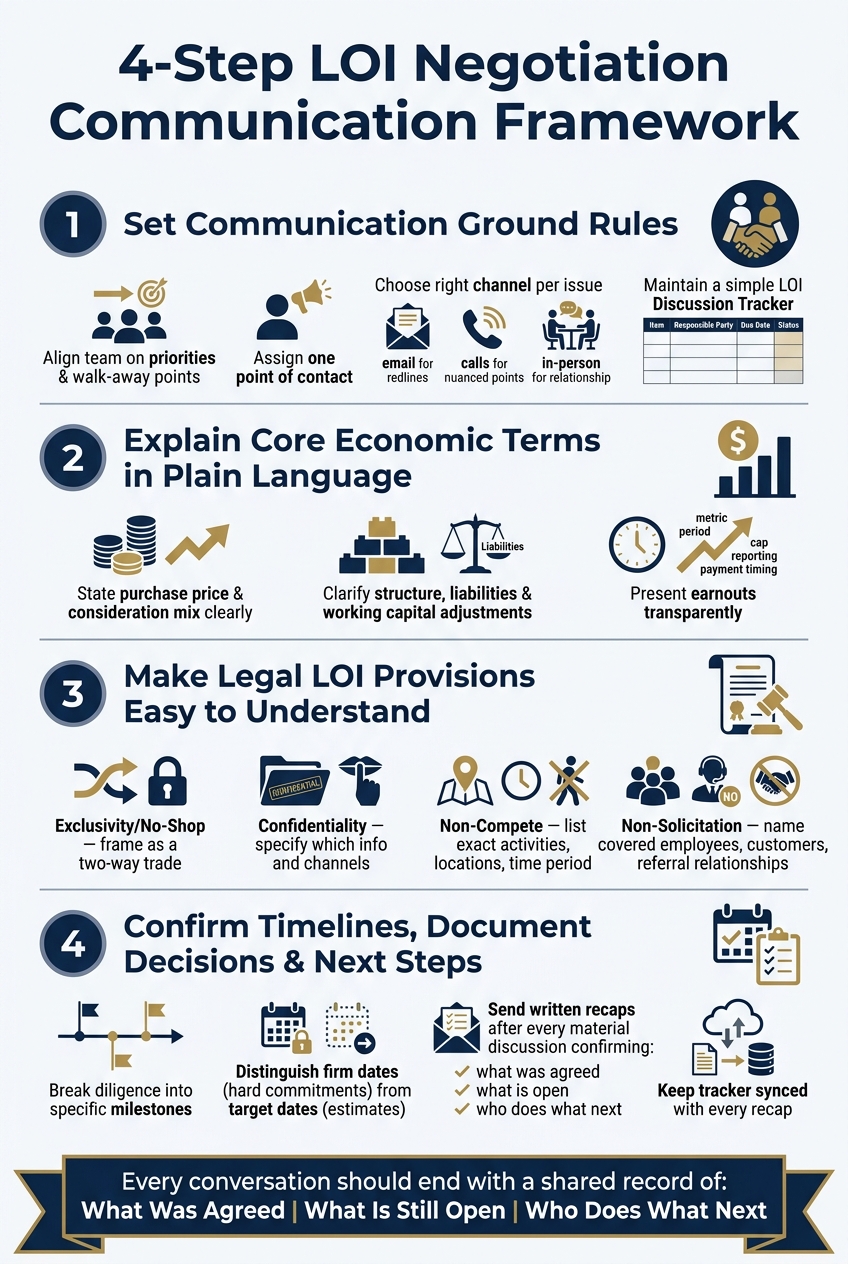
4-Step LOI Negotiation Communication Framework
Mastering the Letter of Intent (LOI) in M&A: Best Practices & Common Mistakes
sbb-itb-97ecd51
Step 1: Set Communication Ground Rules Before You Negotiate Terms
Before you get into term talks, get your own house in order. Your team should line up on priorities, walk-away points, and who speaks for the group.
Align on Priorities, Walk-Away Points, and Decision Makers
Before the first negotiation call, your legal counsel, finance lead, and deal lead should agree on what matters most. Put the core terms in order: purchase price, asset vs. stock structure, working capital adjustments, earnouts, and exclusivity. Then decide where you have room to bend and where you don't.
It also helps to document the owner's day-to-day responsibilities. That way, if you need to make a replacement-cost case, you can explain it in plain English instead of scrambling mid-conversation.
Just as important, pick one main point of contact. If the seller hears different answers from different people, trust can slip fast.
Choose the Right Channel for Each Issue
Not every issue should live in email. Use email for redlines, calls for nuanced points, and in-person meetings when the relationship needs face time.
Valuation talks need extra care. Many sellers see the company as something they built piece by piece, not just a set of numbers. A blunt email can sting in a way that the same message on a call might not.
After each key discussion, send a written recap with:
- open items
- the person handling each one
- a clear due date
That simple habit keeps things from drifting or getting lost.
Keep a Simple LOI Discussion Tracker
A basic tracker can keep the LOI process from turning messy. Use four columns:
| Column | Purpose |
|---|---|
| Item | The specific LOI term or task under discussion |
| Responsible Party | The lead (Legal, Finance, or Deal Lead) for that item |
| Due Date | The deadline for the next action |
| Status | Current stage - Open, Pending, or Resolved |
Kumo can centralize deal notes, timelines, and communication history so every stakeholder works from the same record.
Once roles, channels, and tracking are set, you can move into the deal terms with less confusion.
Step 2: Explain Core Economic Terms in Plain Business Language
Once the communication process is set, the next step is making sure the other side understands the economics in plain English. Not just the top-line number, but also how the deal is built, which obligations move over, and how adjustments work.
State Purchase Price and Consideration Mix Clearly
Spell out the total consideration piece by piece so the seller can see what gets paid at closing and what depends on future events.
Clarify Structure, Liabilities, and Working Capital Adjustments
Say which liabilities transfer and which post-close obligations stay in place. Define the working-capital target, list what counts in that calculation, and explain how the purchase price changes if actual working capital comes in above or below the target.
Discuss Earnouts Without Creating Surprise or Distrust
Present the earnout as a way to bridge a valuation gap, not as a term dropped in at the last minute. Be clear about the metric, the measurement period, the reporting process, any cap, and when payment will be made. Walk through the downside case early so the seller knows what happens if performance shifts and how disputes will be handled.
Then state the concession in plain terms and name the tradeoff you expect in return. That kind of reciprocity framing helps keep the discussion balanced and honest.
Once the economics are clear, move to the legal terms that govern exclusivity, confidentiality, and restrictions.
Step 3: Make Legal LOI Provisions Easy to Understand
Even when both sides line up on the economics, a deal can still get stuck on legal terms that no one explained in plain English. Clauses like exclusivity, confidentiality, non-solicitation, and non-compete often cause friction for that exact reason.
The fix is simple: translate each term into business language before the draft goes out.
Start with exclusivity first. It usually shapes how the rest of the draft is received.
Set Expectations for Exclusivity and No-Shop Terms
Treat exclusivity as a two-way concession, not a surprise limit. Make the request clear and explain why the buyer wants it. The buyer is spending time and money on diligence, legal work, and financing, and wants comfort that the seller won't keep shopping the deal while that work is happening. Then say, in plain terms, what the buyer is giving in return, such as a firm price or financing commitment.
It also helps to use simple if/then wording to show the trade. For example, a buyer might say it will agree to the price only if the seller gives a 60-day exclusivity period to finish financing. That framing makes the exchange easier to see. It feels less like one side is losing something and more like both sides are making a trade.
Once those deal-protection terms are out in the open, the next step is to define the post-close limits with the same level of clarity.
Explain Confidentiality, Non-Solicitation, and Non-Compete Scope
Vague legal wording leads to arguments. So instead of mentioning non-compete scope in a loose way, spell out the exact activities, channels, and business functions it covers. A good starting point is the owner's day-to-day work: lead generation, quoting, scheduling, invoicing, and collections. If the business depends on certain marketing or referral channels, name those too. That way, everyone can see what is being protected.
These restrictions also land better when they're framed in normal business terms. Sellers often see their company as something they've built over years, not just an asset on paper. So non-compete and non-solicitation terms should be explained as protection for the business, its employees, and its customer relationships.
Comparison Table: High-Risk LOI Clauses and Where Communication Breaks Down
| Provision | Plain-English point | Likely breakdown |
|---|---|---|
| Exclusivity / No-Shop | Why it is being requested, what the seller gives up during the period, and what the buyer is offering in return | Sellers think they can keep talking to other buyers in the background |
| Confidentiality | Which information, channels, or business functions are sensitive and how they relate to the business's value | Sellers may not realize the protected information is tied to how the business makes money |
| Non-Compete | The specific activities, locations, and time period that are restricted | Sellers assume broad language reaches unrelated ventures |
| Non-Solicitation | Which employees, customers, or referral relationships are covered | Sellers view it as a personal restriction rather than a business-protection term |
Use the table as a quick check before the next draft goes out. If a clause hasn't been explained in plain English, that's usually where confusion starts.
Once these terms are clear, put them in writing and move on to timelines and written recaps.
Step 4: Confirm Timelines, Document Decisions, and Confirm the Next Step
LOI momentum usually comes down to three simple habits: set realistic timelines, write down decisions, and make sure every conversation ends with a clear next step.
Set Realistic Milestones for Diligence, Drafting, and Closing
Don't rely on one broad "diligence completion" date. Break the process into specific milestones instead.
Tie diligence to the workstreams most likely to slow down closing. Then set target dates for due diligence completion, financing steps, the first draft of the purchase agreement, and the expected closing date. That extra detail helps teams spot bottlenecks early, before they knock the deal off schedule.
It's also important to spell out the difference between firm dates and target dates.
- A firm date is a hard commitment, like the end of an exclusivity period.
- A target date is a working estimate, like when the first purchase agreement draft should be ready.
If those two get mixed together without clear labels, trouble tends to show up later in negotiations. One side thinks a date is locked. The other thinks it's just a goal. That's where quiet friction starts.
If someone wants the timeline compressed, treat it like a trade. Agree to it only if the other side is giving something concrete in return.
Those dates should also show up in the recap so nobody mistakes an estimate for a deadline.
Send Written Recaps After Every Material Discussion
After every substantive call or meeting, send a short written summary right away.
That recap should do three things:
- confirm what was agreed
- flag what is still open
- list the next action for each party
Send it to the decision-makers, the other side, and the relevant advisors, including legal counsel and accounting advisors. If a point still needs confirmation from counsel before it can be finalized, say that plainly in the summary instead of leaving it hanging in the air.
If a new tax or structure issue comes up, document it in the recap as soon as it appears. Then update the tracker right after each recap.
The tracker should match the recap before the next call.
Conclusion: Communication Habits That Make LOI Negotiations Run Smoothly
Once the recap goes out, the next job is simple: make sure the next draft matches it.
The habits that keep LOI negotiations on track are pretty straightforward. Align internally before negotiating. Explain economics in plain English. Define exclusivity and confidentiality with precision. Write down every milestone and every open issue. And when terms change or a deadline slips, acknowledge the seller's investment in the business and explain the reason clearly.
Kumo helps teams track LOI status and keep recap history in one place.
FAQs
Is an LOI legally binding?
Generally, no. A Letter of Intent (LOI) usually isn't legally binding. In most cases, it lays out the basic shape of the deal and gives both sides a working blueprint for the final purchase agreement.
That said, some clauses can still have legal force. Because of that, the material terms should be spelled out clearly so there's less room for confusion or disputes later.
It's smart to have a legal professional review the LOI before you sign. A lawyer can help make sure it's drafted the right way and lines up with your acquisition goals.
How long should exclusivity last?
Exclusivity in a Letter of Intent should usually line up with the time needed for due diligence. For most middle-market acquisitions, that means 60 to 90 days.
Pick a window that gives you enough time to review key items like customer contracts, intellectual property, and material agreements. At the same time, it should stop the seller from shopping the deal to other buyers.
Be clear about the timeframe. A specific start and end date helps keep the process moving and gives you some protection before closing.
What should be in a deal recap?
A deal recap should give everyone a clear record of what changed and what was agreed to during negotiations. That means writing down every concession tied to price, financing terms, timelines, and employee agreements.
It should also include key metrics, supporting documents, and short explanations for anything that looks unusual, especially in performance-based agreements like earnouts. A small gap in the numbers can turn into a big argument later, so it helps to spell things out while the details are still fresh.
Done well, a recap keeps everyone on the same page and cuts down on confusion before it starts.