

Codely v2.0 public release is here
Lorem ipsum dolor sit amet, consectetur adipiscing elit lobortis arcu enim urna adipiscing praesent velit viverra sit semper lorem eu cursus vel hendrerit elementum morbi curabitur etiam nibh justo, lorem aliquet donec sed sit mi dignissim at ante massa mattis.
- Neque sodales ut etiam sit amet nisl purus non tellus orci ac auctor
- Adipiscing elit ut aliquam purus sit amet viverra suspendisse potent i
- Mauris commodo quis imperdiet massa tincidunt nunc pulvinar
- Adipiscing elit ut aliquam purus sit amet viverra suspendisse potenti
What has changed in our latest release?
Vitae congue eu consequat ac felis placerat vestibulum lectus mauris ultrices cursus sit amet dictum sit amet justo donec enim diam porttitor lacus luctus accumsan tortor posuere praesent tristique magna sit amet purus gravida quis blandit turpis.
All new features available for all public channel users
At risus viverra adipiscing at in tellus integer feugiat nisl pretium fusce id velit ut tortor sagittis orci a scelerisque purus semper eget at lectus urna duis convallis. porta nibh venenatis cras sed felis eget neque laoreet suspendisse interdum consectetur libero id faucibus nisl donec pretium vulputate sapien nec sagittis aliquam nunc lobortis mattis aliquam faucibus purus in.
- Neque sodales ut etiam sit amet nisl purus non tellus orci ac auctor
- Adipiscing elit ut aliquam purus sit amet viverra suspendisse potenti
- Mauris commodo quis imperdiet massa tincidunt nunc pulvinar
- Adipiscing elit ut aliquam purus sit amet viverra suspendisse potenti
Coding collaboration with over 200 users at once
Nisi quis eleifend quam adipiscing vitae aliquet bibendum enim facilisis gravida neque. Velit euismod in pellentesque massa placerat volutpat lacus laoreet non curabitur gravida odio aenean sed adipiscing diam donec adipiscing tristique risus. amet est placerat in egestas erat imperdiet sed euismod nisi.
“Nisi quis eleifend quam adipiscing vitae aliquet bibendum enim facilisis gravida neque velit euismod in pellentesque massa placerat”
Real-time code save every 0.1 seconds
Eget lorem dolor sed viverra ipsum nunc aliquet bibendum felis donec et odio pellentesque diam volutpat commodo sed egestas aliquam sem fringilla ut morbi tincidunt augue interdum velit euismod eu tincidunt tortor aliquam nulla facilisi aenean sed adipiscing diam donec adipiscing ut lectus arcu bibendum at varius vel pharetra nibh venenatis cras sed felis eget dolor cosnectur drolo.
If I had to sum this up in one line: start with empathy, verify with facts, and make the final call with discipline.
When I look at small business deals, one thing stands out fast: sellers are not only selling cash flow. In many U.S. SMB deals, they’re also selling years of work, close ties with staff, and part of their identity. That’s why a buyer who talks only about price can lose a deal, while a buyer who leans only on rapport can end up paying too much.
Here’s the short version:
- Empathy helps me learn what the seller wants most
- Facts help me check what is true
- Deal discipline helps me avoid bad terms
- Price is only one part of the deal
- Structure often matters just as much as headline price
In plain English:
- If a seller cares about employees, I can address that in terms
- If a seller cares about certainty, I can use cleaner terms instead of a higher number
- If a seller pushes on value, I should answer with TTM financials, process notes, and working capital data
- If I make a concession, I should ask for something back, such as 20% seller financing
- If the deal moves past my limit, I should walk
The main point: empathy opens the conversation, but it should not set the price.
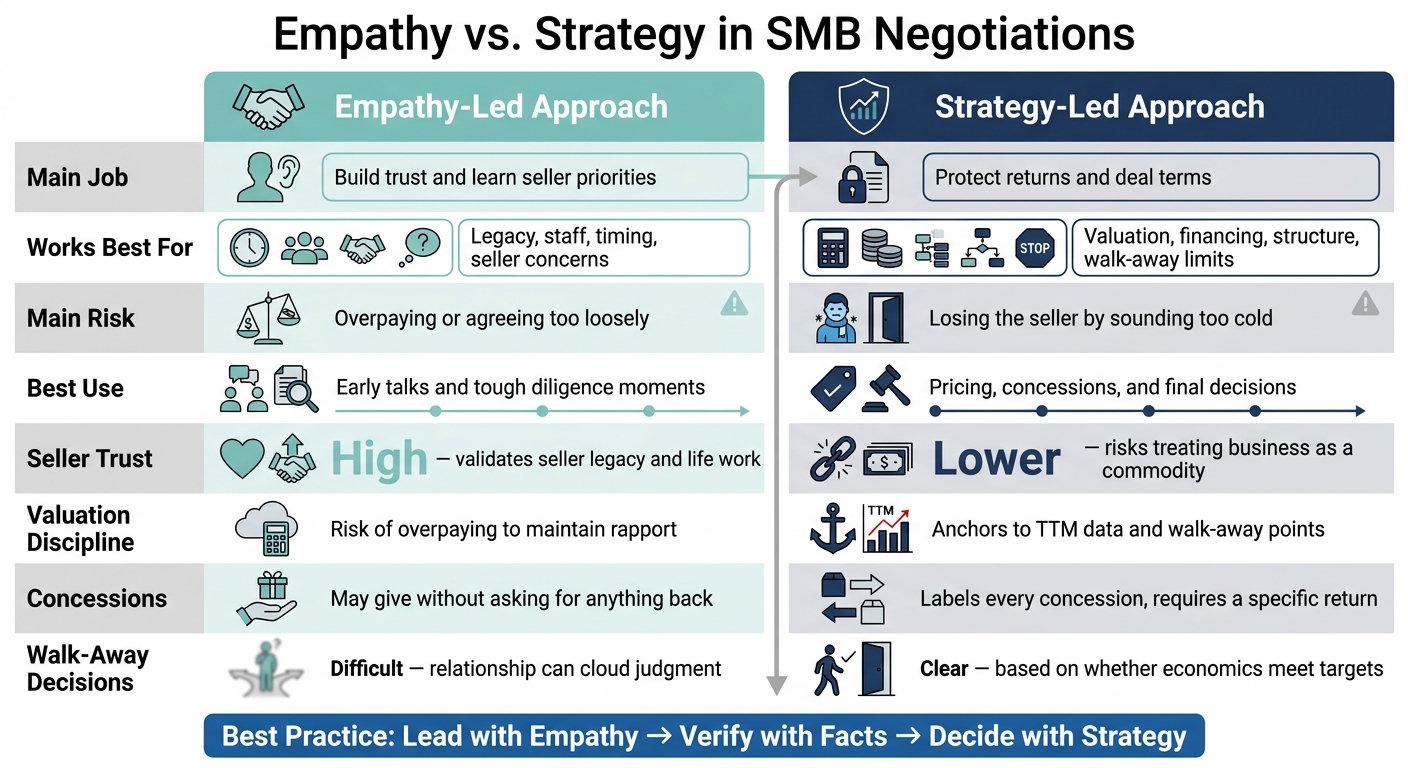
Empathy vs. Strategy in SMB Negotiations: When to Use Each
Chris Voss | The How-To of High-Stakes Negotiations: The Secrets of Tactical Empathy
sbb-itb-97ecd51
Quick comparison
| Area | Empathy-led approach | Strategy-led approach |
|---|---|---|
| Main job | Build trust and learn seller priorities | Protect returns and deal terms |
| Works best for | Legacy, staff, timing, seller concerns | Valuation, financing, structure, walk-away limits |
| Main risk | Overpaying or agreeing too loosely | Losing the seller by sounding too cold |
| Best use | Early talks and tough diligence moments | Pricing, concessions, and final decisions |
So if I’m buying an SMB, I don’t treat empathy and deal discipline as opposites. I use both. One gets the seller talking. The other keeps me from making a bad deal.
What Empathy Does Better in Seller Negotiations
Empathy means understanding the seller's needs without lowering your standards. In SMB deals, that matters because sellers often negotiate from identity, not just money. So the first job is simple: figure out what matters most to them.
How Empathy Surfaces the Seller's Real Motivations
Most sellers care about more than price. Some want to look after long-time employees. Others want the business name and local reputation to stay intact. You won't know which one matters most unless you ask.
Early in the conversation, open-ended questions can bring those priorities out. For example: "What does a good outcome look like for you after the sale?" That kind of question helps lower the seller's guard and gets them talking. And that's the point. Sellers tend to share sensitive details in layers. Customer names, key employee identities, and proprietary processes often stay locked up until they trust that you're serious. Once that trust is there, you get the information you need to price risk and shape the deal.
When those motives are out in the open, diligence gets a lot easier to discuss without setting off resistance.
How Empathy Reduces Defensiveness During Diligence
Diligence talks can get uncomfortable fast. Weak margins and owner dependence need to be discussed. The issue isn't whether to bring them up. It's how you do it.
Framing makes a big difference. Instead of calling out a gap like it's a flaw, treat it like a process question: "Walk me through how this runs day to day." That wording feels less like an attack. It keeps the seller in the conversation.
Wesley Sparr recommends mapping the owner's tasks step by step - quoting, scheduling, invoicing, customer relationships - before making any judgment. That approach shows respect for what the seller built, while also giving you the facts you need to estimate the real cost of replacing them.
That same trust can also make deal trade-offs much easier to work through.
Where Empathy Leads to Better Deal Terms
Once you know what the seller cares about, you can often meet that need without changing the headline price. When the seller feels understood, it's easier to trade on terms beyond price. A seller worried about employees may accept a lower number in exchange for a retention commitment. A seller who cares about certainty may pick a cleaner structure over a higher price tied to contingencies.
"Concessions are often necessary in negotiation... But they often go unappreciated and unreciprocated." - Deepak Malhotra, Professor, Harvard Business School
The answer is to label each concession clearly and connect it to a specific return. For example: I'll agree to this price, but only if you provide 20% seller financing. That keeps the exchange balanced.
The next step is to protect those gains with clear deal terms and hard numbers.
What Strategy Does Better in Protecting Deal Economics
Strategy protects your economics after empathy gets the seller talking. Once that door opens, the buyer has to keep the deal tied to facts. If the seller feels deeply connected to the business, strategy helps you stay level-headed instead of getting pulled into their story.
Set Valuation Ranges and Walk-Away Points Before Negotiating
The biggest strategic move happens before the first call. Set your valuation range using Trailing Twelve Months (TTM) financials, not the seller's asking price or their personal view of what the business is worth. Sellers often tie value to the years they poured into the company, not just to current performance.
"To the seller, their company is not an object to be traded nor is it an instrument to drive returns. It is a living creation, with people they care about, in which they have invested years of their life." - Wesley Sparr
That quote gets to the heart of it. A seller may be talking about numbers, but they may also be talking about pride, time, and identity. That's exactly why you need clear limits before any back-and-forth starts.
Before you negotiate, define your walk-away point.
Use Package Bargaining Across Price and Structure
Don't negotiate on price alone. Treat the deal like a package of terms you can move around: purchase price, seller financing, seller notes, earn-outs, payment schedules, non-competes, training commitments, and retention agreements.
This gives you room to solve the problem without just paying more. If price turns into a roadblock, shift the discussion to financing terms, payment timing, or asset inclusions. That can help protect your cash flow while keeping the deal alive.
Anchor Disputes in Evidence, Not Opinion
When a seller pushes back on your valuation, opinions usually go nowhere. Documents do. Build your case from financial records, process maps, and diligence findings. Process maps are especially useful because they help you estimate what it would cost to replace the owner's role.
Here’s how to answer common valuation pushback with evidence:
| Dispute Area | Objective Evidence to Use |
|---|---|
| Valuation | Trailing Twelve Months (TTM) financial records; pro forma payroll adjustments |
| Working capital | Invoicing terms, collection history, and non-paying customer ratios |
| Risk mitigation | Process maps for customer acquisition, quoting, and job dispatch |
| Financing | Reciprocal trade-offs, such as a higher price in exchange for 20% seller financing |
When the file is stronger than the feeling, the conversation shifts. You're no longer debating stories or gut reactions. You're talking about facts, trade-offs, and what the business can support. That leads straight into the next issue: when does empathy give you leverage, and when does strategy protect the deal?
Empathy vs. Strategy: Strengths, Risks, and Best Uses
Empathy opens the door. Strategy protects the price.
In SMB negotiations, the best buyers know how to use both, and when to switch gears. That matters because emotional pressure can change how price, diligence, and concessions land. A deal can feel warm and cooperative one minute, then turn hard-edged the moment the talk shifts to terms.
Where Empathy Outperforms Strategy Alone
Use empathy when the seller is under pressure, especially around valuation or diligence. It helps keep the seller engaged and brings out priorities that don’t show up in the numbers.
Sometimes that’s the whole game. A seller may care just as much about legacy, staff, or timing as they do about headline price. If you miss that, you can misread the deal.
Where Strategy Outperforms Empathy Alone
Use strategy when the deal needs discipline. Stay inside your valuation range, and tie every concession to something in return. Package bargaining helps here because it lets you trade price, financing, timing, and protections together instead of one by one.
As Harvard Business School Professor Deepak Malhotra notes:
"Concessions are often necessary in negotiation... But they often go unappreciated and unreciprocated."
That’s where strategy earns its keep. Every “give” needs a clear “get.” Once the conversation moves to price, structure, and walk-away terms, that kind of discipline stops the deal from drifting.
The Main Failure Modes of Each Approach
The table below maps both approaches across the dimensions that matter most in an SMB deal:
| Dimension | Empathy-Led | Strategy-Led |
|---|---|---|
| Seller Trust | High; validates the seller's life work and legacy | Lower; risks treating the business as an "object to be traded" |
| Valuation Discipline | Risk of overpaying to maintain rapport | Anchors to market data and walk-away points |
| Concessions | May give without asking for anything in return | Labels every concession and requires a specific benefit back |
| Walk-Away Decisions | Difficult; relationship-building can cloud judgment | Clear; based on whether economics meet target returns |
Pure empathy tends to fail through vague commitments. The buyer agrees to terms to keep the seller happy, but never locks in the protections that make the deal work.
Pure strategy fails in a different way: the deal can fall apart. If the seller starts to feel like the business is just a commodity, they pull back.
That’s the rule in practice: lead with empathy, test with evidence, decide through strategy. A buyer who relies only on strategy may win the logic and still lose the deal. That balance is what the next framework turns into a repeatable process.
A Repeatable Framework for Balanced SMB Negotiations
Apply Listen, Diagnose, Structure, Test, Decide
Use this sequence when empathy and economics start pulling in opposite directions. It also helps when a conversation starts mixing personal trust with price pressure.
Listen for emphasis and omission, not just what the seller says out loud. Diagnose the seller’s actual interests - employees, legacy, or timing of the exit. Structure terms around the risks you’ve spotted, test those terms in diligence and in your pro forma, then decide based on target returns and clear walk-away criteria.
Prepare a Two-Column Negotiation Plan Before Key Calls
Before an important call, turn the seller’s emotional signals into a written plan. A simple way to do that is with two columns: human concerns and your response.
One column should list what the seller cares about and what they’re afraid of losing. The other should map your response: the exact term, proof point, or boundary that answers each signal.
"To the seller, their company is not an object to be traded nor is it an instrument to drive returns. It is a living creation, with people they care about, in which they have invested years of their life." - Wesley Sparr
If a seller is stuck on price, answer with a term that narrows the gap without increasing the headline number. And when you give ground, say so plainly: "I'll agree to this price, but only if you provide 20% seller financing." That makes reciprocity visible and helps stop one-sided concessions.
Keep Your Pipeline Active So No Single Deal Skews Your Judgment
Balanced judgment gets harder when one deal starts to feel like the deal. If a buyer has only one live opportunity, empathy can slide into overcommitment, and strategy can harden under pressure. Same root problem: no alternatives.
An active pipeline helps fix that. Kumo helps keep sourcing organized with centralized listings, filters, alerts, and deal tracking. When you have other options, your leverage stays real.
FAQs
How do I know when to switch from empathy to strategy?
In SMB negotiations, empathy and strategy work best as a pair.
Start with empathy. It helps you build rapport, understand what’s actually driving the seller, and earn trust early in the conversation.
Then shift into strategy when it’s time to set boundaries, handle concessions, or lock in terms. Keep listening as you do it, so the conversation still feels collaborative while you protect your bottom line.
What facts matter most when a seller challenges valuation?
Shift the conversation away from opinions and toward hard facts: comparable transaction data and industry benchmarks.
If it helps, bring in an independent expert to run a formal analysis, such as a discounted cash flow model or a comparable company review. That gives both sides something concrete to look at.
At the same time, acknowledge the seller’s emotional investment. Many owners have poured years of work into the business, so price isn’t just a number to them. Explain the economics in plain English, keep the tone respectful, and use deal terms like earnouts or seller financing if you need a practical way to close the gap.
How can I show empathy without overpaying?
Empathy doesn't mean giving up your financial interests. You can stay professional, show empathy, and still protect your bottom line by treating concessions as tools in a negotiation, not automatic losses.
Use active listening to figure out what the seller actually wants. Then, if you make a concession, label it clearly and say what you expect in return, like seller financing or a longer transition period.