

Codely v2.0 public release is here
Lorem ipsum dolor sit amet, consectetur adipiscing elit lobortis arcu enim urna adipiscing praesent velit viverra sit semper lorem eu cursus vel hendrerit elementum morbi curabitur etiam nibh justo, lorem aliquet donec sed sit mi dignissim at ante massa mattis.
- Neque sodales ut etiam sit amet nisl purus non tellus orci ac auctor
- Adipiscing elit ut aliquam purus sit amet viverra suspendisse potent i
- Mauris commodo quis imperdiet massa tincidunt nunc pulvinar
- Adipiscing elit ut aliquam purus sit amet viverra suspendisse potenti
What has changed in our latest release?
Vitae congue eu consequat ac felis placerat vestibulum lectus mauris ultrices cursus sit amet dictum sit amet justo donec enim diam porttitor lacus luctus accumsan tortor posuere praesent tristique magna sit amet purus gravida quis blandit turpis.
All new features available for all public channel users
At risus viverra adipiscing at in tellus integer feugiat nisl pretium fusce id velit ut tortor sagittis orci a scelerisque purus semper eget at lectus urna duis convallis. porta nibh venenatis cras sed felis eget neque laoreet suspendisse interdum consectetur libero id faucibus nisl donec pretium vulputate sapien nec sagittis aliquam nunc lobortis mattis aliquam faucibus purus in.
- Neque sodales ut etiam sit amet nisl purus non tellus orci ac auctor
- Adipiscing elit ut aliquam purus sit amet viverra suspendisse potenti
- Mauris commodo quis imperdiet massa tincidunt nunc pulvinar
- Adipiscing elit ut aliquam purus sit amet viverra suspendisse potenti
Coding collaboration with over 200 users at once
Nisi quis eleifend quam adipiscing vitae aliquet bibendum enim facilisis gravida neque. Velit euismod in pellentesque massa placerat volutpat lacus laoreet non curabitur gravida odio aenean sed adipiscing diam donec adipiscing tristique risus. amet est placerat in egestas erat imperdiet sed euismod nisi.
“Nisi quis eleifend quam adipiscing vitae aliquet bibendum enim facilisis gravida neque velit euismod in pellentesque massa placerat”
Real-time code save every 0.1 seconds
Eget lorem dolor sed viverra ipsum nunc aliquet bibendum felis donec et odio pellentesque diam volutpat commodo sed egestas aliquam sem fringilla ut morbi tincidunt augue interdum velit euismod eu tincidunt tortor aliquam nulla facilisi aenean sed adipiscing diam donec adipiscing ut lectus arcu bibendum at varius vel pharetra nibh venenatis cras sed felis eget dolor cosnectur drolo.
When deciding how to exit your business, you’ll likely consider two main options: mergers and acquisitions. Both have distinct benefits and challenges, and your choice will depend on your goals, company size, and timeline.
- Mergers: Two companies of similar size combine to form a new entity. This typically involves shared control, ongoing involvement, and long-term growth potential. However, mergers take more time and require seamless integration of operations and cultures.
- Acquisitions: A larger company buys and absorbs a smaller one, often providing an immediate cash payout. Acquisitions are faster, but sellers lose control, and buyers assume responsibility for integration and potential risks.
Quick Comparison
| Feature | Merger | Acquisition |
|---|---|---|
| Control | Shared between both companies | Full control by the buyer |
| Outcome | New entity formed | Target company absorbed |
| Seller’s Role | Continued involvement required | Seller typically exits |
| Payout | Equity in new company | Immediate cash or stock |
| Timeline | Longer due to complexity | Faster, depending on deal size |
If you want a cash exit, acquisitions are ideal. If you prefer staying involved and growing the business, a merger may be the better fit. Both options require careful planning, financial transparency, and expert guidance to succeed.
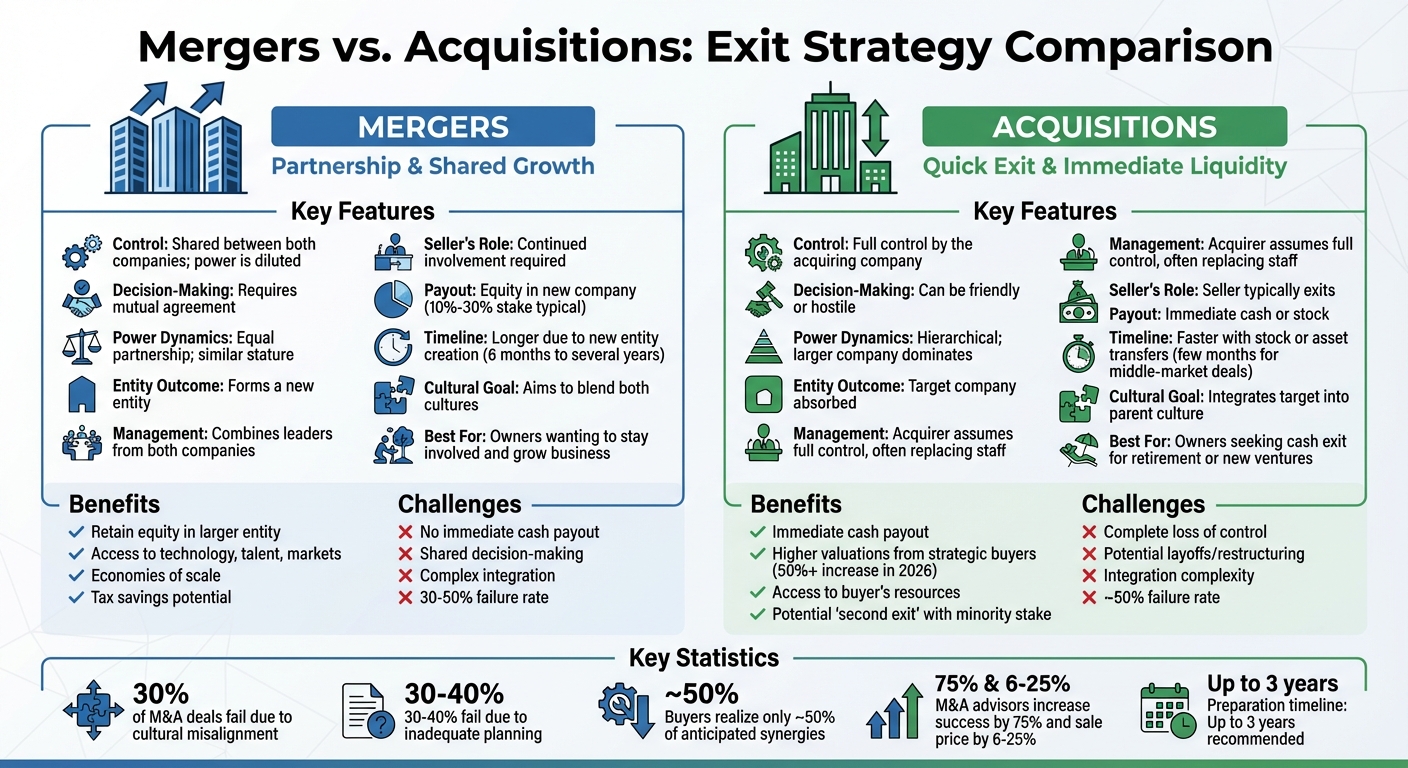
Mergers vs Acquisitions: Key Differences and Exit Strategy Comparison
Mergers and Acquisitions Explained: A Crash Course on M&A
What Is a Merger?
A merger occurs when two companies of similar size voluntarily combine to create a new legal entity with a fresh name, shared ownership, and joint management. Unlike an acquisition, where one company absorbs another, a merger results in an entirely new business structure.
The process requires approval from both boards and shareholders, with new shares typically issued instead of cash payments. For instance, when Glaxo Wellcome and SmithKline Beecham merged in 2000 to form GlaxoSmithKline, both companies dissolved their original stocks, and shareholders received shares in the newly established entity.
Mergers are often motivated by goals like achieving operational efficiencies, increasing market share, reducing costs, and enhancing shareholder value. A recent example is ExxonMobil's October 2023 merger with Pioneer Natural Resources. This all-stock deal, valued at $59.5 billion, aimed to strengthen ExxonMobil's presence in the Permian Basin and generate double-digit returns by combining their resources.
Key Characteristics of Mergers
Mergers involve shared decision-making and a redistribution of power between the two companies. The resulting entity typically operates under a new name and is managed by a team that includes leaders from both original companies. For example, in 2024, HBC acquired Neiman Marcus Group for $2.65 billion and merged it with Saks Fifth Avenue to form "Saks Global." This new luxury retail conglomerate combined Saks, Neiman Marcus, and Bergdorf Goodman to compete more effectively with online retailers.
For a merger to succeed, the companies need to integrate their cultures and operations seamlessly. This includes aligning business practices, management styles, and corporate values, as well as consolidating technologies and procedures.
Challenges of Mergers
Mergers often face hurdles, with cultural differences being a major challenge. When companies with distinct corporate cultures, management styles, and operational methods join forces, conflicts can arise that jeopardize the merger's success. A well-known example is the 1998 merger of Chrysler and Daimler-Benz to form DaimlerChrysler, which struggled due to cultural incompatibilities.
Additionally, mergers involve lengthy and complex negotiations. Both parties must agree on key decisions and secure shareholder approval, which can extend the process to six months or even several years. Studies show that nearly half of mergers and acquisitions fail, often because synergies are overestimated, integration costs are underestimated, or cultural compatibility is not thoroughly evaluated during the due diligence phase.
Next, we’ll explore acquisitions as an alternative exit strategy.
What Is an Acquisition?
Acquisitions offer an alternative approach to mergers, where one company gains full control over another. An acquisition happens when a business takes over another by purchasing at least 51% of its stock, effectively establishing ownership and control. Unlike mergers, which often involve shared decision-making, acquisitions give the buyer complete authority over the acquired company.
"When one company absorbs another and establishes itself as the new owner, the purchase is called an acquisition." - Investopedia
In this process, the acquired company stops operating independently and becomes part of the buyer's structure. However, in some cases, the acquired business may keep its original branding as a subsidiary. For instance, when Amazon bought Whole Foods Market in 2017 for $13.7 billion, the grocery chain retained its name and leadership initially, but its operations came under Amazon's control. Similarly, Facebook (now Meta Platforms) acquired Instagram in 2012 for $1 billion, allowing it to function as a distinct brand while operating under Meta's umbrella.
Acquisitions are typically structured in one of two ways: stock purchases, where the buyer acquires shares directly from shareholders, or asset purchases, where the buyer selects specific assets and liabilities. Sellers often prefer stock purchases due to favorable tax outcomes, while buyers lean toward asset purchases to avoid inheriting unexpected liabilities. For business owners, acquisitions often provide a quicker and more straightforward exit option compared to mergers, offering them the chance to secure funds for retirement or new ventures.
Key Characteristics of Acquisitions
Acquisitions simplify the exit process by focusing on buying existing assets or stock, rather than forming a new corporate entity. This allows the buyer to assume full decision-making authority, making the transaction less complex than a merger.
Payments in acquisitions are often cash-based, giving sellers immediate liquidity. A notable example is Johnson & Johnson's acquisition of Omrix Biopharmaceuticals in 2008, where they bypassed management to offer shareholders $25.00 per share in cash, totaling $438 million. More recently, in October 2022, Elon Musk acquired Twitter for $44 billion. This deal included $25.5 billion in debt and margin loan financing and resulted in Twitter becoming a private company with its board of directors dissolved.
The time frame for acquisitions can vary. Deals involving large, multinational companies may take years to finalize, while smaller, middle-market transactions often close within a few months.
Challenges of Acquisitions
While acquisitions provide clear control, they come with their own set of challenges. For sellers, the most significant drawback is the loss of control over their former company. Once the deal is complete, the buyer makes all strategic decisions, and the seller typically exits after a brief handover period. This can be particularly tough for founders who have a personal attachment to their business.
For buyers, acquisitions demand thorough due diligence, requiring detailed reviews of financial, legal, and operational records to confirm the company's value and identify risks. This process usually takes 30 to 60 days but can extend for more complicated transactions. Sellers should prepare for extensive documentation requests, including financial reports, commercial agreements, and equity details. Despite these efforts, about 50% of acquisitions fail, often because buyers overpay or overlook hidden liabilities during due diligence.
"The single most important drawback of an acquisition is the cost to the buyer. If you pay too much, the cost of the buyout can outweigh the sales increase you get from the acquisition." - Shelly Garcia, BizBuySell
To improve the chances of success, sellers should ensure their capitalization table is accurate and complete before due diligence begins. This helps avoid delays caused by missing or incorrect records. Additionally, both parties should agree on a well-defined transition plan to manage leadership changes and smoothly integrate operations after the deal closes.
Key Differences Between Mergers and Acquisitions
Mergers and acquisitions are often grouped together, but they operate on distinct principles. The main difference lies in control and power dynamics: mergers involve combining two companies of similar size into a single entity with shared management, while acquisitions grant the buyer full control, often leading to the target company's loss of independence. This fundamental distinction shapes how decisions are made and how the companies integrate.
The decision-making process is another area where the two diverge. Mergers are collaborative efforts between equals, requiring approval from both boards and shareholders. Acquisitions, on the other hand, can be either friendly or hostile, depending on whether the target company's board agrees to the deal.
Cultural integration presents unique challenges for both. Mergers demand a blending of organizational cultures, which can result in leadership struggles when neither company has clear dominance. Acquisitions often impose the acquiring company's culture on the target, which can lead to resistance and management turnover. Studies reveal that 30% of M&A deals fail to achieve financial goals due to cultural misalignment.
"Culture is what happens when leaders leave the room. Culture is what you see in the behavior and attitudes of your organization's people." - Ian Croft, Director and Engagement Lead in Advisory Services, Prosci
Timelines also vary significantly. Smaller deals might close in a few months, while larger, cross-border transactions can take years. Mergers tend to take longer because they involve creating a new legal entity, which includes dissolving the original companies, obtaining new tax IDs, and reapplying for licenses and permits. Acquisitions, especially straightforward stock or asset purchases, are often quicker, though hostile takeovers can introduce delays. Regardless of the structure, the entire M&A process rarely takes less than three months due to regulatory reviews and financial audits.
Here’s a quick comparison of the key differences:
| Feature | Merger | Acquisition |
|---|---|---|
| Control | Shared between both parties; power is diluted | Full control by the acquiring company |
| Decision-Making | Requires mutual agreement | Can be friendly or hostile |
| Power Dynamics | Equal partnership; similar stature | Hierarchical; larger company dominates |
| Entity Outcome | Forms a new entity | Target company is absorbed |
| Management | Combines leaders from both companies | Acquirer assumes full control, often replacing staff |
| Cultural Goal | Aims to blend both cultures | Focuses on integrating the target into the parent culture |
| Timeline | Longer due to new entity creation | Faster with stock or asset transfers |
Benefits and Challenges of Mergers as an Exit Strategy
Mergers offer business owners the chance to stay involved while leveraging the resources of a larger entity. By merging, owners can retain a minority equity stake, typically between 10% and 30%, which often surpasses the business's pre-merger valuation. This approach offers long-term growth potential, as opposed to the immediate cash payout of a traditional acquisition.
The operational advantages of mergers are also compelling. They provide instant access to advanced technology, skilled talent, and expanded markets. Mergers can streamline operations by eliminating redundant departments, achieving economies of scale, and reducing fixed costs relative to revenue. If the merger involves a competitor, it can also remove a rival from the market while boosting pricing power. Additionally, certain mergers present tax benefits, allowing a profitable company to offset its earnings with the partner's losses.
However, mergers are not without their challenges. Unlike acquisitions, they don’t provide an immediate cash payout. Owners often need to stay actively involved in the business for several years and share decision-making responsibilities with their new partners. As Shelly Garcia from BizBuySell points out:
"A merger generally won't allow you to walk away from the business scot-free. As a business owner, your expertise and experience will usually be considered a key reason for the merger".
Integration is another hurdle. Forming a new legal entity may require reapplying for licenses, opening new bank accounts, and obtaining new tax IDs. Poor integration planning can lead to significant setbacks - nearly half of failed deals lose value due to integration issues. Research shows that 30% to 40% of mergers and acquisitions fail because of inadequate planning or a lack of strategic alignment. Additionally, buyers often only realize about half of the anticipated synergies, as the rest is typically factored into the purchase price.
Here’s a quick breakdown of the pros and cons:
| Benefits | Challenges |
|---|---|
| Retain equity in a larger, potentially more valuable entity | No immediate cash payout; liquidity is deferred |
| Gain access to advanced technology, talent, and broader markets | Shared decision-making authority with the merger partner |
| Reduce costs through economies of scale | Complex operational challenges from integrating systems |
| Potential tax savings by leveraging a partner's losses | Long-term involvement in management post-merger |
| Eliminate competitors and strengthen market position | Risk of failed integration and potential talent loss |
Choosing a merger as an exit strategy requires weighing the potential for growth against the operational and integration complexities involved.
sbb-itb-97ecd51
Benefits and Challenges of Acquisitions as an Exit Strategy
Acquisitions offer a straightforward way to exit a business, often providing an immediate cash payout. Unlike mergers, which typically involve receiving equity in a new entity, acquisitions generally deliver cash, stock, or a mix of both at the time of the deal. This makes them ideal for owners looking to retire or move on to new ventures without lingering obligations. Strategic buyers often pay above-market value for businesses because they can quickly benefit from synergies, like cost savings or increased market reach. In fact, as of early 2026, transaction values for deals exceeding $100 million had risen by over 50% year-over-year.
Another advantage is the access sellers gain to the buyer's resources, such as their customer base, technology, and distribution networks. If selling to a private equity firm, owners may retain a minority stake (typically 10%-20%), setting the stage for a potential "second exit" down the line. These buyers also tend to maintain the existing management team, preserving the company's legacy and ensuring continuity for employees.
However, these perks come with notable drawbacks. Selling your business means giving up control entirely. As Shelly Garcia from BizBuySell explains:
"In an acquisition, the acquiring company calls all the shots".
This shift in control often results in significant changes, including layoffs or restructuring to align with the buyer's strategy. The integration process can be challenging, with issues like cultural clashes, training requirements, and merging IT or HR systems adding layers of complexity. Poor due diligence can also lead to failed synergies, leaving the buyer with high costs and minimal benefits.
Another cautionary note: avoid deals heavily tied to earn-outs, where part of the sale price depends on the company's future performance. In these cases, the buyer controls the resources needed to meet those performance targets, which can create conflicts. Additionally, external factors like market instability, geopolitical issues, or economic uncertainty can delay deal closings by 4%-20% and reduce valuations by more than 34%.
| Benefits | Challenges |
|---|---|
| Immediate cash payout for retirement or new ventures | Full loss of control over the business |
| Higher valuations from strategic buyers seeking synergies | Potential layoffs and restructuring |
| Access to buyer's customer base, technology, and distribution | Complex integration challenges |
| Opportunity for a "second exit" with minority stake retention | Risks tied to earn-out structures |
| Continuity through retaining existing management | Market volatility that delays or devalues deals |
Weighing these pros and cons carefully can help you decide if an acquisition aligns with your long-term goals.
How to Choose Between a Merger and an Acquisition
When deciding between a merger and an acquisition, it’s essential to align your financial and operational goals with the specifics of each option.
If you’re looking for a cash exit, acquisitions are typically the better route. They offer immediate liquidity, allowing you to retire or invest in your next venture. On the other hand, mergers often require your continued involvement, as your expertise is a key part of the deal’s value. As Shelly Garcia from BizBuySell explains:
"A merger generally won't allow you to walk away from the business scot-free... your expertise and experience will usually be considered a key reason for the merger".
Company size and structure also play a significant role. Mergers are more common between businesses of similar scale, while acquisitions are better suited for situations where a larger company absorbs a smaller one. According to the U.S. Small Business Administration, true mergers are rare because it’s uncommon for two equal companies to equally benefit from combining resources and staff.
Operational complexity is another factor to weigh. Mergers often involve forming a new legal entity, obtaining new tax IDs (EINs), securing new licenses, and integrating two separate accounting and management systems. In contrast, acquisitions are generally more straightforward, as the buyer absorbs your company into their existing structure. Middle-market acquisitions can close within a few months, while large mergers may take years to finalize.
Finally, think about your control preferences and financial goals. Mergers involve shared decision-making and equity, while acquisitions transfer full control to the buyer. In an acquisition, the buyer typically purchases at least 51% of your company’s stock using cash, debt, or a mix of both. To ensure a smooth process, assemble a team that includes an attorney, CPA, and business broker to review the legal and financial aspects of the deal.
Deal Structures in Mergers and Acquisitions
When considering mergers and acquisitions, the choice between an asset sale and a stock sale plays a major role in determining taxes, liability, and how smoothly the transaction unfolds.
In an asset sale, the buyer selects specific assets to purchase - such as equipment, inventory, intellectual property, or customer contracts - while agreeing to take on only certain liabilities. Once the sale is complete, the target company is usually dissolved, and the proceeds are distributed to its shareholders. One advantage for buyers in asset sales is the ability to enjoy a tax "step-up" to the fair market value of the purchased assets, which allows for increased depreciation deductions over time. However, sellers operating as C-corporations may face double taxation: first at the corporate level and then again when proceeds are distributed to shareholders.
On the other hand, a stock sale involves the buyer purchasing shares directly from the shareholders, leaving the company intact. This means the buyer takes on all the company’s assets, liabilities, and historical tax attributes. As attorneys Robert E. Futrell, Jr. and Jack R. Magee put it:
"Whether to provide for the buyer to acquire the assets or the stock (or other equity interests) of the target company will impact virtually every aspect of the deal".
For sellers, stock sales are often more tax-efficient, with taxes typically assessed only once at the shareholder level, usually as long-term capital gains. However, buyers in stock sales inherit the company’s existing tax basis, which limits opportunities for depreciation benefits.
Liability exposure is another key difference. With an asset sale, buyers avoid unknown or contingent liabilities since they only acquire the specified assets. In contrast, stock sales transfer all historical legal and tax risks to the buyer, which is why buyers often negotiate safeguards like price adjustments, escrow accounts, and indemnification clauses to reduce potential risks.
There’s also a middle-ground option: the Section 338(h)(10) election, which allows a stock sale to be treated as an asset sale for tax purposes. This gives the buyer the tax benefits of a step-up in basis while maintaining the simpler legal structure of a stock sale.
For smaller businesses, asset sales are often more practical because they involve fewer employees and contracts. Larger companies or public corporations, however, tend to favor stock-based deals or mergers to avoid the logistical challenges of retitling numerous assets. These deal structures highlight the strategic considerations that influence both buyers and sellers in shaping the final outcomes of a transaction.
Preparing Your Business for a Successful Exit
Getting your business ready for an exit - whether through a merger or acquisition - means ensuring financial transparency and defining your future role. Buyers want to see clear evidence of your company’s value while minimizing their risks. The first step? Organize your financial records to reflect the true worth of your business.
Start with your financial statements. Gather annual, quarterly, and monthly records that adhere to Generally Accepted Accounting Principles (GAAP). Many buyers, especially sophisticated ones, will expect audited financials to confirm your operations and cash flow. It’s also wise to secure a Quality of Earnings (QER) report, which can help identify potential red flags in areas like EBITDA, cash flow, or customer concentration before due diligence begins. As the Carta Team explains:
"M&A transactions of any size are complex, and likely have significant tax and legal implications for the buyer, target, and stockholders of the target".
Beyond financials, you’ll need an accurate capitalization table that includes documentation for equity issuances, 409A valuation reports, and stock compensation expenses. To streamline the process for potential buyers, set up an online data room containing key corporate documents, contracts, and intellectual property details. Richard Harroch, a senior advisor, highlights the importance of competition in these situations:
"The best deals for sellers usually occur when there are multiple potential bidders. By leveraging the competitive environment... sellers can often obtain a higher price, better deal terms, or both".
Once your documentation is in order, turn your attention to your future role in the business. Define your post-exit involvement early. In mergers, you’ll often stay on to help with integration, while acquisitions might offer options ranging from a complete exit to retaining 10%-30% equity. Buyers often prefer key leaders to remain during a transition period to ensure smooth operations. As Ben Tickler, Executive Director at J.P. Morgan, advises:
"Don't get distracted from building a great product, business, IP and client base as that will ultimately be what is attractive to buyers".
Before buyers begin their assessment, conduct a thorough self-review. Look for unsigned contracts, missing board minutes, or errors in your cap table - any of these could delay negotiations. Use scenario modeling to predict potential payouts for different shareholder classes based on varying exit values. This approach helps you understand your breakeven valuation and strengthens your position during negotiations.
Conclusion
Deciding between an acquisition or a merger depends on your goals and how involved you want to remain. If quick access to funds is your priority - whether for retirement or to fuel a new venture - an acquisition offers immediate liquidity through a straightforward cash deal. On the other hand, if you're eager to stay engaged while expanding your business, a merger might be the right choice, even though it involves shared control with a partner company.
Both paths come with their own pros and cons. Acquisitions typically give the buyer full control, often letting you step away after a transition period. Mergers, however, require ongoing collaboration and shared decision-making between management teams.
Planning ahead is essential, as it can take up to three years to prepare for a successful exit. Partnering with an experienced M&A advisor significantly improves your chances of success - boosting the likelihood of a favorable sale by 75% and increasing the final sale price by 6% to 25%. Aligning your strategy with your personal goals and market trends is critical to achieving the best possible outcome.
If you're ready to take the next step, consider exploring Kumo. This platform simplifies your exit strategy by consolidating business listings, leveraging advanced data analytics, and providing AI-driven deal alerts to guide you through the acquisition process.
FAQs
What should I consider when deciding between a merger and an acquisition?
When weighing a merger versus an acquisition as an exit strategy, it’s important to align the decision with your specific goals and circumstances. Here’s the difference: a merger brings two companies together to form a new entity, often aiming to leverage combined strengths. An acquisition, on the other hand, happens when one company takes over another, usually to gain market share, assets, or unique capabilities.
Here are some key points to think about:
- Control and integration: Mergers require both companies to collaborate and align their cultures, which can be a complex process. Acquisitions, however, typically give the acquiring company more control and are often quicker to execute.
- Financial and legal considerations: Each approach comes with different challenges, from valuation and due diligence to navigating regulatory requirements. These factors should match your resources and goals.
- Strategic priorities: If the focus is on mutual growth and shared benefits, a merger might make sense. If the goal is to expand through ownership, an acquisition may be the better route.
The right choice hinges on factors like company size, market dynamics, and long-term objectives. Taking the time to analyze these elements carefully is critical to ensuring your strategy supports your overall goals.
How do cultural differences influence the success of mergers and acquisitions?
Cultural differences can heavily influence the outcome of mergers and acquisitions (M&A), especially when it comes to how well two organizations blend. When values, communication styles, or workplace behaviors don’t align, it can lead to serious roadblocks. These might include leadership clashes, a drop in employee morale, or even the departure of key team members.
To navigate these challenges, it's crucial to understand and address cultural dynamics. Aligning organizational cultures and encouraging open communication can lead to better employee retention, stronger customer connections, and smoother operations. This is especially important in diverse markets like the United States, where cultural differences can be quite pronounced. Successfully managing these aspects can make all the difference in achieving lasting success.
What are the key steps for preparing a business for a successful exit strategy?
Preparing for a successful exit strategy takes careful planning and attention to detail. Start by pulling together key documentation that showcases your company’s strengths. This includes things like an executive summary, detailed financial statements, and projections for future growth. Having this information ready not only attracts potential buyers but also makes negotiations go more smoothly.
It’s also crucial to get familiar with the valuation process so you can set realistic expectations. Valuation depends on factors like market trends, your company’s financial health, and how well it aligns with a buyer’s strategic goals. Research similar deals in your industry to better understand what to expect. At the same time, think through your options - whether that’s a merger, acquisition, or another type of exit - and map out a plan that fits your objectives.
Lastly, start preparing early. This means conducting due diligence, tackling any legal or financial issues ahead of time, and exploring deal structures that could increase your company’s value. Taking a proactive approach can go a long way in boosting your chances of a successful exit and maximizing your returns.