

Codely v2.0 public release is here
Lorem ipsum dolor sit amet, consectetur adipiscing elit lobortis arcu enim urna adipiscing praesent velit viverra sit semper lorem eu cursus vel hendrerit elementum morbi curabitur etiam nibh justo, lorem aliquet donec sed sit mi dignissim at ante massa mattis.
- Neque sodales ut etiam sit amet nisl purus non tellus orci ac auctor
- Adipiscing elit ut aliquam purus sit amet viverra suspendisse potent i
- Mauris commodo quis imperdiet massa tincidunt nunc pulvinar
- Adipiscing elit ut aliquam purus sit amet viverra suspendisse potenti
What has changed in our latest release?
Vitae congue eu consequat ac felis placerat vestibulum lectus mauris ultrices cursus sit amet dictum sit amet justo donec enim diam porttitor lacus luctus accumsan tortor posuere praesent tristique magna sit amet purus gravida quis blandit turpis.
All new features available for all public channel users
At risus viverra adipiscing at in tellus integer feugiat nisl pretium fusce id velit ut tortor sagittis orci a scelerisque purus semper eget at lectus urna duis convallis. porta nibh venenatis cras sed felis eget neque laoreet suspendisse interdum consectetur libero id faucibus nisl donec pretium vulputate sapien nec sagittis aliquam nunc lobortis mattis aliquam faucibus purus in.
- Neque sodales ut etiam sit amet nisl purus non tellus orci ac auctor
- Adipiscing elit ut aliquam purus sit amet viverra suspendisse potenti
- Mauris commodo quis imperdiet massa tincidunt nunc pulvinar
- Adipiscing elit ut aliquam purus sit amet viverra suspendisse potenti
Coding collaboration with over 200 users at once
Nisi quis eleifend quam adipiscing vitae aliquet bibendum enim facilisis gravida neque. Velit euismod in pellentesque massa placerat volutpat lacus laoreet non curabitur gravida odio aenean sed adipiscing diam donec adipiscing tristique risus. amet est placerat in egestas erat imperdiet sed euismod nisi.
“Nisi quis eleifend quam adipiscing vitae aliquet bibendum enim facilisis gravida neque velit euismod in pellentesque massa placerat”
Real-time code save every 0.1 seconds
Eget lorem dolor sed viverra ipsum nunc aliquet bibendum felis donec et odio pellentesque diam volutpat commodo sed egestas aliquam sem fringilla ut morbi tincidunt augue interdum velit euismod eu tincidunt tortor aliquam nulla facilisi aenean sed adipiscing diam donec adipiscing ut lectus arcu bibendum at varius vel pharetra nibh venenatis cras sed felis eget dolor cosnectur drolo.
SBA financing can help you afford a construction business - but it doesn’t make the business worth more. I’d set your offer using verified earnings, project risks, and debt coverage - not the loan limit.
Here’s what I’d check first:
- Loan purpose: 7(a) can fund an operating-business purchase and working capital; 504 funds eligible fixed assets, not goodwill.
- Cash required: Buyer equity can start at 10%, depending on the deal. Budget for closing costs, working capital, and cash needed after closing.
- Debt coverage: In the article’s hypothetical model, a 20% EBITDA decline cuts coverage from 1.56x to 1.18x at the same purchase price.
- Construction risks: Verify backlog, collections, equipment needs, customer retention, licenses, and bonding before committing.
My rule: <u>keep the offer within both supported value and lender capacity</u>. I’d use listings as screening inputs, then verify the seller’s numbers. The research does not establish a typical construction purchase multiple or an SBA-driven price premium.
SBA 7(a) and 504 Loans for Construction Acquisitions
7(a) Business Acquisition Loans vs. 504 Fixed-Asset Loans
Separate the operating business from the assets before choosing financing. The purchase-price allocation should identify goodwill, equipment, real estate, inventory, receivables, and assumed liabilities. This breakdown determines what each program can fund. A 7(a) loan can support ownership changes and working capital. A 504 loan covers eligible fixed assets - not goodwill or ordinary working capital.
The financing structure also affects the price you can afford. In a construction acquisition, the loan type determines both what you can buy and how much debt the business can carry.
| Financing consideration | SBA 7(a) | SBA 504 |
|---|---|---|
| Maximum loan amount | $5 million. | SBA-backed debenture of up to $5.5 million for eligible projects - not total project financing. |
| Construction-business application | Buying the operating contractor, including goodwill and other intangible assets. | Financing an eligible yard, warehouse, headquarters, or qualifying equipment. |
| Equity structure | Typically at least 10% borrower equity; structure varies by transaction. | Typically at least 10% borrower equity; structure varies by transaction. |
| Repayment considerations | Terms depend on the financed purpose; real estate financing can extend to 25 years. | Assess payments on both the debenture and the third-party loan. |
The SBA loan limit isn't the purchase price the business can support. Lenders still need a supported valuation and cash flow that can cover debt payments over time.
Confirm eligibility, control, and guarantor status early. Passive ownership layers can change how the SBA treats the transaction. Check current SBA guidance before counting on financing to back your offer.
How Underwriting Limits the Purchase Price
SBA guidance may require an independent business valuation. Lenders can also ask for more valuation work or apply stricter credit standards. Before settling on a price, confirm those requirements and whether the proposed purchase-price allocation is acceptable. Your financing request should include fees, documented working capital, and post-closing liquidity - not just the seller’s asking price.
More buyer equity means less debt, but a seller note doesn't automatically count as equity. Its treatment depends on standby terms, payment restrictions, subordination, and documentation. Equipment, vehicles, receivables, and real estate may serve as collateral, but liens, age, and resale prospects affect their lending value. Neither collateral nor seller financing fixes an unsupported valuation.
Use the repayment term allowed for each financed purpose. Then test combined debt payments against slower collections, lower gross margins, and equipment replacement needs.
Those limits come into sharper focus when backlog, project timing, and dependence on the owner affect cash flow.
sbb-itb-97ecd51
Will a Lender Approve This $2.5m SBA Acquisition (High Customer Concentration)
Construction Risks That Affect Value and Borrowing Capacity
After checking financing capacity, the next valuation test is whether the contractor’s earnings and project risks hold up under lender scrutiny.
Earnings Adjustments, Backlog, and Project Liabilities
Match the earnings measure to the multiple. Use SDE for owner-operated shops and EBITDA for larger contractors. Don’t mix the two.
Before applying the multiple, adjust backlog for cancellation risk, unapproved change orders, retainage, warranty exposure, and other open project liabilities.
Customer concentration can cut both value and repayment capacity. Measure each major customer’s EBITDA contribution - not just revenue. Then remove the largest customer’s EBITDA to stress-test the multiple, test debt coverage with the lower cash flow, and confirm that the customer relationship transfers with the business rather than staying with the seller.
Dependence on one customer, project, or owner can reduce SBA borrowing capacity. Include open projects and contract liabilities in that same cash-flow test.
Working Capital, Equipment, and Business Continuity
Forecast cash based on collection dates, not profit. Timing gaps can mean more working capital - and potentially more buyer equity - at closing, leaving less room in the budget for the acquisition price.
Set a 90-day plan to retain key employees and customers.
Those cash needs usually appear first in the deal model.
Acquisition Model and Research Findings
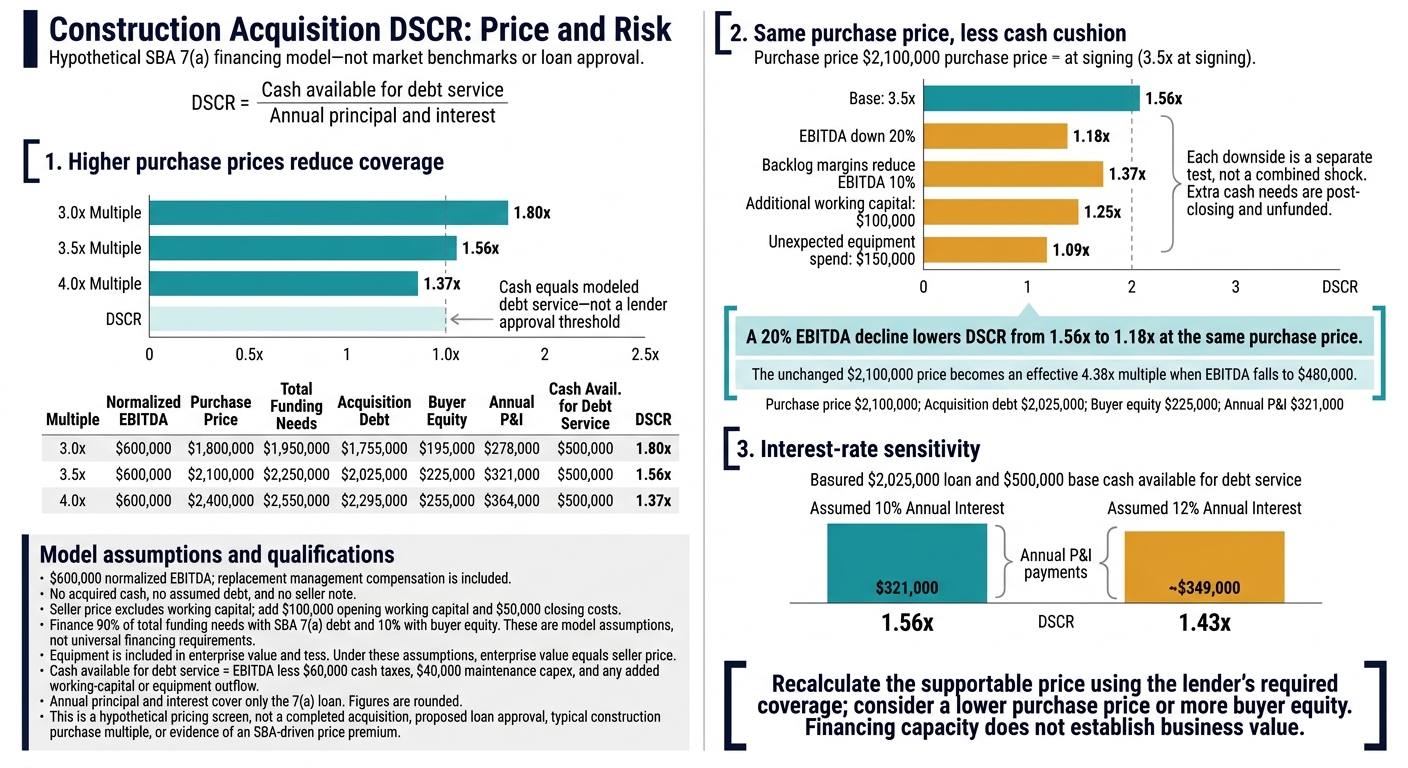
Construction Acquisition DSCR: Price and Risk
Financing limits come into focus when you compare the purchase price with debt payments.
Hypothetical Contractor Purchase at 3.0x–4.0x Earnings Multiples
Assume $600,000 of normalized EBITDA, no acquired cash and no assumed debt, and seller price excludes working capital. Add $100,000 of opening working capital and $50,000 of closing costs. Finance 90% with SBA 7(a) debt and 10% buyer equity; no seller note.
Under these assumptions, enterprise value equals seller price: $1,800,000 at 3.0x, $2,100,000 at 3.5x, and $2,400,000 at 4.0x. Total funding needs are $1,950,000, $2,250,000, and $2,550,000. Equipment is included in enterprise value; it is not added again.
Assume 10% annual interest, monthly payments, and 10-year amortization. This is a hypothetical pricing screen, not a completed acquisition or proposed loan approval. These inputs are not market benchmarks or lender commitments. The table below shows how the supportable price changes as operating risk increases.
Debt-Service Coverage Under Downside Scenarios
The table tests whether the business can cover debt payments with lower EBITDA, weaker backlog margins, extra working capital, or unexpected equipment costs. Apply the backlog, collection, and equipment risks from the prior section when testing your offer price.
Cash available for debt service = EBITDA less $60,000 in cash taxes, $40,000 in maintenance capex, and any added working-capital or equipment outflow.
Normalized EBITDA includes replacement management compensation. Annual principal and interest cover only the 7(a) loan; there are no seller-note payments. Figures are rounded.
Scenario Assumed purchase multiple Normalized EBITDA Purchase price Acquisition debt Buyer equity Annual principal and interest Cash available for debt service DSCR Base: 3.0x 3.0x $600,000 $1,800,000 $1,755,000 $195,000 $278,000 $500,000 1.80x Base: 3.5x 3.5x $600,000 $2,100,000 $2,025,000 $225,000 $321,000 $500,000 1.56x Base: 4.0x 4.0x $600,000 $2,400,000 $2,295,000 $255,000 $364,000 $500,000 1.37x EBITDA down 20% 3.5x at signing $480,000 $2,100,000 $2,025,000 $225,000 $321,000 $380,000 1.18x Backlog margins reduce EBITDA 10% 3.5x at signing $540,000 $2,100,000 $2,025,000 $225,000 $321,000 $440,000 1.37x Additional working capital: $100,000 3.5x at signing $600,000 $2,100,000 $2,025,000 $225,000 $321,000 $400,000 1.25x Unexpected equipment spend: $150,000 3.5x at signing $600,000 $2,100,000 $2,025,000 $225,000 $321,000 $350,000 1.09x Each downside row is a separate test, not a combined shock. The extra cash needs are post-closing and unfunded.
The unchanged $2,100,000 price becomes an effective 4.38x multiple when EBITDA falls to $480,000. Higher interest also reduces capacity: at an assumed 12%, the same $2,025,000 loan requires roughly $349,000 annually, lowering base coverage to 1.43x.
Recalculate the supportable price using the lender’s required coverage. Then decide whether to lower the purchase price or put in more equity.
Transaction-level evidence is limited, so use this model to screen a deal - not as a market comp.
Documented Cases and Research Limits
The sources do not include a dated construction acquisition with both valuation and financing details. That means they cannot establish a typical purchase multiple or an SBA-driven premium.
SOP 50 10 8 tightened SBA underwriting, including equity-injection and seller-note rules. Check which rules apply when you submit the application. Approval still depends on borrower qualifications, lender review, and support for the valuation.
Conclusion: Set Price Based on Value and Financing
SBA loans affect how much you can pay, not what the business is worth. Compare the asking price, independent value, and lender-supported price. Base the business’s value on transferable cash flow, normalized earnings, and a risk profile you can handle and finance.
Use the valuation screen above to turn the deal into a lender-ready offer.
Acquisition Screening and Due Diligence Checklist
- Reconcile at least three years of tax returns and financial statements, and document add-backs.
- Confirm who will take over the seller’s field, estimating, and project-management duties.
- Request WIP schedules, receivables aging, signed backlog contracts, cost-to-complete estimates, and equipment records.
- Review licensing and bonding documents. Confirm that licenses can transfer or be reissued and that the surety supports the buyer’s entity.
- Match financing to how you’ll use the funds: 7(a) for the operating acquisition and working capital; 504 for qualifying fixed assets.
- Budget equity based on total project costs. Keep enough cash available after closing for working capital and bonding.
- Price the deal at the lower of supported value and lender capacity.
Finding Construction Listings With Kumo
Once you’ve set your target price, use one listing source to keep your search organized.
Use Kumo to find and monitor candidates before starting valuation work. Filter construction listings, set alerts, track changes, and organize deal flow in one place. Treat asking prices and seller-reported earnings as screening inputs only.
FAQs
How do I calculate my maximum SBA-backed offer?
Calculate the total project cost, subject to your lender’s independent business valuation. The purchase price must match that valuation. If your offer is higher, you may need to adjust the price or contribute more equity.
You must contribute at least 10% of the total project cost as equity, with at least 5% paid in cash. A seller note on full standby can cover the remaining 5%, but no more than 50% of the required equity.
What if the lender values the business below my offer?
If the lender’s independent valuation comes in below your offer, the SBA loan amount may be reduced to match the appraised value. You may need to cover the gap with additional personal funds or seller financing. Include price-adjustment provisions in your purchase agreement.
Kumo provides real-time data insights and tracks listing changes to help you prepare accurate valuations and manage acquisition documents.
Can I combine 7(a) and 504 financing for an acquisition?
Yes. SBA 504 loans can finance fixed assets, such as real estate or heavy equipment. They don’t cover intangible assets like goodwill, customer lists, or brand value. If those assets account for a large share of the acquisition, you may need to pair a 504 loan with an SBA 7(a) loan to cover those costs.
Kumo can simplify your search by bringing together business listings that match your financing criteria.