

Codely v2.0 public release is here
Lorem ipsum dolor sit amet, consectetur adipiscing elit lobortis arcu enim urna adipiscing praesent velit viverra sit semper lorem eu cursus vel hendrerit elementum morbi curabitur etiam nibh justo, lorem aliquet donec sed sit mi dignissim at ante massa mattis.
- Neque sodales ut etiam sit amet nisl purus non tellus orci ac auctor
- Adipiscing elit ut aliquam purus sit amet viverra suspendisse potent i
- Mauris commodo quis imperdiet massa tincidunt nunc pulvinar
- Adipiscing elit ut aliquam purus sit amet viverra suspendisse potenti
What has changed in our latest release?
Vitae congue eu consequat ac felis placerat vestibulum lectus mauris ultrices cursus sit amet dictum sit amet justo donec enim diam porttitor lacus luctus accumsan tortor posuere praesent tristique magna sit amet purus gravida quis blandit turpis.
All new features available for all public channel users
At risus viverra adipiscing at in tellus integer feugiat nisl pretium fusce id velit ut tortor sagittis orci a scelerisque purus semper eget at lectus urna duis convallis. porta nibh venenatis cras sed felis eget neque laoreet suspendisse interdum consectetur libero id faucibus nisl donec pretium vulputate sapien nec sagittis aliquam nunc lobortis mattis aliquam faucibus purus in.
- Neque sodales ut etiam sit amet nisl purus non tellus orci ac auctor
- Adipiscing elit ut aliquam purus sit amet viverra suspendisse potenti
- Mauris commodo quis imperdiet massa tincidunt nunc pulvinar
- Adipiscing elit ut aliquam purus sit amet viverra suspendisse potenti
Coding collaboration with over 200 users at once
Nisi quis eleifend quam adipiscing vitae aliquet bibendum enim facilisis gravida neque. Velit euismod in pellentesque massa placerat volutpat lacus laoreet non curabitur gravida odio aenean sed adipiscing diam donec adipiscing tristique risus. amet est placerat in egestas erat imperdiet sed euismod nisi.
“Nisi quis eleifend quam adipiscing vitae aliquet bibendum enim facilisis gravida neque velit euismod in pellentesque massa placerat”
Real-time code save every 0.1 seconds
Eget lorem dolor sed viverra ipsum nunc aliquet bibendum felis donec et odio pellentesque diam volutpat commodo sed egestas aliquam sem fringilla ut morbi tincidunt augue interdum velit euismod eu tincidunt tortor aliquam nulla facilisi aenean sed adipiscing diam donec adipiscing ut lectus arcu bibendum at varius vel pharetra nibh venenatis cras sed felis eget dolor cosnectur drolo.
Employment law is a critical factor in U.S. mergers and acquisitions (M&A), with workforce-related claims making up nearly 30% of disputes. Ignoring issues like worker misclassification, unpaid wages, or WARN Act violations can lead to lawsuits, penalties, and higher costs post-closing. This guide breaks down how employment law impacts deal structures, due diligence, and post-acquisition compliance.
Key points:
- Deal Structure Matters: Stock purchases, asset purchases, and mergers handle liabilities and employee transfers differently. For example, stock purchases automatically transfer all employment liabilities, while asset purchases allow selective liability assumption.
- Due Diligence Is Essential: Reviewing employment agreements, wage records, benefit plans, and litigation histories helps uncover risks like unpaid overtime, misclassification, or discrimination claims.
- Post-Closing Compliance: Actions like aligning policies, managing benefits, and addressing legacy issues (e.g., OSHA violations or pension shortfalls) are crucial in the first 90 days.
Employment and Executive Compensation Considerations in M&A: Preparing for an M&A Transaction
How Deal Structure Affects Employment Law
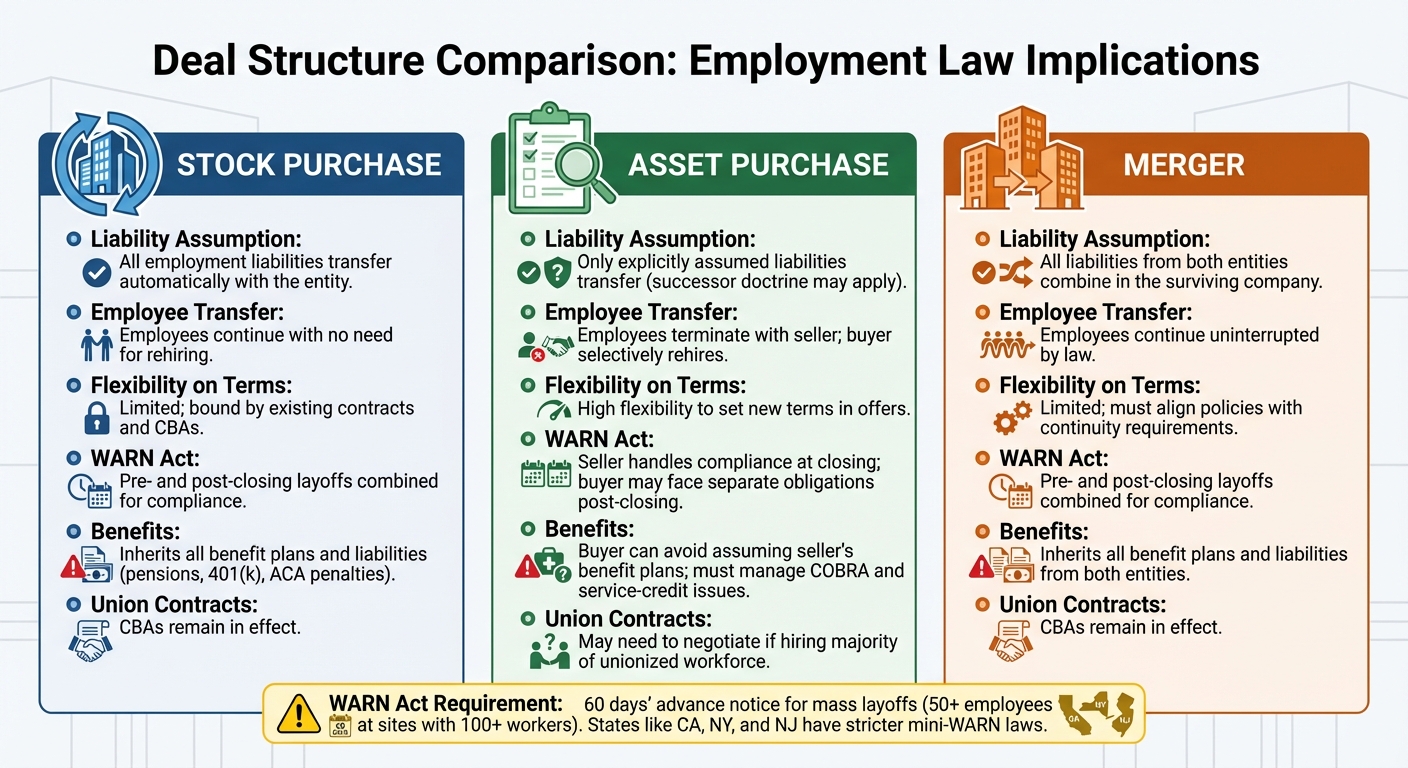
M&A Deal Structure Comparison: Employment Liability and Employee Transfer Guide
The way an acquisition is structured - whether as a stock purchase, asset purchase, or merger - determines how employment liabilities are handled and how employees transition to the new ownership. Each approach creates a unique legal framework for things like wage claims, union agreements, and employee benefits. Let’s break down these differences and explore how due diligence helps clarify liabilities and guides employee transition strategies.
Employment Liabilities and Employee Transfers
In a stock purchase, the company’s legal entity remains intact, meaning all employment liabilities - such as unpaid wages, employee misclassification, discrimination claims, underfunded benefits, and union contracts - transfer to the new owner. Employees stay with the company and do not need to be formally rehired; their employment continues seamlessly under the new ownership.
An asset purchase, on the other hand, allows buyers to pick and choose which assets and employment liabilities to assume. Employees remain with the seller until the buyer extends new offers. However, under the successor employer doctrine, federal liabilities may apply if the buyer continues the business in a substantially similar way - such as operating at the same facilities and hiring most of the seller’s workforce.
A merger legally combines two entities, automatically transferring all employees and employment liabilities to the surviving company.
For at-will employees, the transition process is generally straightforward, as they have fewer protections. In contrast, contractual employees may have agreements that include change-of-control clauses, guaranteed severance, or specific notice requirements, which must be honored regardless of the deal structure. Unionized employees bring additional complexity. In stock purchases and mergers, collective bargaining agreements (CBAs) typically remain in effect. In asset purchases, the buyer may need to negotiate with the union if they hire a majority of the unionized workforce, even if they don’t formally assume the CBA.
Deal Structure Comparison
The table below highlights how each deal structure manages key employment law considerations:
| Deal Structure | Liability Assumption | Employee Transfer | Flexibility on Terms |
|---|---|---|---|
| Stock Purchase | All employment liabilities transfer automatically with the entity | Employees continue with no need for rehiring | Limited; bound by existing contracts and CBAs |
| Asset Purchase | Only explicitly assumed liabilities transfer (successor doctrine may apply) | Employees terminate with seller; buyer selectively rehires | High flexibility to set new terms in offers |
| Merger | All liabilities from both entities combine in the surviving company | Employees continue uninterrupted by law | Limited; must align policies with continuity requirements |
Adding to these complexities, the WARN Act requires 60 days’ advance notice for mass layoffs impacting 50 or more employees at sites with at least 100 workers. In stock purchases and mergers, the employing entity remains, so pre- and post-closing layoffs must be combined to determine WARN obligations. For asset purchases, the seller typically handles WARN compliance if employees are terminated at closing, but the buyer may face their own WARN obligations if layoffs occur post-closing. States like California, New York, and New Jersey enforce stricter mini-WARN laws with lower thresholds and longer notice periods.
When it comes to employee benefits, stock purchases and mergers mean inheriting all benefit plans and liabilities, including underfunded pensions, 401(k) compliance issues, and Affordable Care Act (ACA) penalties. In contrast, asset purchases allow buyers to avoid assuming the seller’s benefit plans. However, buyers must carefully manage COBRA obligations, ensure smooth transitions in coverage, and address service-credit issues for vesting and eligibility when offering their own benefit plans.
Employment Due Diligence in Acquisitions
When it comes to acquisitions, employment due diligence plays a crucial role in uncovering workforce-related liabilities that could derail a deal. According to Axiom Law, employment-related claims account for up to 30% of M&A disputes in the U.S., making it a critical area to address. The primary goal here is to identify risks tied to the workforce - ranging from wage violations and employee misclassification to underfunded pensions and pending lawsuits. These insights help inform decisions on purchase price adjustments, indemnities, or even withdrawing from a deal altogether. This process also lays the groundwork for quantifying risks and shaping integration strategies down the road.
Key Employment Documents and Data to Review
The due diligence process begins with a thorough document request that covers every aspect of the workforce. A detailed employee census is essential, including information such as employee identification, roles, employment type, FLSA status, locations, hire dates, and compensation. Employment agreements - like offer letters, executive contracts, retention bonuses, change-of-control provisions, and severance arrangements - should also be reviewed. Additionally, independent contractor and consultant lists are critical, as misclassification is a common issue.
Other key documents to collect include:
- Wage and hour records: Timekeeping logs, payroll registers, overtime calculations, and audit reports from the Department of Labor or state agencies.
- HR policies: Current and historical policies on anti-harassment, equal opportunity, remote work, and disciplinary procedures.
- Benefits documentation: Plan details for health, dental, life, and disability insurance; 401(k) plans; stock options; severance plans; COBRA procedures; and ERISA filings like Form 5500.
- Health and safety records: OSHA logs, workers' compensation claims, safety programs, training records, and any citations or settlements.
- Immigration files: I-9 forms, E-Verify records, visa sponsorship details (e.g., H-1B, L-1), and audit notices.
- Union-related documents: Collective bargaining agreements, side letters, grievance histories, and National Labor Relations Board (NLRB) charge records.
Lastly, compile litigation and agency charge histories for the past three to five years. This includes employment lawsuits, arbitration cases, EEOC complaints, state agency charges, Department of Labor investigations, and OSHA violations. Be sure to include any WARN Act or state mini-WARN notices for layoffs or plant closures, along with associated severance programs and litigation.
Common Employment Law Risks to Address
Employment due diligence often reveals risks in areas like wage violations, misclassification, and discrimination. Here’s a closer look at these issues:
- Wage and hour violations: Issues under the Fair Labor Standards Act (FLSA) and state laws - like unpaid overtime, minimum wage shortfalls, off-the-clock work, and missed meal/rest breaks - can lead to liabilities such as back wages, liquidated damages, and legal fees.
- Misclassification: Incorrectly classifying employees as independent contractors or exempt workers without proper analysis can result in retroactive taxes, unpaid benefits, and penalties.
- Discrimination and harassment claims: Complaints under Title VII, the Americans with Disabilities Act (ADA), and the Age Discrimination in Employment Act (ADEA) often arise from EEOC filings or internal investigations. Settlements for these claims typically range from $50,000 to $100,000 and may include additional injunctions or consent decrees.
- WARN Act violations: Failing to provide 60 days’ notice for mass layoffs involving 50 or more employees can result in back pay liabilities of up to 60 days per affected worker.
The table below highlights key risk areas, relevant documents, and potential financial impacts:
| Risk Category | Key Laws | Documents to Review | Potential Impact |
|---|---|---|---|
| Wage & Hour Violations | FLSA, state wage laws | Payroll records, time logs, audits | Back pay, liquidated damages, legal fees ($10,000+ per claim) |
| Misclassification | FLSA, IRS rules | Employment agreements, classifications | Retroactive taxes, benefits arrears, penalties |
| WARN Act Non-Compliance | Federal WARN, state laws | Layoff notices, severance records | Back pay up to 60 days per employee |
| Discrimination Claims | Title VII, ADA, ADEA | EEOC filings, personnel complaints | Settlements ($50,000–$100,000), injunctions |
| Benefits & ERISA Issues | ERISA, ACA, IRS rules | Benefit plans, Form 5500, funding reports | Pension liabilities, ACA penalties, correction costs |
| Health & Safety Violations | OSHA, state laws | OSHA logs, incident reports | Fines, operational disruptions, litigation |
sbb-itb-97ecd51
Employment Law After Closing
The first 90 days following a business acquisition are critical for addressing employment law concerns. According to the U.S. Department of Justice, buyers who conduct thorough post-closing diligence, promptly report any misconduct, and integrate the acquired company into their compliance program may receive favorable treatment in enforcement actions. This phase builds on earlier due diligence efforts, laying the groundwork for long-term compliance.
Day 1 Priorities
Start by clearly communicating the ownership change to employees. Issue concise transfer letters that confirm the employer of record and outline key details, including continuity of employment, base pay, FLSA classification (exempt or nonexempt), recognition of prior service (when applicable), and essential benefits. Clear communication reduces uncertainty among employees.
Implement core policies immediately. Distribute an employee handbook covering critical topics like anti-harassment, anti-discrimination, retaliation policies, complaint procedures, timekeeping, overtime approval, meal and rest breaks, and workplace safety. Collect signed acknowledgments for recordkeeping. Additionally, ensure all required federal and state workplace notices - such as those related to the EEOC, FLSA, OSHA, FMLA, and state wage laws - are properly displayed at worksites and available digitally for remote employees.
Within the first 30 days, review legacy employment practices. Align existing job titles with your organizational structure and reassess FLSA classifications. Audit roles performed by independent contractors or gig workers against IRS and Department of Labor standards. If misclassifications are suspected, consult legal counsel to create a remediation plan, which may involve reclassifying roles, adjusting compensation, enrolling workers in benefits, or addressing back pay. Evaluate current pay ranges against your compensation bands, keeping an eye on equal pay risks and any collective bargaining constraints. Document all changes and communicate them within regular payroll cycles.
Managing benefits transitions also requires careful planning. Take inventory of existing plans - health, dental, vision, 401(k), pensions, equity programs, bonuses, and PTO - and work with insurers to ensure uninterrupted coverage. If any plans are terminated, issue COBRA notices promptly. For retirement plans, address underfunded benefits, mergers, or spin-offs, and ensure timely filings. Review ACA "pay or play" compliance by examining measurement periods, affordability, and providing clear benefit comparisons and enrollment support during the transition.
If the acquired company has unionized employees, determine whether you’ll assume successor employer responsibilities. On Day 1, confirm that wages, hours, and working conditions will remain unchanged without new bargaining agreements. Communicate your intent to honor current collective bargaining agreements while retaining the right to negotiate future changes. Review provisions related to seniority, layoffs, successorship, subcontracting, grievance procedures, and benefits to identify any limitations on integration or restructuring. If changes are planned, provide timely notifications and schedule bargaining sessions to avoid potential labor disputes.
Compliance Monitoring and Audits
After completing immediate integration tasks, ongoing audits are essential for maintaining compliance. A structured approach ensures alignment with the standards identified during due diligence.
Develop a post-closing compliance workplan targeting high-risk areas like wage-and-hour practices, discrimination claims, safety issues, and benefits administration. Within the first 90 days, conduct targeted audits to review timekeeping and overtime calculations, address open EEOC or agency charges, examine I-9 and immigration records, and verify OSHA logs and safety programs. Assign HR, legal, and finance teams to oversee compliance, establish a 30-60-90 day audit calendar, and create an escalation process for issues that may require self-disclosure or indemnification.
Review personnel, payroll, and benefits records to confirm compliance. This includes job descriptions, time records, classification analyses, plan documents, nondiscrimination testing, ACA reporting, COBRA administration, personnel files, complaint records, investigation reports, signed acknowledgments, incident logs, and safety or benefit plan documentation. If the integration involves operations in new states or cities, update wage, leave, and scheduling policies to comply with local laws.
When legacy issues arise - such as misclassification, unpaid overtime, discrimination claims, or OSHA violations - work with legal counsel to assess the situation, quantify potential liabilities, and determine whether these issues are covered under seller indemnities, escrow arrangements, or the purchase agreement’s representations and warranties. Decide whether to quietly resolve the issue (e.g., settling back pay) or formally report it, weighing the risk profile and regulatory guidance. For ongoing litigation or agency proceedings, develop a defense strategy, notify insurers as needed, and carefully evaluate settlement options to balance potential reputational impacts with integration goals. Use insights from these audits to strengthen your compliance program and minimize future risks.
For buyers who frequently acquire and integrate companies - often using tools like Kumo to identify opportunities - developing a repeatable post-closing playbook can help reduce employment law risks over time. By treating employment law integration as a key part of your value-creation strategy, you can align compliance efforts with broader goals like cost savings, workforce planning, and growth. Use lessons from post-closing reviews to refine future due diligence checklists and improve screening criteria, incorporating metrics such as turnover rates, litigation history, benefit costs, and unionization levels.
Using Employment Law Insights in Deal Sourcing
Incorporating employment law considerations early in your acquisition strategy can save both time and resources. Buyers who evaluate workforce-related risks during the initial stages of deal sourcing avoid complications like unexpected price adjustments, additional structural safeguards, or even walking away from deals altogether. By treating employment law as a key commercial factor - rather than a last-minute legal hurdle - you can streamline your pipeline and set the foundation for stronger long-term outcomes. Below, we’ll dive into how this approach can be structured into a data-driven screening process.
Employment Data in Deal Screening
A well-designed deal-sourcing playbook can transform past employment law challenges into actionable screening criteria. For instance, if previous acquisitions revealed costly issues like misclassified independent contractors, you might exclude future targets in high-risk sectors - such as gig work, logistics, or staffing - unless they can demonstrate clean Department of Labor records and recent independent audits. Similarly, if legacy union agreements previously limited restructuring flexibility, you could prioritize targets with no union presence or contracts nearing expiration.
At the very start of deal screening - before formal due diligence - request concise, high-value employment data to assess risks early. Key data points to collect include:
- Headcount by location and employment type (e.g., W-2 vs. 1099 workers)
- Use of independent contractors or staffing agencies
- Presence of unions or collective bargaining agreements
- Known or pending employment claims or investigations
- Recent layoffs triggering WARN Act compliance
- Turnover rates in critical roles
Additionally, quick checks of litigation databases and OSHA enforcement records can help identify recurring or severe issues. Red flags like widespread misclassification, frequent wage-and-hour disputes, EEOC charges, or significant OSHA violations should prompt deal repricing or even abandonment.
To guide decision-making, implement a risk-scoring framework that assigns weighted scores to employment factors. For example, you could evaluate litigation frequency, contractor reliance, unionization levels, and compliance track records. These scores - ranging from 1 to 5 - can then be tied to specific actions, such as setting minimum IRR thresholds, requiring legal protections (e.g., escrows or caps), or choosing asset over equity deals. By explicitly linking workforce risks to growth strategies - like limits on layoffs due to WARN or necessary investments for safety upgrades - you’ll avoid surprises later in the process and ensure these factors are accounted for during underwriting.
Finding Deals with Kumo

Modern tools like Kumo make it easier to integrate employment law insights into your sourcing efforts. Kumo consolidates listings from marketplaces, brokerages, and proprietary sources, allowing you to apply custom filters based on industry, business size, and U.S. jurisdiction to match your risk criteria. For example, you could filter for non-union manufacturing companies in the Midwest with fewer than 100 employees or multi-location businesses in states where you already understand compliance requirements.
Kumo’s AI-powered analysis can flag potential employment risks by scanning listing descriptions for terms like "heavy contractor reliance", "unionized workforce", "ongoing litigation", or "recent restructuring." You can also set deal alerts to identify opportunities that align with your workforce risk tolerance. Use data analytics to compare metrics like headcount, geography, and labor costs across similar deals, helping you identify outliers that may signal misclassification or under-reported wages.
By incorporating these tools into your workflow, you can focus on deals that align with your employment risk appetite while avoiding those requiring extensive remediation or exposing you to liabilities.
Refining this employment-law-focused sourcing process over time can further reduce risks. Track metrics such as the percentage of deals rejected early due to employment concerns, average price adjustments tied to workforce issues, post-closing employment claims versus expectations, and time spent on employment-related diligence. These insights will help you fine-tune your criteria, improve your playbook, and ensure employment law considerations remain central to every acquisition decision.
Conclusion
Employment law plays a critical role in shaping deal structures, pricing, and long-term value from the very beginning of an acquisition. Both law firms and in-house counsel rank employment and labor issues alongside tax and regulatory concerns as key risk areas in U.S. M&A.
Taking a proactive approach to employment law does more than just identify risks - it helps shape your entire acquisition strategy. Conducting thorough due diligence in areas like contracts, worker classifications, benefits, litigation, unions, and compliance is the best way to guard against unexpected liabilities and disputes after the deal closes. The insights gathered during this process should directly influence deal terms, such as indemnities, purchase-price adjustments, and whether an asset or stock purchase structure aligns better with your risk profile. Once the deal is closed, the focus shifts to workforce integration: aligning policies, compensation, and benefits while managing workplace culture to retain top talent - because losing key employees can quickly diminish the value of your investment.
Incorporating employment law considerations early in the process sets the foundation for stronger deals and smoother integration post-closing. Tools like Kumo make this easier by aggregating over 100,000 business listings and using AI to identify promising targets across industries and regions. Custom filters and deal alerts enable you to zero in on opportunities in jurisdictions where you’re familiar with the employment law landscape, while data analytics help flag potential red flags, such as headcount fluctuations, union activity, litigation history, or compliance risks. This kind of screening allows you to prioritize deals that align with your risk tolerance and integration capabilities.
The involvement of legal and HR experts shouldn’t be an afterthought - it’s essential from the outset. By embedding employment law considerations into every stage of the process - from initial screening with platforms like Kumo to post-closing integration - acquirers can close deals more efficiently, minimize post-closing disputes, and preserve long-term value. Successful acquirers recognize that people are both their greatest asset and a potential risk. Planning strategically from the start, involving expert counsel and HR leadership early, and leveraging data-driven tools can turn employment law challenges into opportunities for strategic growth.
FAQs
How does the structure of a deal affect employee transfers and related liabilities in an acquisition?
The way a deal is structured significantly impacts how employees are handled and what responsibilities the buyer takes on. Sometimes, employees remain with the company under their existing terms. Other times, they might be transferred to the new organization or even face termination. These choices directly affect important liabilities, including severance packages, unpaid benefits, and ongoing commitments like healthcare or retirement plans.
It's essential for buyers to thoroughly assess these aspects during due diligence. This process helps ensure compliance with employment laws and prepares them for any potential costs or risks tied to the workforce transition.
What employment documents should be reviewed during due diligence in an acquisition?
When conducting due diligence for an acquisition, reviewing employment-related documents is a critical step to spot potential risks and confirm compliance. Key documents to examine include:
- Employee handbooks and policies: These outline workplace rules and expectations.
- Employment agreements and offer letters: They detail terms of employment and contractual obligations.
- Non-compete, non-solicitation, and non-disclosure agreements: These safeguard the business’s interests and intellectual property.
- Benefit and retirement plans: It's important to verify the structure and compliance of these offerings.
- Payroll records and compensation structures: These provide insight into payment practices and employee costs.
- Records of employment disputes or claims: Ongoing or past issues could indicate potential liabilities.
Carefully assessing these documents ensures a smoother transition and helps prevent unexpected legal or financial challenges after the acquisition.
What should be prioritized for employment law compliance right after closing a deal?
After finalizing a deal, tackling employment law compliance should be at the top of your list. Start by updating employee records to accurately reflect any changes. Make sure to communicate updates or transitions clearly to your team to avoid confusion. It's also essential to review employment agreements, ensuring they meet all legal standards.
Take a close look at employee benefits, policies, and procedures to confirm they align with compliance requirements. If the deal involves integrating workforces, address any potential challenges early to ensure a seamless transition while staying within legal boundaries.