

Codely v2.0 public release is here
Lorem ipsum dolor sit amet, consectetur adipiscing elit lobortis arcu enim urna adipiscing praesent velit viverra sit semper lorem eu cursus vel hendrerit elementum morbi curabitur etiam nibh justo, lorem aliquet donec sed sit mi dignissim at ante massa mattis.
- Neque sodales ut etiam sit amet nisl purus non tellus orci ac auctor
- Adipiscing elit ut aliquam purus sit amet viverra suspendisse potent i
- Mauris commodo quis imperdiet massa tincidunt nunc pulvinar
- Adipiscing elit ut aliquam purus sit amet viverra suspendisse potenti
What has changed in our latest release?
Vitae congue eu consequat ac felis placerat vestibulum lectus mauris ultrices cursus sit amet dictum sit amet justo donec enim diam porttitor lacus luctus accumsan tortor posuere praesent tristique magna sit amet purus gravida quis blandit turpis.
All new features available for all public channel users
At risus viverra adipiscing at in tellus integer feugiat nisl pretium fusce id velit ut tortor sagittis orci a scelerisque purus semper eget at lectus urna duis convallis. porta nibh venenatis cras sed felis eget neque laoreet suspendisse interdum consectetur libero id faucibus nisl donec pretium vulputate sapien nec sagittis aliquam nunc lobortis mattis aliquam faucibus purus in.
- Neque sodales ut etiam sit amet nisl purus non tellus orci ac auctor
- Adipiscing elit ut aliquam purus sit amet viverra suspendisse potenti
- Mauris commodo quis imperdiet massa tincidunt nunc pulvinar
- Adipiscing elit ut aliquam purus sit amet viverra suspendisse potenti
Coding collaboration with over 200 users at once
Nisi quis eleifend quam adipiscing vitae aliquet bibendum enim facilisis gravida neque. Velit euismod in pellentesque massa placerat volutpat lacus laoreet non curabitur gravida odio aenean sed adipiscing diam donec adipiscing tristique risus. amet est placerat in egestas erat imperdiet sed euismod nisi.
“Nisi quis eleifend quam adipiscing vitae aliquet bibendum enim facilisis gravida neque velit euismod in pellentesque massa placerat”
Real-time code save every 0.1 seconds
Eget lorem dolor sed viverra ipsum nunc aliquet bibendum felis donec et odio pellentesque diam volutpat commodo sed egestas aliquam sem fringilla ut morbi tincidunt augue interdum velit euismod eu tincidunt tortor aliquam nulla facilisi aenean sed adipiscing diam donec adipiscing ut lectus arcu bibendum at varius vel pharetra nibh venenatis cras sed felis eget dolor cosnectur drolo.
A business can look fine on paper and still have a license problem that can delay closing or stop the company from operating after the deal. When I review license risk in an SMB deal, I focus on four things right away: what licenses should exist, whether official records match the seller’s files, whether the licenses fit current business activity, and whether the licenses can stay in place after a sale.
Here’s the short version:
- I find businesses for sale and map each entity, DBA, activity, and location
- I check licenses in state, city, county, and agency records
- I confirm the license is active, current, and tied to the right name and address
- I review whether the business is working within license limits
- I flag anything that may need renewal, consent, transfer approval, or reapplication
- I put each issue into a deal log for price cuts, escrow, indemnities, or closing conditions
A missed item can lead to fines, lost sales, filing costs, and legal fees. And if financing is involved, lenders often want proof that the company is properly licensed before they fund.
| Step | What I check | Why it matters |
|---|---|---|
| 1 | Required licenses by activity and location | Finds what should be in place |
| 2 | Seller documents vs. agency records | Confirms status, dates, and ownership |
| 3 | Scope, expiration, and sale-trigger rules | Spots gaps that can block post-close use |
| 4 | Deal log and fix plan | Turns issues into closing actions |
If I had to sum up the process in one line, it would be this: don’t just ask for licenses - verify them, test them, and tie each problem to a deal fix.
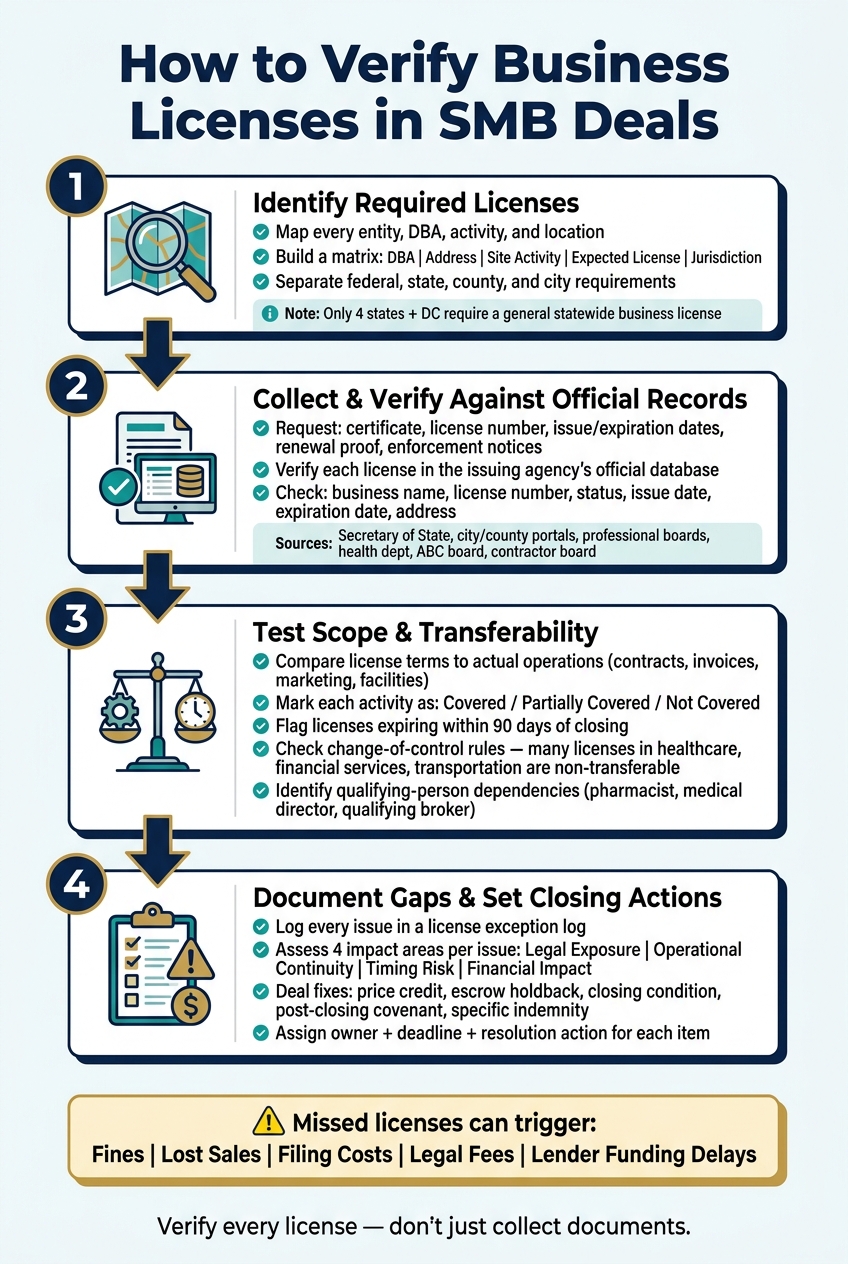
Business License Verification Process for SMB Deals
1. Identify the licenses the target business should have
Start with the business itself, not the seller’s file. An LLC or corporation may exist on paper and still be missing licenses it needs to operate. First, map what the company does and every U.S. location where it sells, serves customers, stores inventory, or employs staff. That gives you a clear picture of which licenses should be in place before you look at any documents.
Map activities, entities, and locations
Gather the legal entity name, every DBA or trade name, each facility address, and the jurisdictions where the business operates. Then note what happens at each site. A retail storefront and a clinic, for example, can trigger different license rules even under the same company. Licenses usually attach to the activity and the location, not only to the entity name.
Put the findings into a simple matrix. Use one row for each entity, location, and activity combination. Include:
- DBA
- Address
- Site activity
- Expected license
- Governing jurisdiction
That matrix becomes your working checklist for collecting documents and checking public records.
Separate federal, state, and local requirements
License rules can apply at the federal, state, county, and city levels. Federal rules usually come into play only for regulated activities. State rules often cover professional, occupational, tax, and industry-specific licensing. Local rules are easy to miss, and they’re often the most tied to a specific address.
Only four states plus the District of Columbia are commonly cited as requiring a general statewide business license. In many states, local licenses or industry-specific permits may still apply, especially if the company operates across several cities or counties.
The main question in this step is straightforward: What does the business do, where does it do it, and which jurisdictions regulate that activity? Once you’ve built that checklist, you can compare it against the seller’s documents and public records.
sbb-itb-97ecd51
2. Collect seller documents and verify each license against official records
Use the license matrix from Section 1 to ask for documents for each entity, activity, and location. Think of every line in that matrix as two things at once: a document request and a database check.
For each license, request the certificate, license number, issuing agency, issue and expiration dates, renewal proof, payment records, and any suspension or disciplinary notices. Pull entity formation documents, DBA registrations, and lease or facility records too. That’s how you tie each license back to the exact legal entity and operating address.
Build a source document checklist
Sort everything by entity, DBA, and site address. For each license, collect:
- The license certificate
- Renewal proof
- Regulator correspondence
- Pending applications
- Enforcement notices
Once you have the documents, compare each one against the issuing agency’s public record.
Match seller documents to official databases
Seller PDFs are just the starting point. They may be old, expired, or no longer valid after a suspension. Always verify directly through the issuing authority's official database.
Check the business name, license number, status, issue date, expiration date, and address. Small mismatches can be a big deal. A license for "ABC Holdings LLC" tied to "ABC Market" at another address needs follow-up. Also confirm whether the license is issued to the entity, an individual, or a site. That detail matters because it affects whether the license stays usable after the deal closes.
Use the issuing agency below to verify each record:
| Record or License Type | Where to Verify |
|---|---|
| Business entity status | State Secretary of State business entity search |
| Local business license | City or county business license portal |
| Professional or occupational license | State professional or occupational licensing board |
| Health or facility permit | State or local health department |
| Liquor license | State alcohol beverage control board |
| Contractor license | State contractor licensing board |
Many state and professional board lookup tools also show disciplinary history, including violations, suspensions, or prior enforcement actions that may not appear in a seller's file. Save each verification result and note the check date in the deal file.
3. Check whether each license covers actual business operations
An active license, by itself, doesn't tell you much. First confirm the license exists. Then check whether it matches what the company is actually doing today.
Check license scope against current operations
Start with the license terms from the issuing authority. Note what the license allows, where it applies, any specialty limits, and any conditions tied to it. Then compare that scope with the company’s current products, locations, and customer groups.
To see how the business operates in practice, review items like:
- Customer contracts and invoices
- Website copy and marketing materials
- Lease agreements and utility bills
- Product lists and facility-use records
- HR and payroll files
That evidence helps you map paper approval to day-to-day activity.
Mark each line as covered, partially covered, or not covered. This step often brings gaps to the surface. For example, an HVAC contractor license may allow residential installation, while the contracts show commercial refrigeration work for restaurants across several sites. Or a clinic may promote telehealth in states where it has no professional registrations. That kind of drift is common, and it’s a problem.
You should also walk the facilities. What happens on-site needs to line up with zoning, health, and industry permit approvals. An unlicensed satellite office or warehouse that does not appear on core permits is a liability you may inherit.
Operating outside the approved scope can trigger the same penalties as operating with no license at all, including fines, cease-and-desist orders, and forced shutdowns.
Review expiration, renewals, and change-of-control risk
Once scope is checked, look at whether each license is current and whether it can move with the deal. Build a tracker with the issuer, license number, effective date, expiration date, status, renewal steps, and source. Flag anything that expires within 90 days of the expected closing date. That window can disappear fast, especially when a renewal calls for inspections, agency surveys, or compliance upgrades.
In many jurisdictions, a lapsed license becomes a violation on day one. Some regulators also charge per-day penalties while the business keeps operating.
Then review transfer and change-of-control rules. Many licenses, especially in healthcare, financial services, transportation, and some trades, are not transferable. A sale may trigger agency notice, consent, an amendment, or a full reapplication. Check the license terms and the regulator’s guidance so you know whether the license can be assigned or must be issued again.
Some licenses also depend on a named qualifying person, such as a pharmacist, medical director, qualifying broker, or managing officer. If that person leaves after closing, the business may lose legal authority to operate until a replacement is approved. Also confirm whether the buyer entity must qualify to do business or register as a foreign entity before it can hold the licenses.
Log every scope gap, renewal problem, and transfer limit in the exception log.
4. Document gaps, assess deal impact, and set closing actions
Once you've confirmed scope and transfer risk, the next step is simple: turn each issue into a deal action. Every finding should go into a single license exception log that the deal team can use to assign risk, decide on fixes, and set closing terms.
Create a license exception log
Put every issue in one exception log. Group the findings by category so the team can spot patterns fast. For each item, tie the issue to four impact areas: legal exposure, operational continuity, timing risk, and financial impact.
Here’s what each one should cover:
- Legal exposure: fines, stop-work or shutdown orders, unenforceable contracts, insurance denials, or other enforcement action
- Operational continuity: whether the business can keep operating
- Timing risk: how long the fix will take compared with the closing date
- Financial impact: a dollar estimate tied to fines, cure costs, revenue at risk, and any price or escrow adjustment
The log should also name an owner, set a deadline, and state the fix for each issue. In plain English: who’s handling it, by when, and what needs to happen.
The table below shows what a filled-in exception log should look like in practice:
| License or Permit | Issue Found | Current Status | Business Impact | Responsible Party | Next Diligence Action |
|---|---|---|---|---|---|
| County health permit | Expired 05/31/2026 | Operating without active permit | Closure risk on inspection | Seller | Condition closing on evidence of renewal |
| State liquor license | Non-transferable | Active under seller | Closing delay; revenue loss | Buyer's counsel | Apply for new license; escrow 3 months of projected EBITDA |
| Physical therapist professional license | Lapsed as of 08/01/2026 | Inactive | Payor reimbursement clawback risk | Seller | Suspend billable activity; initiate reinstatement |
| Zoning permit | Scope gap (20-seat limit) | Active but limited | Expansion blocked | Buyer | Request variance review post-close |
| Professional license | Registered under individual name | Active | Compliance risk on ownership transfer | Seller | Post-closing covenant to transfer to entity name within 30 days |
Treat this log as the working tracker. Each row should have an owner, a target resolution date, and a priority level.
Then use the log to shape deal protections. If a license is expired or missing and the business depends on it, that issue usually needs to be fixed before closing. That can mean proof of renewal or a new application on file before the deal closes. If the fix won't happen in time, a price credit or escrow holdback can shift the risk.
Transfer limits are another big one. If a regulator's written consent is needed, make that consent a closing condition. On the other hand, smaller admin issues, like a license still sitting in the seller's personal name, can often be handled with a post-closing covenant and a 30-day deadline.
One more point matters here: use a specific indemnity for known violations instead of relying on a broad compliance rep.
From that point on, the log becomes the deal team's playbook for pricing, covenants, and closing conditions.
Conclusion: A practical workflow for license diligence
License diligence follows a clear path: identify the licenses you need, verify them in official records, test scope and transferability, and turn every gap into a closing action. Then use the exception log to drive price, indemnities, escrow, and closing conditions.
FAQs
Who should verify licenses in a deal?
License verification should be a shared effort between the buyer and seasoned professionals.
The buyer should ask the seller for a full list of licenses and permits. Then, they should check the status of each one with the right agencies on their own.
That extra step matters. A license that looks fine on paper may have transfer limits, renewal issues, or missing filings.
Attorneys, accountants, and industry-specific compliance experts can help sort through those details. They can review transfer rules, flag permits that can't be transferred, and spot liability gaps before they turn into expensive problems.
What records aren’t available online?
Not every business record shows up in a public database. You may find some licensing, court, and tax details online, but many internal company records stay private.
So, ask the seller for copies of key documents, such as internal governance records, inspection reports, signed agreements, and correspondence with regulators. Then check those records against official government sources. Online portals can be incomplete or out of date.
What if a required license is missing?
If a required business license is missing or has expired, start by documenting the issue and estimating the possible cost. That can include fines, penalties, and even downtime if the business has to pause operations.
Then bring that finding into due diligence and use it as leverage in the deal. You might:
- Ask for a lower purchase price
- Require the seller to fix the problem before closing
- Walk away if the issue can't be solved
This matters because a license gap isn't just paperwork. It can turn into added cost, delays, and risk the minute you take over.