

Codely v2.0 public release is here
Lorem ipsum dolor sit amet, consectetur adipiscing elit lobortis arcu enim urna adipiscing praesent velit viverra sit semper lorem eu cursus vel hendrerit elementum morbi curabitur etiam nibh justo, lorem aliquet donec sed sit mi dignissim at ante massa mattis.
- Neque sodales ut etiam sit amet nisl purus non tellus orci ac auctor
- Adipiscing elit ut aliquam purus sit amet viverra suspendisse potent i
- Mauris commodo quis imperdiet massa tincidunt nunc pulvinar
- Adipiscing elit ut aliquam purus sit amet viverra suspendisse potenti
What has changed in our latest release?
Vitae congue eu consequat ac felis placerat vestibulum lectus mauris ultrices cursus sit amet dictum sit amet justo donec enim diam porttitor lacus luctus accumsan tortor posuere praesent tristique magna sit amet purus gravida quis blandit turpis.
All new features available for all public channel users
At risus viverra adipiscing at in tellus integer feugiat nisl pretium fusce id velit ut tortor sagittis orci a scelerisque purus semper eget at lectus urna duis convallis. porta nibh venenatis cras sed felis eget neque laoreet suspendisse interdum consectetur libero id faucibus nisl donec pretium vulputate sapien nec sagittis aliquam nunc lobortis mattis aliquam faucibus purus in.
- Neque sodales ut etiam sit amet nisl purus non tellus orci ac auctor
- Adipiscing elit ut aliquam purus sit amet viverra suspendisse potenti
- Mauris commodo quis imperdiet massa tincidunt nunc pulvinar
- Adipiscing elit ut aliquam purus sit amet viverra suspendisse potenti
Coding collaboration with over 200 users at once
Nisi quis eleifend quam adipiscing vitae aliquet bibendum enim facilisis gravida neque. Velit euismod in pellentesque massa placerat volutpat lacus laoreet non curabitur gravida odio aenean sed adipiscing diam donec adipiscing tristique risus. amet est placerat in egestas erat imperdiet sed euismod nisi.
“Nisi quis eleifend quam adipiscing vitae aliquet bibendum enim facilisis gravida neque velit euismod in pellentesque massa placerat”
Real-time code save every 0.1 seconds
Eget lorem dolor sed viverra ipsum nunc aliquet bibendum felis donec et odio pellentesque diam volutpat commodo sed egestas aliquam sem fringilla ut morbi tincidunt augue interdum velit euismod eu tincidunt tortor aliquam nulla facilisi aenean sed adipiscing diam donec adipiscing ut lectus arcu bibendum at varius vel pharetra nibh venenatis cras sed felis eget dolor cosnectur drolo.
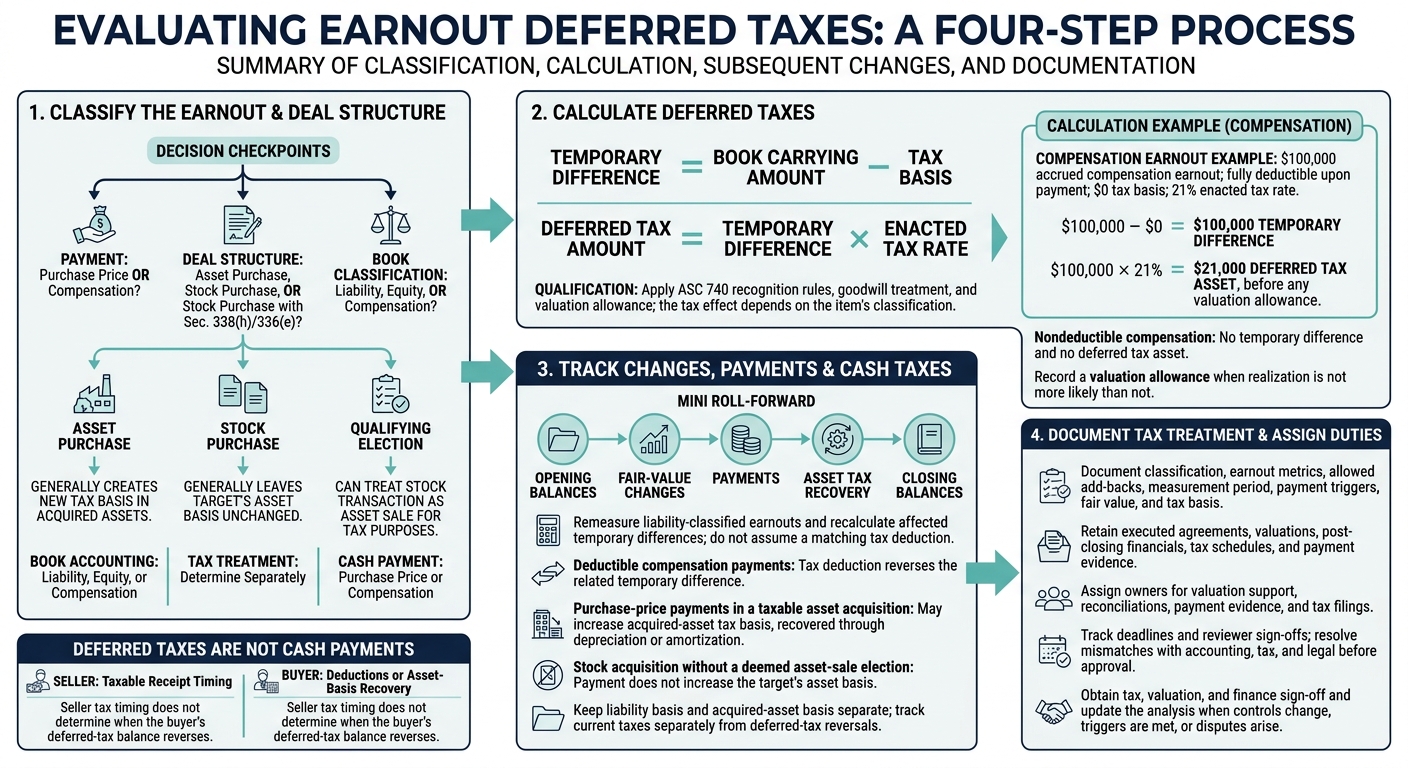
An earnout can create deferred taxes - but not just because payment comes later. I start by checking whether it’s purchase price or compensation, then compare the book treatment with the tax treatment. For example, $100,000 in accrued compensation deductible upon payment can create a $21,000 deferred tax asset at a 21% tax rate, before any valuation allowance.
Here’s the approach I use:
- Classify the payment and deal. Asset purchases, stock purchases, and certain tax elections can produce different tax results.
- Calculate the tax balance. Check book amounts, tax basis, enacted tax rates, goodwill rules, and whether a deferred tax asset needs a valuation allowance.
- Track changes and payments. Separate earnout remeasurement, compensation deductions, and purchase-price additions to asset tax basis.
- Document and assign responsibility. Keep agreements, valuations, tax schedules, deadlines, and reviewer approvals together.
My rule: <u>keep the seller’s tax timing separate from the buyer’s tax recovery</u>. Deferred taxes are not cash payments, so I track both separately.
How Earnouts Affect Deferred Taxes: 4 Steps
Deferred Tax Liability Explained: Calculation & Journal Entries
sbb-itb-97ecd51
Step 1: Classify the Earnout and Deal Structure
Record the acquisition type: an asset purchase, a stock purchase, or a stock purchase with a Section 338(h) or 336(e) election. An asset purchase generally creates new tax basis in the acquired assets. A stock purchase generally leaves the target’s asset basis unchanged.
A qualifying election can treat a stock transaction as an asset sale for tax purposes. The deal structure determines whether the earnout changes tax basis or only timing.
Distinguish Purchase Price From Compensation
Review the purchase agreement and any service or employment agreement. Check the targets, payment timing, and control rights during the earnout period. These terms determine whether the payment counts as purchase price or compensation.
Performance metrics should be objective, measurable, and time-bound. Revenue targets are less vulnerable to post-closing expense allocations. But business-performance metrics alone don’t make a payment purchase price.
Compare Liability, Equity, and Compensation Accounting
Document whether GAAP classifies the earnout as liability, equity, or compensation. Then determine its tax treatment separately. Use that tax treatment to choose the deferred-tax model and calculate deferred taxes in Step 2.
Step 2: Calculate Deferred Taxes
Once you’ve classified the earnout in Step 1, calculate the difference between its book carrying amount and tax basis.
Measure Fair Value and Determine Tax Basis
Measure purchase-price contingent consideration at the acquisition-date fair value used for book accounting.
Create a schedule with the earnout’s book carrying amount, tax basis, and deferred tax balance. Apply ASC 740 recognition rules, goodwill treatment, and any valuation allowance.
Calculate Temporary Differences and Tax Balances
Temporary difference = book carrying amount − tax basis
Deferred tax amount = temporary difference × enacted tax rate
For compensation earnouts, accrue book expense as services are performed. The tax deduction usually comes later, when payment is made. That timing difference creates a deferred tax asset until payment. If the payment is nondeductible, there’s no temporary difference and no deferred tax asset.
Record a valuation allowance against a deferred tax asset when realization is not more likely than not.
Example: Calculate a Compensation Deferred Tax Asset
Assume a $100,000 accrued compensation earnout is fully deductible upon payment, has a $0 tax basis, and is subject to a 21% enacted tax rate. The temporary difference is $100,000 − $0 = $100,000, producing a deferred tax asset of $100,000 × 21% = $21,000, before any valuation allowance.
Use this balance as the starting point in Step 3, and track the deferred tax reversal when the earnout is paid.
Step 3: Track Changes, Payments, and Cash Taxes
Maintain an Earnout and Deferred-Tax Roll-Forward
After measuring the initial deferred tax balance, roll it forward at each reporting date. Remeasure liability-classified earnouts and update the related deferred taxes using the agreement’s metric definitions.
| Roll-forward line | Book balance | Tax basis and current taxes | Deferred taxes |
|---|---|---|---|
| Opening balances | Prior-period closing liability | Opening tax bases for liabilities and acquired assets | Opening deferred tax asset or liability |
| Fair-value changes | Record liability remeasurement | Check whether tax basis changes; do not assume a matching deduction | Recalculate affected temporary differences |
| Payments | Reduce the settled liability | Record compensation deductions separately from purchase-price basis additions | Reverse or adjust the related balance |
| Asset tax recovery | Track related book depreciation or amortization | Reduce asset tax basis as tax deductions arise | Update asset-level temporary differences |
| Closing balances | Reconcile to the general ledger | Reconcile to tax schedules and payment records | Reconcile to the tax provision |
Keep liability basis and acquired-asset basis in separate columns. Tie opening balances to purchase accounting and later changes to valuation and payment records. Track current taxes separately from deferred-tax reversals.
Separate Seller Taxes From Buyer Tax Recovery
Deductible compensation payments reverse the temporary difference through the tax deduction. Purchase-price payments may increase acquired-asset tax basis in a taxable asset acquisition, with recovery through depreciation or amortization. In a stock acquisition without a deemed asset-sale election, the payment does not increase the target’s asset basis.
Separate the timing of the seller’s taxable receipt from the buyer’s deduction or basis recovery in the roll-forward. Keep separate seller and buyer schedules, and use the same reports to support payment timing and tax recovery.
The seller’s taxable receipt and the buyer’s tax recovery may fall in different periods. That means seller tax timing does not determine when the buyer’s deferred-tax balance reverses.
Step 4: Document Tax Treatment and Assign Duties
Complete the Accounting and Tax Checklist
After the roll-forward, document the final tax position and assign owners for supporting records, filings, and review. Build the file using the Step 1 classification and Step 2 calculation.
Prepare an accounting and tax memo covering the earnout classification, earnout metric, allowed add-backs, measurement period, payment triggers, and fair-value and tax-basis analysis. Link each conclusion to the executed agreement, earnout clauses, valuation report, post-closing financials, and tax schedules.
| Earnout type | Accounting and deferred-tax rule |
|---|---|
| Compensation | Expensed as service is rendered; deductible when paid; creates a DTA during accrual. |
| Liability-classified purchase consideration | Fair value at close; remeasured; DTA or DTL depends on book value vs. tax basis. |
| Equity-classified purchase consideration | Fair value at close; no remeasurement; usually limited deferred-tax impact after initial recognition. |
Assign owners for valuation support, reconciliations, payment evidence, and tax filings. Track deadlines and reviewer sign-offs in the closing file. Keep supporting records in one compliance file, and route any mismatches to accounting, tax, and legal for review before approval.
Follow the agreement’s dispute process, including explicit deadlines and separate routes for accounting expert review and legal disputes. Use the file to support the conclusion during the final review.
Conclusion: Review Deferred Taxes and Cash Timing
After classification, measurement, and roll-forward, confirm the earnout’s classification, tax basis, and reporting owner before approval. Document any buyer controls that affect how the earnout is measured.
Deferred taxes track timing, not cash. Keep seller tax reporting separate from buyer deductions or basis recovery. Track payment dates separately from tax effects.
Get sign-off from the tax, valuation, and finance teams at closing. Update the analysis when controls change, triggers are met, or disputes arise so book treatment, tax treatment, and cash timing stay aligned.
FAQs
What if my earnout is never paid?
If an earnout is never paid, it usually means the business didn’t meet the required performance targets. Earnouts depend on future business performance - payment isn’t guaranteed.
To reduce disputes over nonpayment, your agreement should spell out the metrics, how they’re calculated, and how disputes will be handled, such as through mediation or arbitration. If you believe a payment is owed but is being withheld, follow the dispute resolution steps in your purchase agreement.
How do tax rate changes affect my earnout?
Tax rate changes can affect how much of your earnout you keep after taxes. Earnouts classified as compensation are taxed at ordinary income rates of up to 37%. Those structured as purchase price generally face capital gains rates of 15%–20%.
Changes to these rates or the net investment income tax can shift your tax liability. Corporate tax changes can also affect the net income targets that trigger earnout payments. Work with a tax professional to model how potential changes could affect you.
What if my earnout includes both compensation and purchase price?
Tax treatment depends on how the agreement labels each portion. Amounts treated as purchase price generally trigger capital gains tax for the seller - often 15%–20%, plus a possible 3.8% net investment income (NII) tax - and may qualify for installment sale tax deferral. Amounts treated as compensation face ordinary income tax rates up to 37%, plus employment taxes.
If the contract doesn’t clearly allocate these amounts, the IRS may look at the deal’s facts and tax filings, particularly the allocations reported on Form 8594.